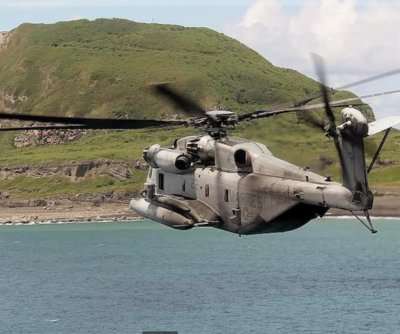
The 11th Marine Expeditionary Unit with 2,500 marines and sailors and an embarked combat battalion of about 800 are headed to the Gulf — with another en route. Photo by U.S. Marines
March 25 (UPI) — General of the Army Douglas MacArthur believed that the reason why wars were lost was explained by “too little, too late,” meaning failure to anticipate the enemy and act in a timely fashion. Perhaps more appropriately and accurately, wars are lost due to strategic ignorance.
Strategic ignorance arises from two factors. The first is failure to comprehend the contradictions in decisions that assure defeat. The second is the absence of a thorough and, in some cases, any understanding and knowledge of the circumstances requiring the use of force.
History is replete with warnings and examples, some that directly apply to the “excursion” as President Donald Trump calls the attacks on Iran launched by the United States and Israel.
It was inconceivable that in striking Iran the most obvious outcome underscored by decades of war games, the closing of the Strait of Hormuz, was ignored. Clearly, Trump and Israeli Prime Minister Benjamin Netanyahu assumed that the decapitation of Iranian leadership would immediately collapse the regime. It did not.
But even someone with a basic recollection of the past might recall Japan believed that by sinking the U.S. fleet at Pearl Harbor on Dec. 7, 1941, the isolationist mood in America would mandate an immediate negotiation granting Tokyo its gains.
And Adolf Hitler knew that terror bombing British cities after France fell in June 1940 would bring Winston Churchill to that infamous train on which Germany surrendered in 1918 to offer his capitulation. Yet, in both cases, the opposite happened.
Then, in attacking Iran, the administration ignored the most fundamental strategic contradiction in that decision. Despite what the White House falsely claimed about the immediacy with which Iran could build 11 nuclear bombs in two weeks — asserted by negotiator Steve Witkoff — the war was existential for Israel.
It was not existential for the United States, and as anyone with a basic knowledge of nuclear and rocket physics knows, Iran was not remotely close to becoming a nuclear and long-range-missile power.
By failing to achieve regime change, Israel is doomed to fight, if not a forever war, certainly a long one with Iran. The United States, however, can claim victory in that it has “obliterated” Iranian nuclear ambitions; destroyed its military and security forces; and left it as a failed state struggling to exist and thus a threat to no one.
And make no mistake. If the regime in Iran survives, the chances are very high it will develop nuclear weapons despite any religious prohibitions on obtaining weapons of mass destruction.
The examples of North Korea, which has nuclear weapons, and Saddam Hussein and Muammar Qaddafi, who did not, are telling. Possibly, as Pakistani chemist A.Q. Khan assisted North Korea in its pursuit of nuclear weapons, that nation could return the favor to Iran. If so, that would be a real axis of evil. And how would Israel and the United States react? Too little, too late?
At this time, the United States has not struck Kharg Island and the oil facilities. Here is another contradiction. Iran is blocking the Strait of Hormuz to most, but not all, traffic, namely allowing oil sent to China and choking off supplies to other regions.
Yet, while demanding that the Strait be reopened, destroying Iran’s oil facilities on Kharq would have the same effect of closing off oil for export. Hence, the leverage and threat Trump is attempting to use against Iran may be self-defeating.
As in June 1914, when the assassination of Archduke Franz Ferdinand and his wife, Sophie, on that bridge in Sarajevo precipitated World War I, other sparks could ignite a much wider war.
Suppose that the Chinese are so dependent on Iranian oil from the Gulf that they provide warships as escorts. What would the United States do as tankers bound for China with Iranian oil are guarded by the Chinese Navy?
Further, with the 11th Marine Expeditionary Unit with 2,500 marines and sailors and an embarked combat battalion of about 800 headed to the Gulf — with another en route — would these personnel be deployed to seize the northern slice of the strait, perhaps Kharq Island?
Or, might airborne forces attempt to recover the enriched uranium buried at Isfahan? If so, that force is too small for such operations and could lead to a catastrophic repeat of Black Hawk Down in Mogadishu, Somalia, in 1993.
To use a bad phrase, “We are are in the Gulf.” As Trump and Netanyahu are now learning or relearning, it is far easier to start a war than to end one.
Harlan Ullman is UPI’s Arnaud de Borchgrave Distinguished Columnist, senior adviser at Washington’s Atlantic Council, chairman of a private company and principal author of the doctrine of shock and awe. His next book, co-written with Field Marshal The Lord David Richards, former U.K. chief of defense and due out later this year, is Who Thinks Best Wins: How Decisive Strategic Thinking Will Prevent Global Chaos. The writer can be reached on X @harlankullman.