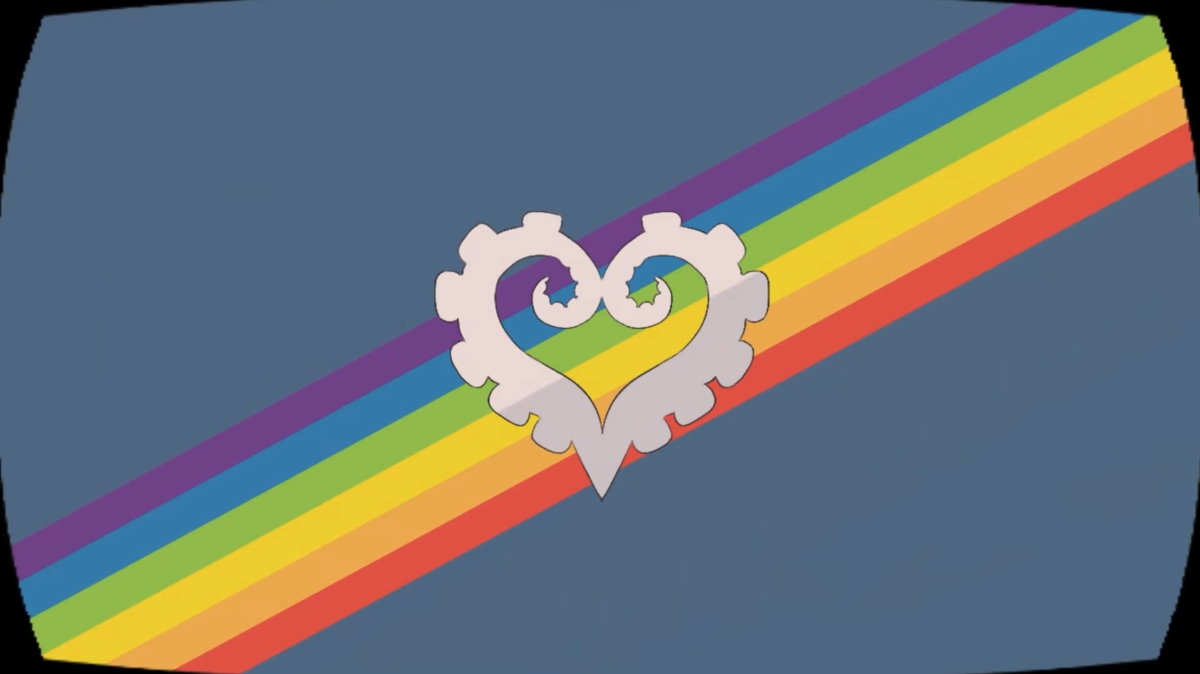
You may think you’ve seen it all, but you’ve never experienced the existential horror of H.P. Lovecraft quite like this. “Sucker for Love” began as a part of a two-week game jam back in 2021 and has since evolved into a full-on franchise, with the third entry, “Sucker for Love: Crush Landing,” due out on Steam later this year.
The series, from solo developer Joseph “Akabaka” Hunter (with help from his wife, Caroline “Akatsuma” Hunter), uses the framework of a visual novel dating sim to tell a story about Lovecraftian horror, deconstructing and subverting the themes of the original source material. The games are comedic in tone, but nevertheless remain reverential to the themes and sensibilities of Lovecraft. It seems like a tricky line to walk, but Akabaka makes it look easy.
More News: Hands-On With ‘Mina The Hollower’ and Developer Interview
Akabaka via Super For Love: Crush Landing Annountement Trailer
More News: ‘Mixtape’ Review
At PAX East, I had the chance to chat with the Hunters about “Sucker for Love” and the larger world of cosmic horror. Read on for Akabaka’s insight into the themes explored in the various games, his favorite Lovecraft stories, and plans to conclude the series with an OVA-style fourth and final “Sucker for Love” story.
Newsweek and Akabaka Talk All Things Lovecraft & “Sucker for Love”
Zak Wojnar, Newsweek: What’s the deal with cosmic horror?
Joseph “Akabaka” Hunter: I’m still learning, to be quite honest. Before the Sucker for Love series, I didn’t know that much about it. The “Sucker for Love” series kind of sprung out from a game jam, and the theme was “Lovecrafting.” So, Lovecraftian horror, and love, and crafting mechanics. And, because of that theme, I had to thoroughly learn, okay, so what is cosmic horror? What is it? What isn’t it? What are the rules? And so, it’s a medium that is a little difficult to research because the readings are so dense. Lovecraft will take three pages to say something.
It’s like reading a James Bond book and how much he talks about food.
Akabaka: Is that what it’s like in James Bond?
Oh, yeah. It’s like, I’m here for some spy action, and I’m reading about, like, the eggs!
Akabaka: That’s like Tolkien. Apparently going on walks with him was miserable because he’d stop and look at a tree for 20 minutes.
But I digress.
Akabaka: So, cosmic horror. From what I’ve learned over the years of working on “Sucker for Love” and through the research, it’s largely things dealing with the unknown, the idea of human existence being wholly untenable with the universe. We are, while doing nothing out of the ordinary, coming into contact with things that we were never designed or equipped to process. And so that’s explored in themes like forbidden knowledge, knowledge that, as soon as you learn it, puts you at grave danger. This appears in “Sucker for Love 3.” Things having untenable human effects. Just observing or being near them can have irreversible, grand scale effects on your existence. Your very existence can then even change on such a grand scale. It’s very interesting. It’s almost in the realm of like sci-fi when you think about it.
I’m thinking about the idea of someone learning something that it completely turns their mind inside out, and that’s actually a pretty good fit for a romance story!
Caroline “Akatsuma” Hunter: That is kind of funny!
Akabaka: Relationships do the same thing, don’t they? Romance and horror go hand in hand so much that there’s actually a thing for it called ‘the suspension bridge effect,’ if you’re familiar with that.
I’m not!
Akabaka: If you stand on a rope bridge, a super unstable rope bridge, and you see somebody on the other side, you will fall in love with them. It’s the superstition. That’s the colloquial term, ‘the suspension bridge effect.’ What it’s scientifically called is ‘misattribution of arousal.’ Getting scared and being in love have very similar physiological effects. The butterflies in your stomach, your heartbeat speeds up, you start sweating. The anxiety is very, very similar when you’re looking at themes of romance or themes of horror. It’s a coupling that I really like exploring because they’re two very exciting mediums that both play on the fears of nervousness and anxiety. Normally, when I’m dealing with the themes of a game, I have to be really careful about which parts are supposed to be funny and which parts are supposed to be scary. But, when I’m working in horror and romance, I don’t have to delineate so strongly between them. Something can be both scary and romantic, like Yandere, for instance, Yandere characters.
What’s more terrifying than realizing that your feelings for a human being might just be nothing more than chemical reactions in your brain, right? Do I really feel this or is this just my brain’s survival instinct?
Akabaka: Existential, yeah!
Let’s get into the game. This is part three, right?
Akabaka: Yes.
First off, can people jump in with this one or do you want them to play the first one?
Akabaka: Absolutely, jump in. Every “Sucker for Love” game is an entry point. You don’t have to have played either of the first two to just pick this up and go. If you have played the first two, you’ll see some call backs and some homages and some cameos from previous characters, but you can come into this completely blind without knowing anything about “Sucker for Love” and you’ll be absolutely fine.
I know it came from a game jam, but how does the idea of “sexy Cthulhu” come to your mind?
Akabaka: The game jam in question, we only had about 10 to 14 days to make this game jam. I could have spent the whole dev window just making a crafting engine. I was like, I can’t do that.What’s kind of similar to crafting? There’d be things like creating and then using items. What kind of game scheme has items that you can create and use and also love mechanics? Dating sims do! Ok, I’m making a dating sim.The only missing piece of the puzzle was Lovecraftian Horror. I was like, okay, boom. We’re making a dating sim about Lovecraftian Horror. Then, whatever made me laugh the hardest was what went into the game. Dating a sexy Cthulhu and ending all of reality over a smooch had me in hysterics. That’s what we ended up doing.
I think we’d all take that risk.
Akatsuma: That’s how you approached the third game, too.
Akabaka: That’s my approach in general. Whatever makes me laugh, it goes in.
You see people taking the themes that you put in the game and the dialogue and exchanges, and they can impart a lot of meaning for them. How much of that is your storytelling goal, how often are you the person with a quill pen at the desk by the fireplace who say, “I’m making something profound.” How much of it is,”Wow, you got that message from the story? Cool!”
Akabaka: It’s a little bit of both! I do try to write things really, really subtly, sometimes. Then people will pick it up immediately. I’m like, how did you guys figure that out? That was supposed to be revealed later! That happens. A lot of these games are steeped in some sort of philosophy. “Sucker for Love,” each of the entries have some sort of claim against Lovecraft’s strongest beliefs. Everyone is a counter argument. For the first game, Lovecraft has this quote, something like, “The strongest human emotion is fear, and the strongest fear is fear of the unknown.” And “Sucker for Love 1” is a counter-argument to say, if you think humans are afraid of anything, you have not been paying attention. Pretty much since we got here, we’ve been inventors, explorers, adventurers, astronauts, sailors. Even sailors, the most superstitious and fearful people on the planet would set sail into oceans they believed were full of sea monsters to the end of the world where they thought they would fall off. Humans have really never been a fearful race of any sort. I think what’s more poignant, what’s more ubiquitous, is feelings of love, or feelings of lust in the case of the main character of “Sucker for Love 1.” You see this across lots of creatures besides just humans. People will absolutely defy fear in the pursuit of love or lust. Otherwise, we wouldn’t be asking people to marry us. It is so ingrained in our culture that we must step over fear in order to get love, to get what we want. That’s kind of what “Sucker for Love 1” was trying to hit home by having you thirst after sexy Cthulhu. The philosophy of my incredibly smutty game. That’s “Sucker for Love 1.”
Wonderful. And then part 2?
Akabaka: Now, “Sucker for Love 2” is Lovecraft’s sentiment that you have the Earth, which is like us. It’s everything that’s decent. And then, outside of the Earth there’s just nothing but suffering, misery, and horror. We’ve got this island and then the rest just must be infinite cruelty, period. I just don’t think that’s true. The plot for that one investigates the feelings of infinity. We have characters that are becoming immortal and exposed to the consequences of that. People on infinite reincarnation loops and the inescapable, infinite cruelty of existence. But I think that if you have something of infinite volume like the universe, you will find infinite horror, but also infinite wonder. There must be. This game was all about the theory of, wherever there is infinite evil, there is going to be infinite good to rise against it. In a cosmos of limitless volume you are going to find whatever it is you’re looking for, be it pain or happiness. There are very sentimental, philosophical backbones to each of these incredibly silly stories. I feel like that keeps it grounded and keeps it feeling like I’m saying something with this love letter to these genres. You know, as opposed to just making a sexy Cthulhu joke, calling it a day, and then moving onto the next one.
If you did that then you probably would have had the first one. Then, by the second one, people would go, “we’ve seen it already.”
Akabaka: I try to avoid having just one joke!
But by plumbing the depths of Lovecraftian themes and subverting them in this way… Lovecraft was, I think you could say, very afraid of ‘the other.’
Akabaka: Yeah. Yes. (Laughs)

Is the Lovecraft cult, or the fandom, if there’s a difference between those two words, are they receptive? Or do you find yourself getting more of response from people who aren’t necessarily that familiar with his work?
Akabaka: I get both. Sometimes people try to attach this sentiment to the games that I’m deliberately trying to piss off Lovecraft, making him roll him in his grave with this type of game. But at the end of it all, this is still a love letter to Lovecraftian horror. I love Lovecraftian horror. I love Junji Ito. I love existential horror. When I was making the original game jam, we had a 10-14 day window. I spent the first third of it just reading Lovecraft stories. Because I didn’t have any background in it. I just reviewed. I wanted whatever I made to be genuine, to be a love letter to the genre. What we saw, the result was that people were coming into this saying. “Hey, my friends bought me this game because they know I’m into Lovecraft. I thought they got it to me as a prank. But oh my God. This game has gave me a new appreciation for Lovecraft.” Or, “It did so much justice to it that I actually quite love it.” I’ve seen a lot of really positive responses from some pretty diehard fans about Lovecraft, that we did do it justice. What’s really cool to me is, when people who aren’t familiar with Lovecraft play my games. And then, just through diffusion, now have a Masters-level understanding of these books. There was a streamer who was playing this other game about The King in Yellow. And when it was revealed in the game that they’re dealing with the King in Yellow, they were like, oh yeah, like in “Sucker for Love!” That person being exposed to my silly Cthulhu dating simulator, he now has a thesis-level understanding of The King in Yellow. Because, even if you read it, you wouldn’t necessarily have the in-depth knowledge of the play, The King in Yellow or Carcosa.
Akatsuma: There’s something really interesting you were telling me back when you first were doing the game jam, you were telling me about how interesting this compendium of work was. And that you were surprised to find that when you talk about the Lovecraftian genre, it’s not just Lovecraft. It’s like a community of authors adding to this canon of cosmic horror.
Akabaka: Yeah it’s a very collaborative field.
Open source.
Akabaka: Yeah, at this point especially. But even when he was alive and kicking, He was collaborating with Durlith Chambers and the rest of them. I don’t think The King in Yellow was Lovecraft’s. I think it was Chambers. And it influenced Lovecraft.
Akatsuma: Yes, The King in Yellow actually came before some of Lovecraft’s work. He was inspired, I think, by it. Because, timeline-wise it came out first.
Akabaka: Lovecraft alluded to The King in Yellow. And then another author was like, that’s pretty cool. I’m going to flesh this out! And then Lovecraft was, like, yeah that’s pretty good. And then they sent each other love letters about each other dying in horrible ways in their world. And they loved it. “This is how you die in my world.” And, “Well this is how you die in mine.” (Laughs)
Akatsuma: This was back in the 1920s, 1930s. You have 100 years building of this community of artists. To me, what’s kind of interesting is that your contribution, now, in a way, makes you also kind of part of this community!
Akabaka: To circle back, the people that are not even into Lovecraft end up walking away with a pretty strong understanding of it as a result. And that’s really cool to see happen. Even while I’m being silly and doing kind of this, what seems like a joke at Lovecraft’s expense, sees people developing an actual appreciation or knowledge of the stuff is really really cool to see.
Yeah it’s just a different prism through which to view these themes. I’m thinking of “Heart Eyes” that came out a year or two ago. It’s a slasher movie. But it’s also a romantic comedy. It’s not less of a romantic comedy just because people get stabbed in the face.
Akabaka: Yeah.
Writing, these games do you feel like you had three – or more – boxes laid out, however many years ago when you first started this, and you’ve just kind of been opening one after the other for each project? Or has your process as a writer evolved?
Akabaka: In terms of my process it’s pretty much been about the same, which is putting on my spelunking gear and then just going out into Lovecraft’s work until I find something like, hey that’s kind of interesting, I can use this. This runs really really well with a theme in anime. When I was working on “Sucker for Love: First Date,” I was just digging around in the family tree and I saw that Cthulhu has a half-brother slash-cousin thing going on with The King In Yellow. I was like, oh okay, sibling rivalry is absolutely a huge thing in anime and cheesy dating sims. So, what if we had Lunetta from chapter one, but then we have her half-sister show up and try to steal you away? It’s about finding things with a parallelism or like some sort of synchronicity.A theme in Lovecraftian and Lovecraft stories clicks really well or in an unusual way with an existing anime trope. Why don’t I try that and see if anything comes out of it. And so a lot of the process is just exploring, researching, and then testing to see if I’ve kind of put two things together that really click.

Akabaka via Sucker for Love Crush Landing presskit
With “Sucker for Love,” do you feel like you want to keep on making these stories like forever? Not to put the cart in front of the horse, but do you want to make “Sucker for Love” 4, 5, 6, 7? Or do you want to do that while also kind of exploring different styles of storytelling and gameplay?
Akabaka: I’ve got this one, which is part 3, and then I’ve got one more, a finale where I think I’m going to try to tell every joke that I could possibly think of about Lovecraftian horror. It’s going to have all the characters, all the playable characters, and kind of one big sort of farewell to the IP. That will be after this one. As much as I do like “Sucker for Love,” I also do want to see what else I can make. I think I want the story to go out with a bang as opposed to “Sucker for Love” 17, 18, 19. I could do this for along time, but I’d also like to see what else I’ve got in me as well. At this point I’ve been with “Sucker for Love” for four or five years out of my seven-year game dev career. So I’d like to see what other things I can come up with. What weird genre mash-up I’m going to do next. I’m really excited to see what other kind of things I can do.
Back in the old days, 3 games in 4 or 5 years was pretty normal. Now that’s an incredible pace! Granted, you’re a solo dev.
Akatsuma: The pace is pretty tough, I’ll say that. This dev cycle has been pretty different. To your last question, you (Akabaka) held off a while before starting to write this third game because he was waiting to find a story worth telling.
Akabaka: Yeah, this story did evolve quite a bit in development. I had the set pieces, but I wasn’t convinced I had the story to tell you that wasn’t going to waste your time. It’s very easy to fall into a silliness trap, where you have a silly premise and you end up being inauthentic with the development process. But I sat on this premise for four months or so just perfecting.
Because you don’t want to be kitsch.
Akabaka: Yeah, I don’t want to be kitsch. I wanted to have a game that was going to measure up to the previous two.
Akatsuma: I am very excited for the plot of this one!
Can you tease a little bit about what we can expect from the story without spoiling anything?
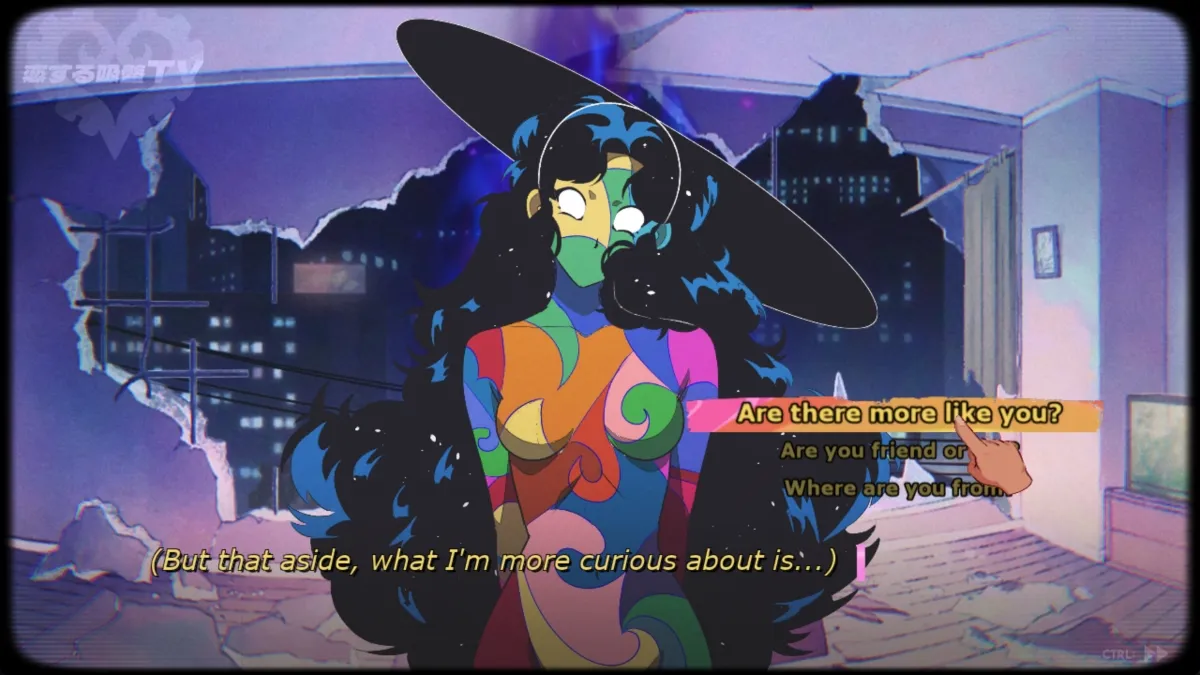
Akabaka: The demo is out and that’s a good half hour or so. So I can absolutely tell you about it. Basically, you’ve got a meteorite that is based on the Color Out of Space, that’s crash landed in the player’s apartment. And it begins affecting the living things around it. Plants, animals, people. Very, very, very much like the Nicolas Cage movie, Color Out of Space. The player has to keep feeding various living things of various colors to the Color Out of Space in order to keep it burning. Because if the Color Out of Space extinguishes, there is a secondary entity, which has been inspired by a few Lovecraftian stories, which is basically the Sentient Darkness. In this story they are opposed to each other. The Color Out of Space is meant to be light, color. And you have the Sentient Darkness, who is, of course, the absence of light or color. These are metaphors for invention and annihilation in terms of human nature. To put this philosophically, it would be like the Color Out of Space represents a dangerous invention or procedure or discovery, like nuclear power. And, it’s like, we have to keep researching this, otherwise annihilation from either global warming or something else is going to come and get us. So we must keep feeding this discovery, this invention, in order to stave off annihilation. But then it starts coming at a cost. We have Chornobyl, we have Hiroshima and Nagasaki, and it puts humans into a really existential question: what do you do when you wish on a shooting star, and then the shooting star makes its own wish back on you. And so that’s sort of what the theme of this one is. Discovery, invention, etc. taking on a life of its own. And when you’re trying to get something out of it, maybe it tries to get something back out of you. It’s like Little Shop of Horrors, in that you’ve got this alien entity here that needs to be fed, and as a result, things are going to start getting mutated around you. And it’s a bit of a return to form with the first game, where it’s still funny and it’s still romantic, but I’ve gotten feedback that apparently this one is winding up to be one of the scarier ones, as well. So that should be a lot of fun!
I mean, that’s just an immediately relatable thing. We’ve seen the conversation on nuclear power go back and forth. Now we’re looking at AI and people think that that’s good… I mean, judgment-free zone. If you love AI, then great. But yeah, hey, you don’t even need to do the drawings anymore. You just scrape the past games, or any image on Google to make a ‘totally’ new one.
Akabaka: (Laughs)
Akatsuma: Just call it Body Horror when it adds an extra finger.
Akabaka: Ha! Oh, the hands aren’t wrong, it’s Body Horror!
So, did you reach out to Nic Cage?
Akabaka: No. (Laughs) No.You know what? I have the weirdest idea that he might be down for this. He might be down for this project!
I feel like he would have taken the call, at least!
Akabaka: I hadn’t even thought about that. Maybe I should give him a ring.
Akatsuma: I really liked that movie, I thought it was surprisingly really good. And Cosmic Horror is very hard to capture in a visual medium, in my opinion.
What about “Sucker for Love: The Movie?” “Sucker for Love: The Cartoon?” “Sucker for Love, The Lunchbox?”
Akatsuma: The fighting game!
Akabaka: Well, let’s see. I do like our plush line a lot.
Oh, you do have a plush line. You have merch?
Akabaka: Yeah, we have some plushies that I really do like.
Sexy plushies?
Akabaka: They’re…
Akatsuma: Cute.
Akabaka: They’re cute. Yeah, no, they’re not figurines. They’re not figurines, they’re just plushies. Marketable plushies! No body pillows either. That was on the table for a minute, though!
Body pillows? Even I’m not that lonely!
Akabaka: That was a real thing that we were going to do for a while. It just fell to the wayside.
That is very anime, though!

Akabaka: Yeah, absolutely. As for movies? Probably not.The company that has rights to “Sucker for Love” 1 and 2 at DreadXP, they are a movie-making company, and they did just make a movie for “The Mortuary Assistant.” I do think, if they wanted to make a “Sucker for Love” movie, they probably would have told me about it by now, so I don’t think that’s going to happen. But there have been talks of doing a comic spin-off, since we’re collaborating with Ukiyo on a lot of different stuff. There is a possibility of further spin-off type stuff in the future.
For the idea of doing any kind of spin-off, do you feel like you would have to write it, or are you open to the idea of allowing other people to write? Even though it’s a collective…Someone earlier said the very, very smart open-source storytelling. It was me. I said it. It was started by Lovecraft, and picked up by everyone from “Re-Animator” to “The Sinking City,” etc. Do you like the idea of someone else doing a version of your specific corner of the mythos?
Akabaka: Yeah! This entire IP only exists because Lovecraft put in the work so many years ago to design the basis for all these characters. If I had the exhaustive rights to the game and IP, which I don’t, as soon as I shipped the last game I would have made it all open-source, just as an homage to Lovecraft’s work being open-source as well. Just as an acknowledgment that this game and all these characters live in this collaborative space. They only exist because of the work that Lovecraft or Chambers and everybody else over the last however many decades put in, to fleshing out and making this genre so compelling. From the very beginning, I felt like I only ever had joint ownership over these characters and stories just because of how much this IP borrows from the genre. So if I had exhaustive rights, which I do not, I would have…
Is there an owner? It’s not all public domain?
Akabaka: Lovecraft is open-source. You can say Cthulhu. You can call your product “Call of Cthulhu” and get away with it. But “Sucker for Love,” specifically, I can’t say, “”Sucker for Love” is open source, you can use our original characters and make your own merch and games and movies without consulting me.” I can’t say that, because I share rights with the publishers.
So you won’t be able to take it public domain or open source, even after you finish. They’ll still have money to make.
Akabaka: Exactly. In general, to circle back, these comic spin-offs, I wouldn’t want to be controlling of that at all. I’d be super welcoming of somebody taking these existing characters and running with them to see what they can do, that would be cool.
They can re-horror-ify it.
Akabaka: That’s what I was about to say! We take “Sucker for Love” but do a pure horror version with none of the romance! You reinvented the wheel!
I mean, girls are just scary in general. All dating sims are horror games! Okay, each of your games have been based on a specific Lovecraft story or theme. Maybe you don’t want to give too much away, but do you have any Lovecraft things you want to tackle but haven’t? Or something you started but pivoted away from in favor of something else?
Akabaka: My favorite is The Shadow over Innsmouth, and I got to tackle that for “Sucker for Love 2,” so I’m happy. The final game is going to be very steeped in the anime/OVA style, “just for fun” style, like the ‘beach’ episode of every anime, that kind of thing. It’s going to have that vibe.