Darius James remembers sitting before Gwent County Council at ten, asked: ‘Why should we give you money?’ He had earned a place at the Royal Ballet School, but his parents couldn’t afford the fees. Source: bbc.co.uk.
At the time, it was ‘really, really unusual’ for a boy to do ballet in 1970s Newport. His father, a lifelong footballer and Alcan aluminium factory worker, initially didn’t understand. But he came to love it — a rare moment of a working-class man embracing something outside traditional male roles.
From a Childhood Promise to a Community Company
After years at the Royal Ballet School and professional dancing, James returned to Newport in 1986 and founded Ballet Cymru, originally called Gwent Ballet Theatre.
He called the idea ‘totally crazy, but totally needed and logical.’ He saw deep talent in Newport — ‘so many brilliant, brilliant young people’ — yet lacked the spaces found in cities like London or Cardiff.
The company wasn’t born from ambition. It grew from a belief: local talent could thrive through accessible, community-based arts.
Early Years Without Funding
For 13 years, Ballet Cymru got no government funding. For 28 years, it had no dedicated studio.
During those years, the company relied on personal effort and creative solutions. James toured with other ballet troupes, including Northern Ballet, to stay financially stable.
Rehearsals happened in schools, community centres, or any available space. Amy Doughty, who joined in 1996, remembers rehearsing in a school hall one week, a community room the next.
The company once carried all its equipment — dance bars, floors, costumes — from place to place. This showed both resilience and dedication.
James once covered the word ‘ballet’ on their workshop van. He feared it might scare families. He wanted to avoid the idea that dance was elitist or out of reach.
Building Trust Through Outreach
Amy Doughty joined Ballet Cymru in 1996 as a dancer. She recalls the early days — rehearsing in whatever space was available.
She grew up in Australia with four siblings. Without scholarships, she wouldn’t have pursued a dance career. That shaped her belief: ‘We’ve got to take it to them. They’re not going to seek us out, why would they?’
The Duets scheme, launched in 2012, finds children in Welsh schools with natural dance ability but no formal training. These children get two years of free tuition.
The scheme aims to break down cultural and financial barriers. Many parents don’t see ballet as relevant or accessible. They say: ‘My son doesn’t dance. He doesn’t want to do ballet.’
Yet, the children ‘absolutely loved it.’
To help families engage, Ballet Cymru gives free show tickets to participants and their families. For many, it’s their first time seeing live ballet — a key moment in building awareness and appreciation.
Legacy and Future Challenges
Ballet Cymru celebrated its 40th anniversary with shows at the Riverfront Theatre in Newport on Thursday and Friday, followed by performances in Leeds and Bangor.
These events honor the company’s longevity and its role in shaping local culture. Doughty hopes the work will grow beyond her and James. ‘We’ve worked hard to go into schools, to do shows here, to develop people who understand what we’re about.’
She sees it as a long-term investment in community identity and cultural resilience.
James reflects on the council’s decision: ‘They believed in me.’ He believes even one child inspired to pursue dance beyond their original path is worth it. ‘If in the last 40 years we’ve reached one kid and inspired them to be better than they would have been otherwise, then surely that’s worth it.’
Barriers remain — especially parental resistance to dance. The company continues to change perceptions, one school, one performance, one child at a time.
Sources & further reading
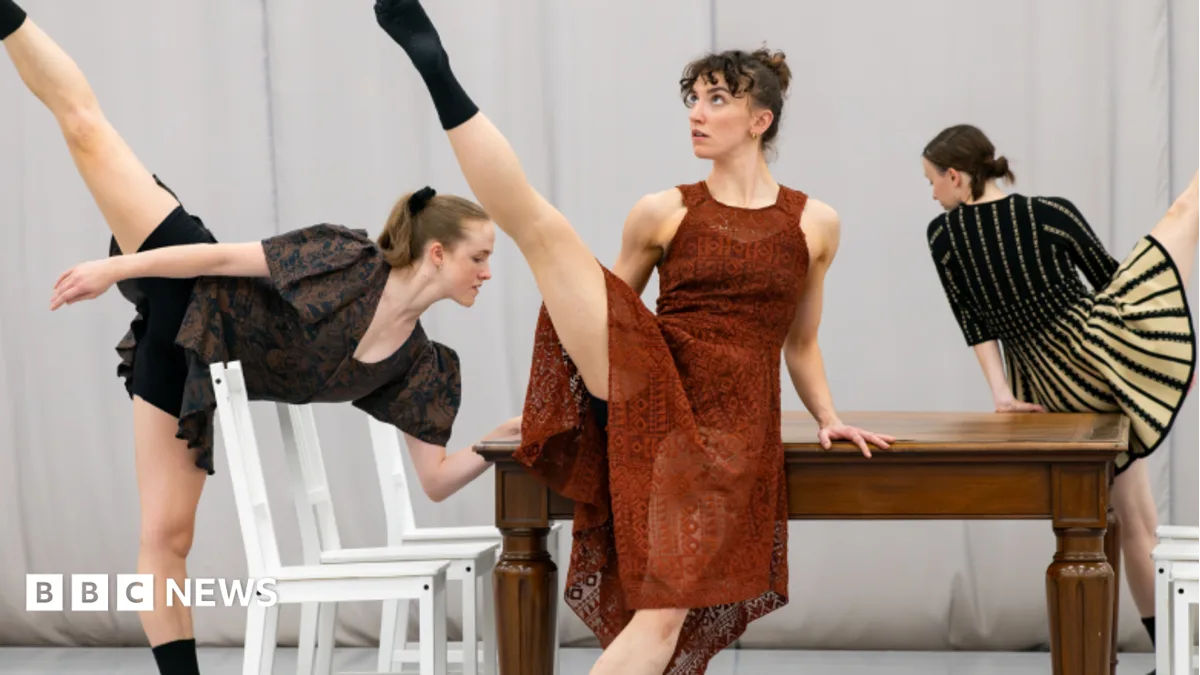
Featured image: Three female, brunett ballerinas, each leaning on a wooden table and posing with one leg up in the air.. Via original publisher. Image source