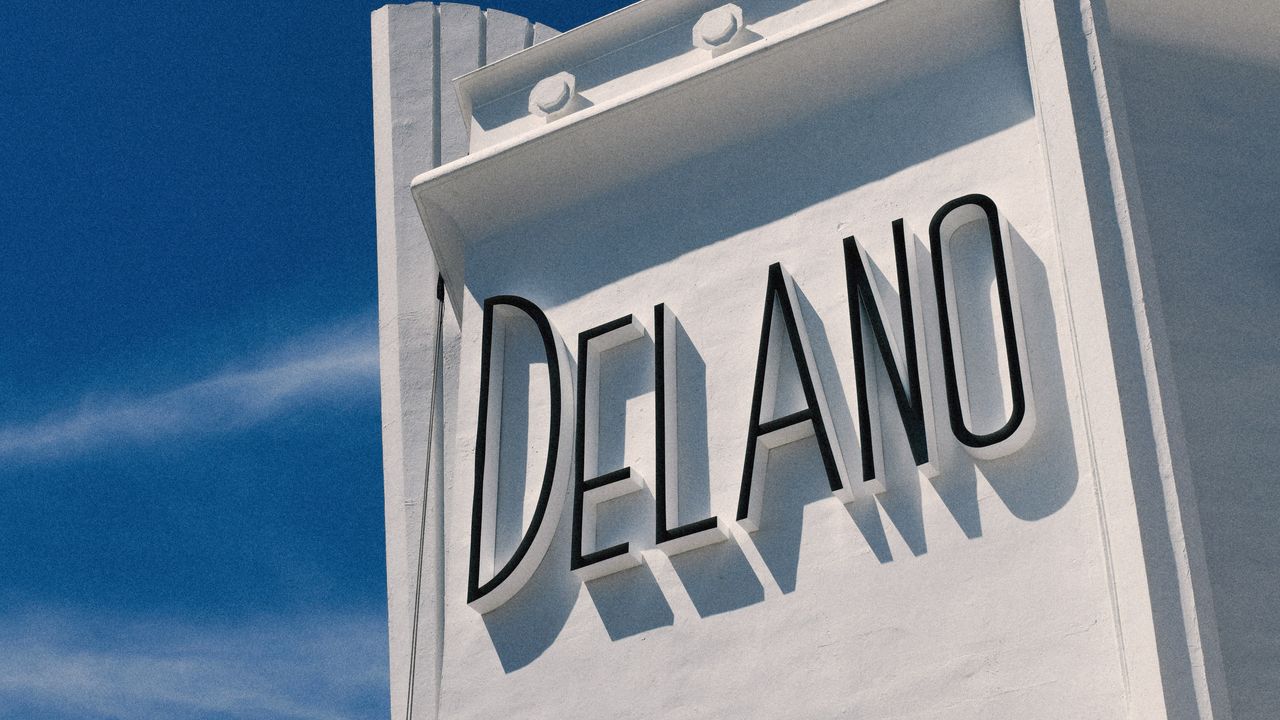
The Magic City’s Delano Hotel—now known as Delano Miami Beach—will reopen shortly after a six-year closure. It has undergone an approximately $100 million renovation.
It’s a famous address (where Madonna once co-owned a restaurant, and where Lenny Kravitz once opened a club in the basement), on a famous strip (Collins Avenue) with plenty of famous hotels, both then and now, in close proximity (the stalwart Setai, the old Raleigh, the dismantled Shore Club, and the reimagined Shelborne among them).
There’s something extra resonant about the Delano for me, though: it is the very first place I ever set foot in Miami Beach. I was a gangly teenager who’d taken the Tri-Rail from West Palm Beach to meet friends from New York City—two girls named Emily, both of whom were having lunch at the Delano with their mothers at a restaurant then called the Blue Door. I even remember exactly where we sat (the terrace is still mostly the same, and now part of a restaurant named Gigi). It was the first time I was invited into a slice of Big City Life outside of Manhattan, and I was immediately hooked. The brassy sun, the kinetic music, the euphoric energy, the beautiful people, the glossy aughts glamor; it was for me. The Delano basically sparked what has become my multi-decade fondness for the 305; I ended up enrolling at the University of Miami in part because of the magnetism I felt from that first hour there, and I moved back to the region in 2017 for the same reason. (Of course, Miami is so much more than a fancy hotel, but this spot opened the door.)

Photo: Nick Remsen
The Delano had (and still has) a kind of queenly presence, with its Art Deco fins capping its turret, like wings on an unusual crown. (These wings once made the building the tallest in Miami Beach.) The edifice has been, for the most part, preserved, at least in its exterior; it’s a site at which you can still feel and see the tempo of the city’s earlier grandeur and ambitions. There’s a pomp and flourish about the 1947-completed structure—about its inlaid terrazzo ingress in sun-baked hues, about its “sawtooth” façade of angular window-banks that flare out almost like theater marquees, about the pleasure-seeking ghosts of the eras that have passed and shifted and danced through its vaulted lobby (which has now been partially restored to its original design with the re-addition of a bridge across the main span).

Photo: Nick Remsen
I knew the Delano at the middle stage of its raucous boutique hotel era—one born in the late nineties and that carried through into the 2000s. The place was an ultra-slick design temple conceived by Ian Schrager and Philippe Starck, and its high-wattage shellac invited a sort of anything-goes naughtiness. (I had my 21st birthday at the Delano, and I remember smoking a cigarette in the elevator—I’ve been told of far naughtier stories.) It was globally revered for its soaring, magazine-shoot aesthetic: billowing white curtains in the atrium, a triple-XL winged back chair in the foyer, and an Alice in Wonderland-esque, lifesize chess board on the grounds out back (not to mention its surreal wrought-iron chairs placed in the pool, a detail that has been reinstated). In a 1997 letter written by a guest staying at the hotel, the author declares: “My love, Delano is a cathedral of desire, white walls rising like purity itself, but inside, everything burns with temptation… every corner feels alive with a dangerous kind of beauty.” Starck had at one point told the media that the look of the Delano was meant to have “a little poetry” and “be a little lyrical.”

Photo: Nick Remsen
That “dangerous kind of beauty” is no longer, but “a little poetry” might still be apparent; the queen has adapted to the times, and she has sanded out her edges in the process. Bouclé-covered, curve-contoured seats fill most spaces (including the hotel’s reduced 171 guestrooms, down from over 200 in the aughts), and a softer feeling exudes as a result: This new Delano isn’t clubby—it’s loungey.

Photo: Nick Remsen

Photo: Nick Remsen
There are moments of high design, with the sort of jarring high-low clash that Starck is famous for: a Salvador Dalí “Leda” chair here, a “Calvet” chair by Antonio Gaudí there. Yet the general impression of the Delano’s new look is that it is in line with current hospitality trends, and fairly risk-free in terms of its execution. Schrager and Starck swung for the fences, and this iteration plays it safely within the field. That’s not a bad thing; it may attract a broader audience as a result. One cool throwback touch: An old piano of Kravitz’s, made largely of lucite, is on display in the lobby. There’s also a great selection of local artists’ work on view, including that of Nina Surel, a prizewinner at the area’s annual Art Basel fair.

Photo: Nick Remsen
The biggest difference between this Delano and its previous iterations can be found on the fourth floor: the hotel’s developers have added an entire secondary pool (with a checkered finish on the floor, as an homage to that aforementioned chess board) and sun-chaise area. The fourth floor hosts amenities not only for hotel guests, but also a members’ club, which is currently taking applications. The space is anchored by a new outpost of Mimi Kakushi, which originated in Dubai. A Japanese-inspired restaurant-bar, the haunt is nicely, dimly decorated by Pirajeen Lees; it’s layered with rosy and wood tones and beaded, tactile elements, all of which offset the beige and alabaster of the lobby.
The best part of the new Delano, to me, is the Rose Bar, an intimate reincarnation of Schrager and Starck’s time. It’s tucked behind velvet curtains about halfway down the lobby. Once open, those drapes reveal a small, red-marble bar top, back-dropped by a golden liquor case. It’s a time warp back to how this place may have been in the ’50s; very classic, very polished, running well back beyond the bohemian vibes of now and the boutique vibes of then.

Photo: Nick Remsen
Anywhere that can hold the ’50s grandeur, the naughties, and the cleaner present all at once—and make you feel as much nostalgia as enjoyment—is a place that knows exactly what it is. Some hotels have merely a sense of history. The Delano is a piece of history.