Spoilers follow for The Mandalorian and Grogu.
For most of the running time of The Mandalorian and Grogu, the first Star Wars movie to hit theaters in seven years, it’s a romp with the titular characters as they bop from planet to planet, getting into scrapes, and palling around with jacked slug aliens like Rotta the Hutt (Jeremy Allen White). Your mileage may vary, but it’s all intended to be a sweet little barrel of laughs… right up until the New Republic maybe commits a massive war crime.
To back up the X-Wing a bit, the end of the movie takes place on Nal Hutta, the home planet of the Hutts, as The Mandalorian (Pedro Pascal) and – you’re not going to believe this – Grogu attempt to rescue Rotta from the clutches of Jabba The Hutt’s cousins, the Twins. The villainous Hutts have taken over Jabba’s crime empire, and want to get Jabba’s son, Rotta, out of the way. Ultimately, the Twins end up in the same Dragonsnake pit Mando was previously tossed into and are eaten by their own creature. Side-note: Someone please tell the Hutts to stop storing horrible monsters in the caverns under their throne rooms, it’s dangerous!
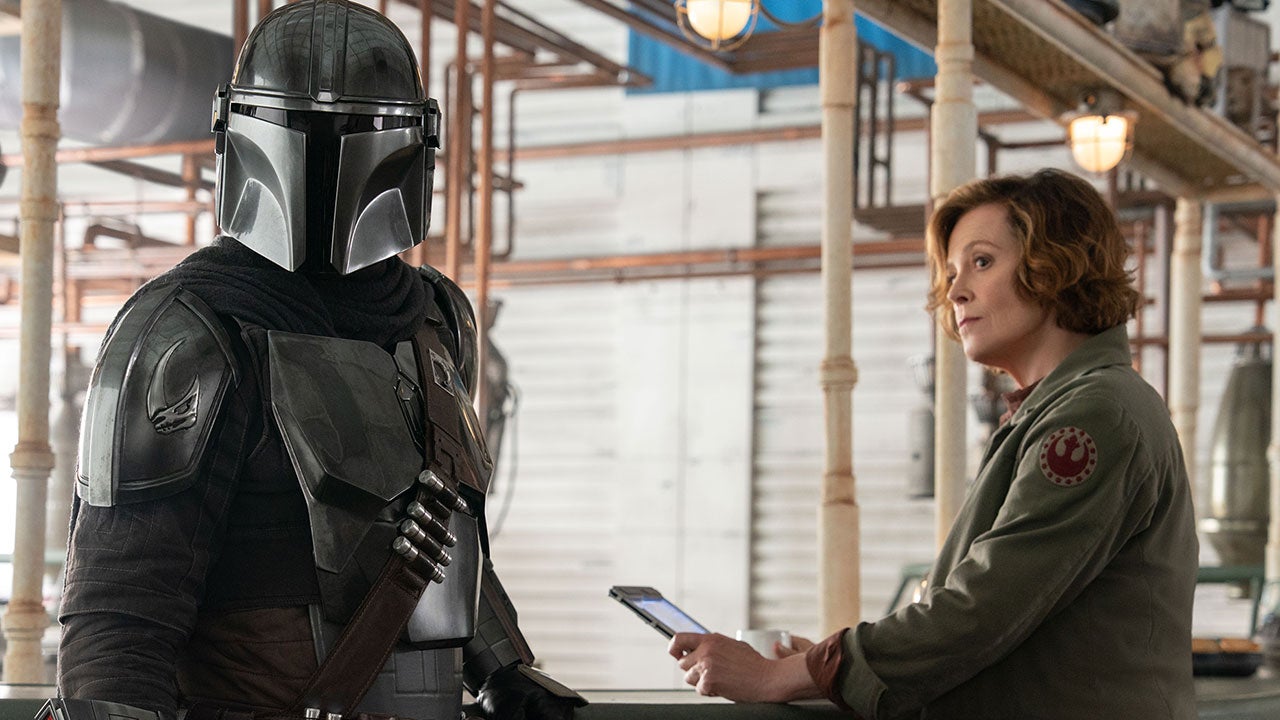
In any case, Rotta rescued and the Twins dispatched of, it seems like the day is saved. Only problem is the day is not saved, because the Twins have a whole droid army at their disposal. Rotta and Grogu make a run for it, while Mando holds back the droids as long as he can. And thankfully, while he does the cavalry arrives in the form of New Republic leader Colonel Ward (Sigourney Weaver) and a squad of X-Wing pilots including Trapper Wolf (Dave Filoni), who is taking a break from co-running Lucasfilm to bring the pain to the remnants of the Empire. Mando tells them to fire on his location, which they’re a little confused about since Mando is at his location. But he has a plan, and it’s a pretty clever and intricate one: jump out of the Hutts’ tree-house/home just as the New Republic absolutely blows it to smithereens. Our main trio gets picked up by pilot Zeb Orrelios (Steve Blum), and are taken back to the New Republic base to enjoy their rousing victory.
…Except there’s one little nagging question here: Did the New Republic just murder an entire population of Hutts for no reason? Earlier in the movie, we get to walk through the Nal Hutta house with Mando and Grogu, where we see dozens of Hutts lazing around, chowing down, and generally being debaucherous. Sure, there are the Twins in the throne room, but they are far from the only Hutts living in the… compound? Enclosure? Da clurb? And while Ward – at the end of the movie once the heroes return to their home base – explains they discovered the Twins were feeding info to the Empire (or, the remnants of the Empire)… Well, they were already dead, eaten by their own Dragonsnake. Whatever happened to the concept of a fair trial by a jury of their peers (aka, other Hutts)? And speaking of which, there are other Hutts who lived in that treehouse. And also, there’s the Dragonsnake, who was potentially blown up and/or crushed to death by the collapsing house. RIP Dragonsnake, all you wanted to do was swim around and eat people.
Whatever happened to the concept of a fair trial by a jury of their peers?“
In short, while the explosion is likely there to give us, the viewing audience, a massive cool explosion to look at and a sense of “heck yeah!” during the climax of the movie, it’s hard to justify the response of the New Republic with what was actually happening. This isn’t The Mandalorian and Grogu: One Last Kill, after all; it’s a Star Wars movie where the good guys had already won, and were far enough ahead of the droid army that they could spend some time bickering about what to do about the wall standing between them and freedom (note: They blew that up, too, also part of The Mandalorian’s fiendishly clever escape plan).
At best it’s a response that isn’t commensurate with the situation our heroes are in… There’s no reason to use that level of firepower on a building that seems to have the same consistency as squash. And at worst they wiped out an entire community because two admitted crime lords were committing crimes, which the New Republic knew and seemed generally fine with, up until they didn’t. So what’s the deal here? Did the New Republic commit a mini Hutt genocide in the name of… Well, betrayal or something?

There is an out for our heroes, which we’ll get to in a second, but this is far from the first time the good guys in Star Wars have been accused of doing some very bad s**t. In fact, this goes all the way back to Luke Skywalker (Mark Hamill) blowing up the Death Star in the first Star Wars movie. Since the film debuted in 1977, fans have debated the destruction of the massive battle station, and whether Luke using the Force to destroy it caused the deaths of innocents. The answer, most likely, is: yes. In the 2015 novel Lost Stars by Claudia Gray, it’s specified that there are well over two million people on the Death Star on a regular day, and at least one million are on the station when Luke blows it up – and not all of them are stormtroopers. So when Han Solo (Harrison Ford) tells Luke that his shot was “one in a million,” it’s more like “one million people died.” It’s a good thing Obi-Wan (Alec Guinness) was already dead, otherwise he would have heard even more voices crying out in terror.
Pretty famously, the debate about the Rebellion being galactic terrorists continued with Return of the Jedi, and specifically in the 1994 classic Clerks where two convenience store employees discuss whether blowing up the second Death Star led to the murder of contractors, plumbers, roofers, etc. That ignores the fact that Death Star II was a [Emperor Palpatine voice] fully armed and operational battle station, but does delve into whether working construction for the Empire makes you evil, and therefore worthy of death.

And that discussion has expanded considerably over various media as the franchise itself has muddied the waters for good guys ranging from the Rebellion to the Jedi Order. It’s essentially the whole idea behind Andor, the critically acclaimed series spinning off of (and leading into) Rogue One, which consistently threw morally grey problems at its main characters as they weighed the human cost of waging war on a fascist dictatorship – both on those they killed, and on their own mortal souls.
Mandalorian and Grogu, it should be noted, is not Andor. It’s a light, fun film which is aimed at families, even while it’s rated PG-13. There’s no real moral complexity going on here, and it’s not aiming for that, either. Bad guys are bad, good guys are good… Which is why the massive response of the New Republic at the end seems so out of step with the rest of the movie.
But, the good news is, there’s a bit of a visual indicator in the film that shows maybe the New Republic is not trying to rack up those Hutt kill points. Specifically, while we don’t get to see the whole of the Twins’ stronghold in the final battle as Mando and Grogu first ram their spaceship into the building and then fight there way through, we also don’t see any Hutts other than the Twins present in the building, when they were omnipresent the first time through. There are dozens of droids roaming the halls, but none of the centuries-old slug aliens. So it’s reasonable to think that all the other Hutts were either evacuated or left by choice as soon as the Twins sent their droid soldiers combing the surrounding jungles for The Mandalorian, after he escaped their Dragonsnake.
Could a line from Ward have helped clarify that? Say, after she reveals the Twins were working with the Empire, she states that they’re working with the other Hutts to reestablish diplomatic relations? Perhaps. And probably unnecessary, but it would have been nice to know if the Dragonsnake was okay as well (though the creature seemed pretty tough). But since we don’t get that dialogue in the movie, the good news is Kevin Smith has a new Star Wars he can write into Clerks 4.
You can chat with Alex Zalben on BlueSky @azalben.bsky.social, or find him regularly yapping on the Comic Book Club podcast.