The problem with being a quietly excellent bakery and restaurant in Philadelphia is that you have plenty of good company. The understated quality of the dining landscape means that greatness abounds. The kind of spot that, in New York, would have lines around the block can easily operate as a low-key neighborhood staple in Philly.

Cold day outside of Fiore
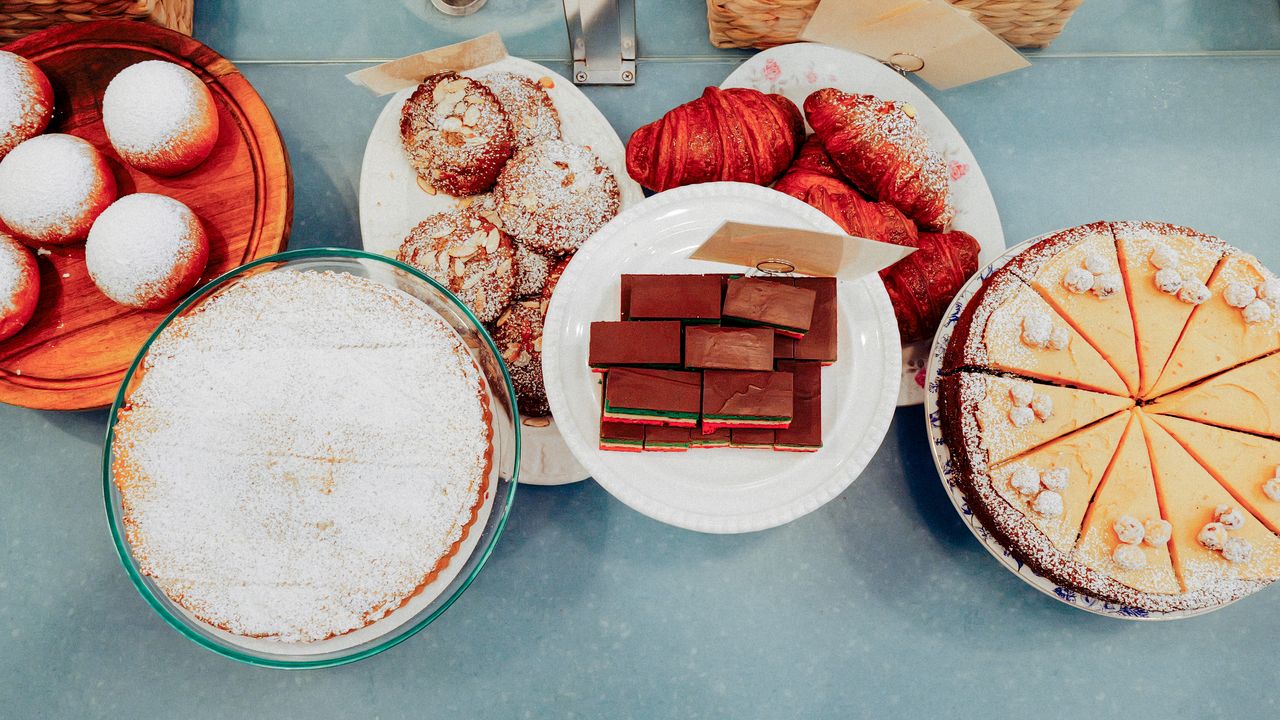
Fiore, for example, is an all-in-one restaurant, bakery, and daytime café, that rare food business that manages to do many things very well, all at the same time. Towers of vanilla cream-filled bomboloni perch on cake stands, maritozzi smile their creamy grins, and cakes are in various states of sliced-ness, giving a lived-in feel to a pastry case that makes ordering an extra slice or two feel entirely reasonable. Yet, you could walk right past the door and never realize that inside is one of the best Italian bakeries in America.
Not Italian American.
Despite the custard-filled place in my heart for Italian American bakeries (I could correctly pronounce sfogliatelle long before I watched The Sopranos), they can feel like a museum display; their displays are frequently dusted, occasionally restored, but rarely significantly altered. People pay to come see these pastries the way they remember them.

Justine MacNeil, the pastry chef and co-owner of Fiore.
Justine MacNeil, the pastry chef and co-owner of Fiore, also sees that reluctance to change. “In South Philly, and on the Jersey shore, and along Route 9 in Jersey where I grew up, the bakeries stay static,” MacNeil says. “They stay the same, and it would almost be sad if they weren’t.”
Italian pastry bears little resemblance to the kaleidoscope of marzipan, pyramids of pignoli cookies, and steelyard-scale of cannoli towers I grew up with. The vibe at Fiore isn’t like the nostalgic temples to Italian American pastry that thrive in the Little Italy neighborhoods of many American cities, and in my heart.

Lemon cream-filled bomboloni.
Fiore instead showcases something new every visit, supplementing a core of offerings regulars have come to expect. While some of the items might look familiar, their names, generally speaking, are untranslated, and new to the uninitiated: schiacciate, cornetti, budino di riso, torta sabbiosa, borsettine.
Exploring Italian pastry traditions little known in America has become a passion—and a business—for MacNeil and her husband (and Fiore co-owner), Ed Crochet. (His specialty is the savory side of the business, with a particular emphasis on handmade pastas, up there with Philly’s best.)
After she completed culinary school in New York, MacNeil traveled with Crochet to Italy and became entranced with the country’s pastry. The breadth of baking traditions in pasticcerias and in homes was completely unlike the fine dining desserts she had come to know while working at New York’s Del Posto restaurant. “Pretty much everything we loved, we took notes on,” she says. “The history of Italian pastry isn’t even close to being known here [in the United States]. We are trying to find unique things most people have never heard of.”

Fiore’s offerings are as unfamiliar as they are beguiling. Take the fiocco di neve, a plain bun hiding an eruption of lightly sweetened sheep’s-milk ricotta and whipped cream, barely contained by the veil of brioche. Or the ricotta-chocolate crostata, whose tender crust cradles a light and gently set filling of ricotta streaked with chocolate, sort of like a stracciatella pie.

A freshly baked torta della nonna.
Part of the charm of these underappreciated baked goods, like torta della nonna (a pine-nut-topped baked custard set in flaky pastry), or torta di nocciole (a hazelnut torte with a touch of chocolate), is that they are usually the domain of home bakers. “How Justine thinks through translating home cooks’ familiar, comforting pastries that are all over Italy, and puts them in our case every day, I think it’s mesmerizing,” Crochet says, waxing reverently about MacNeil’s skills.
I can’t help but wonder about the pressures that must exist for a small business, specifically one selling products less familiar by design. Maritozzi, a giant orb of brioche split open and filled with gently set whipped cream, are an exception that surged in popularity a few years ago. Crochet and MacNeil eschew deliberate attempts at virality with their goods, however; MacNeil had maritozzi on Fiore’s menu years before internet fame broke. “Maritozzi weren’t super common when we started doing them. Now they’re pretty ubiquitous, which is honestly the happiest thing in the world to me,” she says.

Beautifully filled maritozzi.
Not everything lands smoothly. My beloved fiocco di neve, the pastry that inspired me to write about the singularity of Fiore, wasn’t a big hit, it turns out. “Fiocco is a really sad one for me,” MacNeil laments. “It is my absolute favorite, but no matter how many times we posted about it or wrote about it, it just wasn’t selling.”
Crochet and MacNeil are quick to quip that their business would probably be even more successful if they were more willing to chase trends, but that just isn’t who they are. “It makes me so happy when someone says ‘I have never had that before but I am so into it,’” MacNeil says. “That is the best feeling in the world for me.” MacNeil and Crochet have justifiable faith that regulars like me, lured by their unimpeachable sandwiches and pastas, will look at their constantly changing pastries and feel the exact same way.

Fiore co-owners Ed Crotchet and Justine MacNeil.