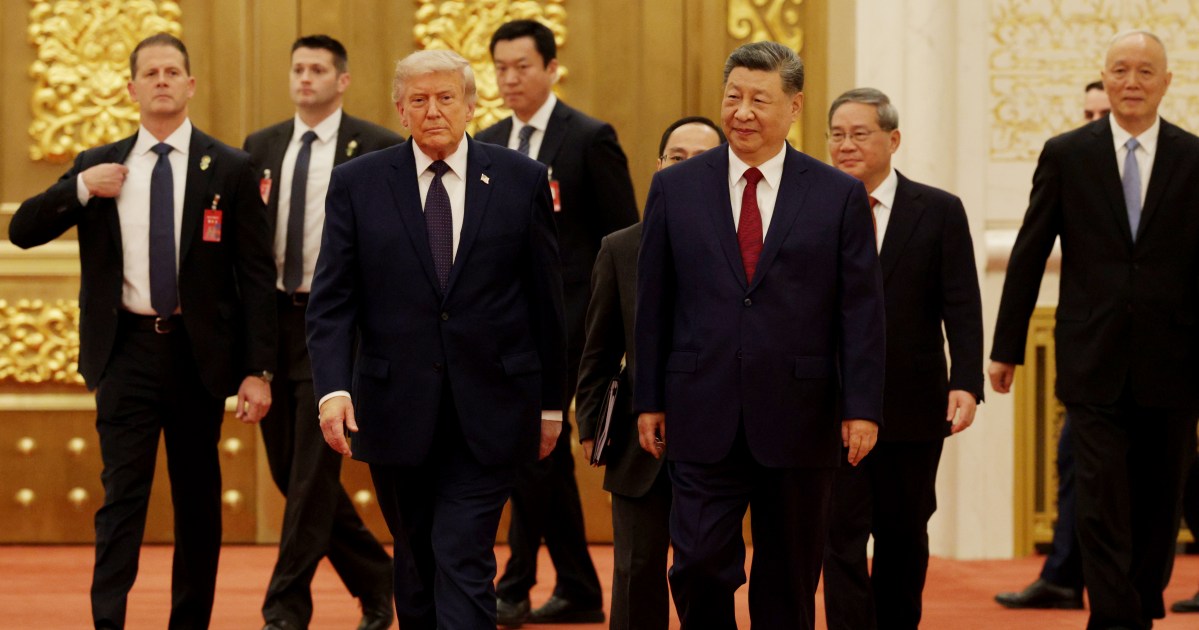
BEIJING (AP) — As President Donald Trump wraps up his whirlwind visit to China on Friday, he’s insistent that relations between the world’s two biggest powers are good and getting better despite deep differences on Iran, Taiwan and more.
Trump started his last day in Beijing by insisting in a social media post that Chinese leader Xi Jinping had “congratulated me on so many tremendous successes” and had been referring only to his predecessor, former U.S. President Joe Biden, when he “very elegantly referred to the United States as perhaps being a declining nation.”
But Trump’s rosy outlook on the U.S.-China relationship collides with some difficult truths about the thorniest issues between the two superpowers.
Beijing has shown little public interest in U.S. entreaties to get more involved in solving the conflict in Iran, even though Trump said in an interview with Fox News’ Sean Hannity that Xi had in their conversations offered to help. And the White House believes China can still do more to stem the flow of Chinese-made precursor chemicals into Mexico used to make illicit fentanyl that has wreaked havoc on many U.S. communities.
Xi, meanwhile, warned Trump during private talks that their differences on the self-ruled island of Taiwan, if handled poorly, could hurtle the world’s dominant powers toward “clashes and even conflicts,” according to Chinese government officials.
Trump and Xi are set to have more time together at Xi’s official residence in Beijing on Friday before the U.S. leader makes the long journey back to Washington.
Taiwan remains the most important issue for China
Xi’s sharp language on Taiwan loomed large over Thursday’s talks, even as Trump sought to play up the notion that the U.S. and China share a “special relationship.”
But Secretary of State Marco Rubio told NBC News that U.S. policy toward Taiwan was “unchanged” and cautioned that it would be “a terrible mistake” for China to try to take Taiwan by force. He also framed Xi’s comments as standard practice.
“They always raise it on their side. We always make clear our position, and we move on to the other topics,” said Rubio, who was among senior aides to join Trump for the talks.
China in recent weeks has sought to put more focus on its view that Taiwan sits at the “core” of its interests and is key to ensuring a stable relationship with the U.S.
Trump has demanded Taiwan increase defense spending, and in December, the White House announced an $11 billion weapons package for Taiwan, the largest ever to the island democracy.
But the U.S. has yet to begin fulfilling the arms sales, and Trump had said he expected to discuss the matter with Xi in Beijing. He’s also groused that Taiwan “stole” America’s semiconductor business and called on Taiwan to pay the U.S. for protection.
All the while, Trump has, with the threat of hefty tariffs and Biden-era incentives, prodded Taipei to agree to massive investments in U.S. semiconductor manufacturing and to purchase billions of dollars’ worth of U.S. liquefied natural gas and crude oil. The attitude toward Taiwan has raised questions about whether Trump might be open to dialing back support for the island democracy.
Ma Chun-wei, an expert in China-Taiwan relations at Taiwan’s Tamkang University, said the elevated defense relationship between Washington and Taipei has caused China to toughen its rhetoric over Taiwan.
“For Xi Jinping, he must show that the Taiwan issue is in China’s hands. He must demonstrate this image, or else he would be criticized,” Ma said.
China wants the Strait of Hormuz opened
Iran was on the agenda when Trump sat down with Xi on Thursday for their two-hour meeting in the Great Hall of the People.
The leaders agreed that the Strait of Hormuz — effectively closed since the start of the Iran conflict — needs to be reopened to support global energy demands, Trump told Fox News in an interview. About 20% of the world’s oil flowed through the strait before the war started on Feb. 28.
Trump said in the interview that Xi privately offered assistance on resolving the war, though it was unclear what that would mean, given China’s strategic partnership with Iran.
“He’d like to see the Hormuz Strait open,” Trump said. “He said if I can be of any help whatsoever, I would like to help.”
The president also said Xi was also opposed to any implementation of tolls on vessels crossing the strait and expressed interest in China potentially purchasing more U.S. oil to reduce Chinese dependence on Gulf oil in the future.
Trump earlier this week had downplayed the importance of talks with Xi on the 11-week-old Iran war that has led to surging energy prices and threatens to plunge the global economy into recession if the conflict does not conclude soon.
“We have a lot of things to discuss. I wouldn’t say Iran is one of them, to be honest with you, because we have Iran very much under control,” Trump told reporters Tuesday shortly before flying to Beijing.
But before Air Force One could land in Beijing, Rubio said administration officials would make the case to the Chinese officials about why they should be invested in prodding Iran to come to terms to end the war.
“Economies are melting down because of this crisis,” Rubio offered aboard the presidential plane as he flew with Trump to Beijing. That dynamic, the secretary added in an interview Wednesday with Fox News’ Sean Hannity, will result in consumers “buying less Chinese product.”
“So it’s in their interest to resolve this,” Rubio said.
Indeed, the Chinese, who have been critical of the U.S. and Israeli bombardment of Iran, hold unique leverage as Iran’s biggest trading partner. The Chinese government has managed to weather the economic damage caused by the war with the help of its strategic oil reserves, but that backstop is not limitless. Economists say the Iran conflict could still have a big impact on China’s export-driven economy.
Will Trump announce any major business deals?
The White House, ahead of the visit, insisted that Trump wouldn’t be making the trip without an eye toward securing results before he leaves, suggesting there could be announcements coming on trade.
Those could still come, with the U.S. side hoping to nail down Chinese commitments to buy U.S. soybeans and beef. Trump told Fox News that Xi had indicated a commitment for China to buy 200 Boeing jets from the U.S.
The leaders on Thursday discussed increasing U.S. agricultural purchases by the Chinese and opportunities for both sides to expand investment into each other’s markets, according to the White House. Trump administration officials also want to work toward establishing a Board of Trade with China to address commercial differences between the countries.
Chinese Premier Li Qiang stressed the need for friendship and cooperation in U.S.-China ties as he spoke with U.S. business titans, including Tesla’s Elon Musk, Apple’s Tim Cook and Nvidia CEO Jensen Huang, who were part of Trump’s delegation in Beijing.
“China and the United States have been able to maintain frank and smooth dialogue and communication and actively safeguard a stable and healthy bilateral relationship” despite international turbulence, Li said.