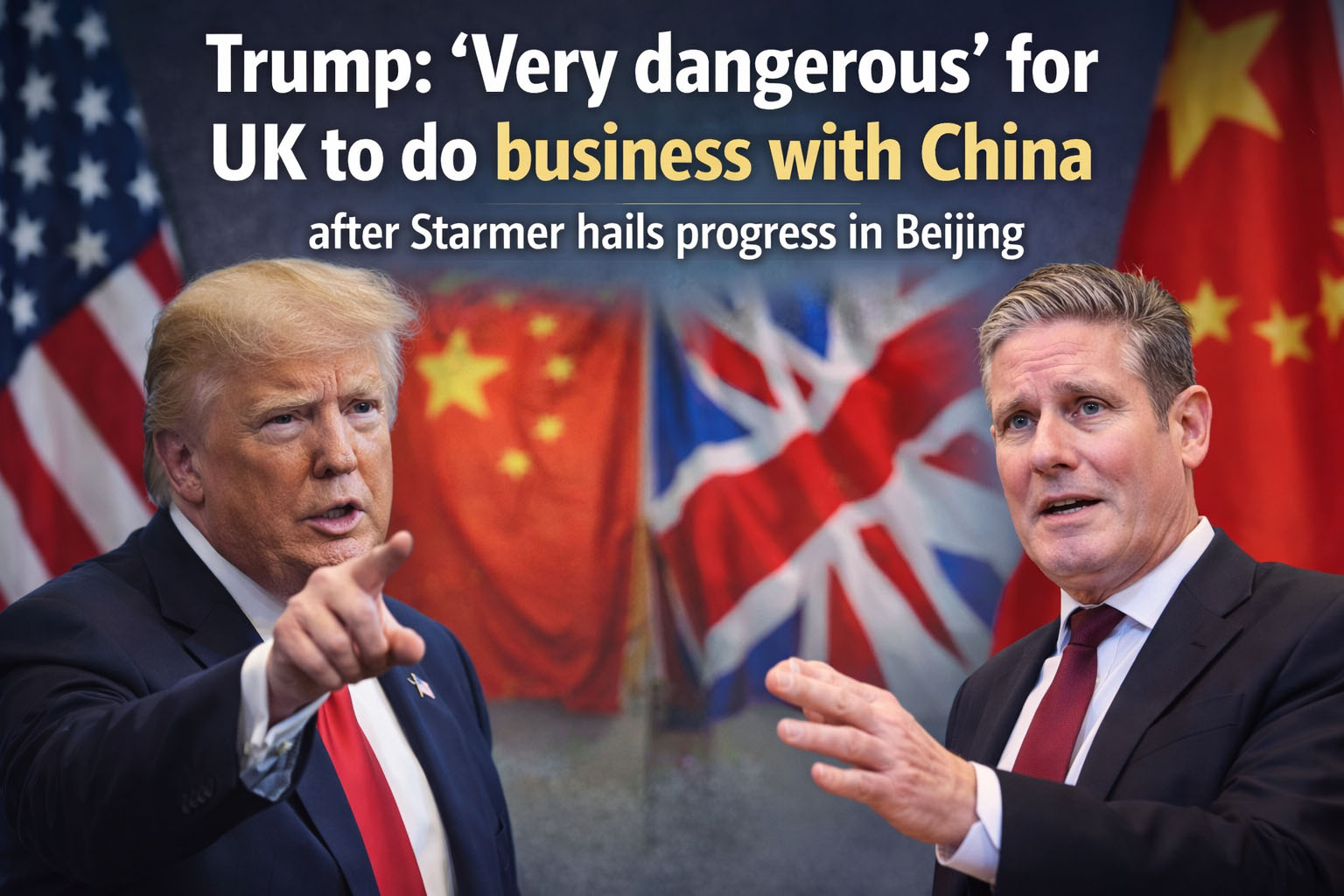
A new diplomatic reset between London and Beijing has collided with a blunt warning from Washington.
On 30 January 2026, U.S. President Donald Trump said it was “very dangerous” for the UK to be “getting into business with China,” as UK Prime Minister Keir Starmer promoted “progress” from his Beijing meetings and pushed for expanded trade and investment ties.
This matters because UK firms are being encouraged to pursue fresh opportunities in the world’s second-largest economy—while simultaneously navigating security concerns, supply-chain risk, and potential friction with the UK’s closest security ally, the United States.
What happened (and why it’s making headlines)
Starmer’s message in Beijing: “progress” and economic wins
Starmer’s visit—reported as the first by a British prime minister in about eight years—was framed around rebuilding a more stable UK–China relationship and unlocking commercial benefits for UK companies.
Coverage of the trip points to concrete deliverables and business-facing announcements, including:
- Lower Chinese tariffs on UK whisky (reported as being cut/halved)
- Visa-free travel for Britons to China (as part of the reset package)
- A push for improved market access, reduced trade barriers, and new investment links
- Meetings with Chinese leadership and business leaders as Starmer continued the trip beyond Beijing, including onward travel to Shanghai
Starmer’s core argument: the UK can pursue a pragmatic economic agenda with China without “choosing” between Beijing and Washington.
Trump’s response: “very dangerous”
Trump’s critique was short but sharp. Asked about the UK “getting into business” with China, he said it was “very dangerous,” without detailing specific triggers in his public remarks.
Multiple reports also link his warning to a broader pattern: Trump has recently criticised other allies’ China engagement—especially Canada—in the context of trade and tariff pressure.
Why this is a big deal for UK businesses
UK–China commercial ties are never “just trade.” They sit inside a live matrix of:
- National security concerns (critical infrastructure, telecoms, dual-use tech)
- Supply-chain resilience (single-country dependency risk)
- Sanctions/export controls (fast-changing compliance landscape)
- Reputational risk (human-rights and ESG scrutiny)
- US–UK alignment (intelligence cooperation and defence partnerships)
In practical terms, Trump’s warning increases the chance that UK companies expanding in China could face:
- More political noise around deals and investments
- Higher compliance costs (extra due diligence, legal review, supplier audits)
- Policy volatility (tariffs, restrictions, or new screening regimes)
Where the opportunities are (and where the risks are highest)
Areas businesses may see opportunity
Based on the visit’s stated goals—market access, lower barriers, and investment promotion—sectors often positioned to benefit include:
- Consumer exports (e.g., spirits/whisky) with tariff changes
- Services and professional expertise (where access improves via negotiated openings)
- Joint ventures and R&D presence (notably referenced in reporting around business meetings)
Highest-risk zones
Risk spikes when deals touch:
- Sensitive technology (AI models, semiconductors, telecoms, cybersecurity tooling)
- Critical infrastructure (energy grids, ports, data centres)
- Data-heavy operations (customer data, biometrics, location data)
- State-linked counterparties (complex ownership structures)
A practical “de-risking” checklist for UK companies
If you’re a UK founder, exporter, or investor considering China-facing business, the smart play is to separate commercial upside from policy exposure:
- Map your exposure
- Which products, components, data, or services are China-linked?
- Screen counterparties
- Ownership, sanctions lists, litigation history, beneficial owners.
- Stress-test your supply chain
- Can you substitute suppliers within 30–90 days if rules change?
- Data governance first
- Keep sensitive data minimised; localise only where required; tighten access control.
- Contract for volatility
- Add termination rights, force majeure clarity, currency clauses, IP protections.
- Scenario-plan for tariffs and controls
- Build “Plan B” routes for logistics, payments, and manufacturing.
What to watch next
In the coming weeks, keep an eye on:
- Whether the UK government publishes more detail on the scope and timelines of the visa/tariff and market-access changes
- Any signals from Washington on whether it intends to pressure allies over China trade strategy
- Business reaction: whether firms accelerate deals—or pause for clarity amid the political crosswind