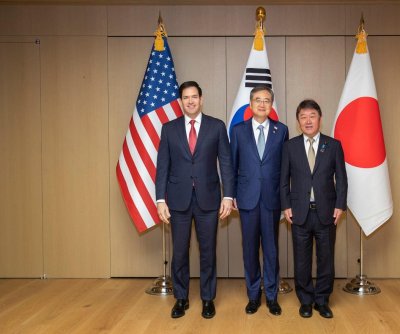
This photo, provided by Seoul’s foreign ministry, shows South Korean Foreign Minister Cho Hyun (C), U.S. Secretary of State Marco Rubio (L) and Japanese Foreign Minister Toshimitsu Motegi on the sidelines of the NATO summit in Ankara on Tuesday. Photo courtesy of South Korea Foreign Ministry
SEOUL, July 8 (UPI) — The top diplomats of South Korea, the United States and Japan reaffirmed their commitment to the denuclearization of the Korean Peninsula and agreed to strengthen cooperation against North Korea’s illicit cyber activities, which help finance Pyongyang’s nuclear and missile programs, Seoul’s foreign ministry said Wednesday.
The commitments came during a trilateral meeting on the sidelines of the NATO summit in Ankara, Turkey, on Tuesday. Foreign Minister Cho Hyun met with U.S. Secretary of State Marco Rubio and Japanese Foreign Minister Toshimitsu Motegi to discuss North Korea, regional security and economic cooperation, according to Seoul.
“The three ministers agreed to continue efforts to preserve peace and stability on the Korean Peninsula through dialogue and diplomacy while adhering to the principle of denuclearization,” the ministry said.
The ministers also “agreed to maintain close coordination on North Korea policy, including responses to the North’s illegal cyber activities.”
Japan’s Foreign Ministry said the three upheld the goal of the “complete denuclearization of North Korea” in accordance with U.N. Security Council resolutions and stressed the importance of addressing Pyongyang’s “malicious cyber-related activities,” including cryptocurrency thefts.
The growing emphasis on cyber threats comes as the United States and its allies have identified North Korea’s hacking operations and cybercrime as a major source of funding for its prohibited nuclear and missile programs.
Last month, Group of Seven leaders highlighted Pyongyang’s illicit cyber activities in their joint statement on geopolitical issues for the first time. North Korean-linked hackers stole roughly $643 million in cryptocurrency during the first half of 2026, accounting for about two-thirds of all crypto funds stolen worldwide, according to blockchain analysis firm TRM Labs.
The ministers also exchanged views on regional and global issues, including developments in Northeast Asia and the Middle East, and agreed to strengthen cooperation on transnational crime, disaster relief, humanitarian assistance and Arctic affairs, Seoul said.
The three reaffirmed economic security as a key pillar of their partnership and agreed to deepen practical cooperation in areas including nuclear energy, artificial intelligence and quantum technology, while strengthening supply chain resilience and coordinating responses to economic coercion.
On the sidelines of the meeting, Cho, Rubio and Motegi signed a memorandum of cooperation establishing a framework for trilateral collaboration on deploying small modular reactors in third countries, with an initial focus on the Indo-Pacific.
The memorandum is intended to encourage cooperation among South Korean, U.S. and Japanese nuclear companies through joint project development, streamlined licensing and stronger supply chains. The three governments said the framework aims to accelerate deployment of the next-generation reactors while maintaining high standards of nuclear safety and nonproliferation.
Rubio said the initiative would help partner countries meet growing energy demands while advancing the three allies’ shared security interests. The U.S. State Department also announced more than $10 million in funding for technical assistance to Indo-Pacific countries pursuing civilian nuclear power.
The meeting marked the first gathering of the three countries’ foreign ministers since they met on the sidelines of the Asia-Pacific Economic Cooperation summit in the southeastern South Korean city of Gyeongju in October.