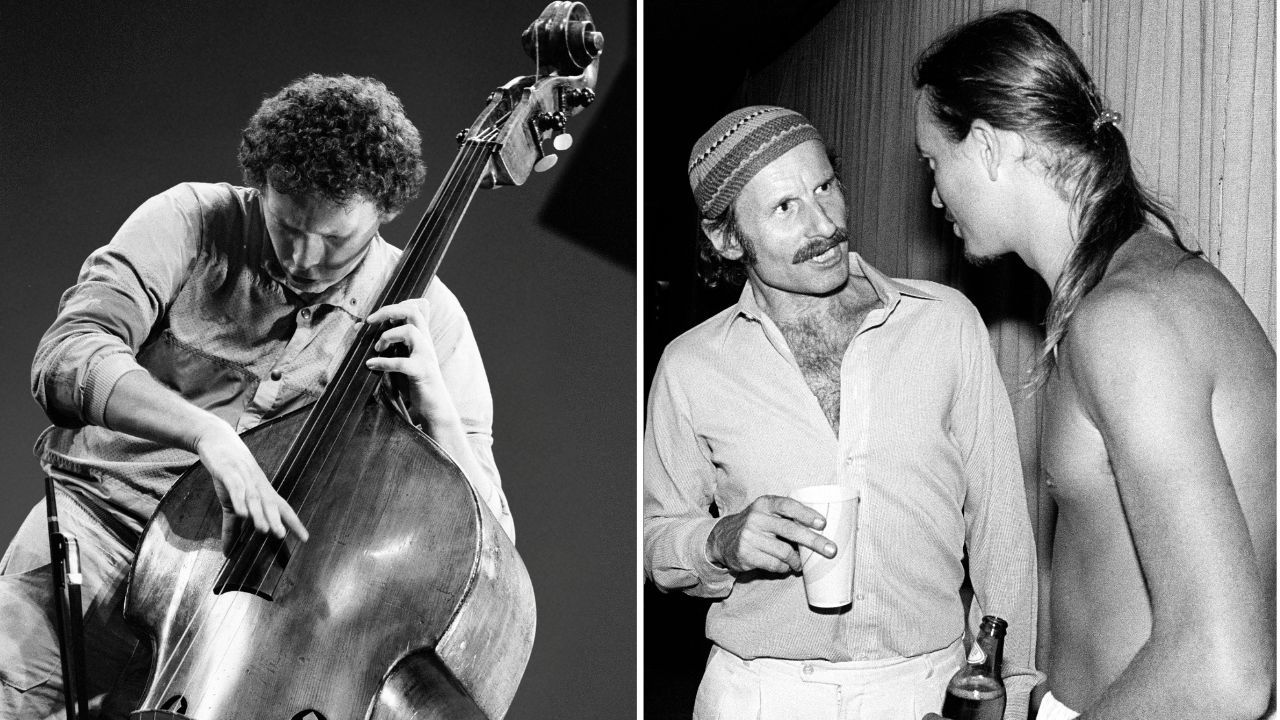

From his early collaborations with the likes of Bob Brookmeyer and Clark Terry to his own constantly evolving recorded work, Miroslav Vitous has continually redefined the role of the bass in jazz.
After winning a scholarship to the Berklee School of Music in 1965, he moved to New York and quickly established himself as one of the young lions of jazz bass, landing high-profile gigs with Herbie Mann, Stan Getz, Chick Corea, and Miles Davis, among others.
Article continues below
When Zawinul and Shorter later steered the group into a more commercial musical direction, Miroslav parted ways and pursued his own path without looking back – until questions arose over his share of the royalties.
“We each wrote two songs on the first album and formed the publishing company Shoviza – short for Shorter, Vitous, and Zawinul,” said Vitous in the October 2016 issue of Bass Player. “Weather Report belonged to the three of us on paper, technically. And when it ended, unfortunately, they didn’t pay me for my third; they just took it. Somebody stole my documents, and that was it.
Weather Report – Waterfall (1971) – YouTube

“It was very unfortunate – the royalties were coming directly from Columbia Records to the office. One-third of those royalties were mine, and they didn’t pay me for seven years, if you can believe that. Nothing came.
“Finally I had to go talk to Joe Zawinul and say, ‘Hey, this is not even a case if I take you to court. You are just sitting on my money. You have the contract with Columbia, everything is right there.’ So then they started to pay me back some of the $45,000 they withheld.”
Prior to Weather Report, you were all playing on each other’s solo projects. What made you decide to get together and form the group?
For a very short while I was with Miles Davis, but that ended quickly, and I didn’t want to go back to Herbie Mann or Stan Getz or the people I had worked with before. I was ready to move on. So I thought I’d start some kind of a band, and decided to give Wayne a call, who had me on his last three albums before that.

He also had just left Miles and was not doing anything quite yet, so it just happened that he was free at that time. I asked him if he’d be interested in putting a group together, and he liked that idea and wanted to think about it.
Two weeks later, he called back and asked me what I thought of having Joe Zawinul in the group, and I said, sure, that’s fine; let’s do that. And that’s exactly how Weather Report started.
What were your thoughts on the bassists who replaced you?
They were all good bass players. With Alphonso Johnson they wanted to have the bass as part of the drum section, you know, bass and drums, and play a funk kind of thing so they could put the melodies on top of that. That’s what they wanted. They didn’t want somebody to ‘talk’ to them any longer, so that’s when the musical conversation disappeared.
But Alphonso Johnson is an excellent bass player. And I was very impressed with Jaco, because I thought he was of their caliber, for sure. He was fantastic.
I heard stories that Zawinul also had a big problem with that, because as soon as somebody was better than him or a threat to him, he started manipulating, and it would end up in a very bad way. Not for Zawinul, but for the other guy!
What was your goal with your 2016 album, Music of Weather Report?
I wanted to show what can really be done with Weather Report’s music. Like Birdland, for example: I studied that intuitively, how the phrases come after each other, and I think I found a more musical way with it than what they did.
The whole idea is about improvisation and playing music – developing the motifs, not just playing the song and going on to the next song. This is what I started to do with Wayne and Joe in the beginning.
That was a hallmark of early Weather Report, the way you developed short phrases into long improvisations.
Right, but eventually that was not enough because Zawinul wanted to be more commercial and play more funk, and he wanted more recognition and money. So everything changed, and the original idea basically stopped with my departure from Weather Report. It was not really what we started.
How did you go about deciding which tunes to record?
I picked the tunes with the melodies I liked the most and which were not too complicated, so we wouldn’t have to go into some kind of serious arrangements.
Pinocchio is fantastic on this album. Nobody has ever done anything to that song; they all play the melody and then go to the races with it, but no music ever came out of it. We took it and we just made some beautiful music and it came from heaven. We developed motifs like a classical composer would.
Do you have one main bass, or do you have several?
I have several of them, but I recorded that album on the Busseto bass, which was built by Barry Kolstein on Long Island. It’s actually a copy of Scott LaFaro’s bass in a small size, but the fingerboard and mensur is exactly the same as on the big bass. It was made for traveling, and I like it so much that I don t play anything else now. It’s like my little Ferrari.

Do you still play electric?
No, it’s been in the closet for the last 15 years. After leaving Weather Report I stopped playing electric bass. I never really liked it; I had no feeling for it. There are no overtones, there’s no body, there’s no ringing. If you get used to the vibration of the body of the acoustic bass, you are hooked on it. The natural overtones are just not there on the electric instrument.
Besides, I can play twice as fast on an acoustic bass than on electric, so what the hell would I be doing with one?
You’re well known for your great technique. What advice can you offer bassists to improve that part of their playing?
You have to train like a classical guy who plays the concertos, like Koussevitzky. Take any concerto, or even cello concertos – whatever you can get your hands on – so that you can develop control over the instrument.
When you have that control then you can have your own ideas and you can execute them. So you have to study the instrument from a classical point of view, because this is where you can get the education and the technique which is required for something like I do.
” data-join-the-conversation-text=”Join the Conversation”>
You must confirm your public display name before commenting
Please logout and then login again, you will then be prompted to enter your display name.