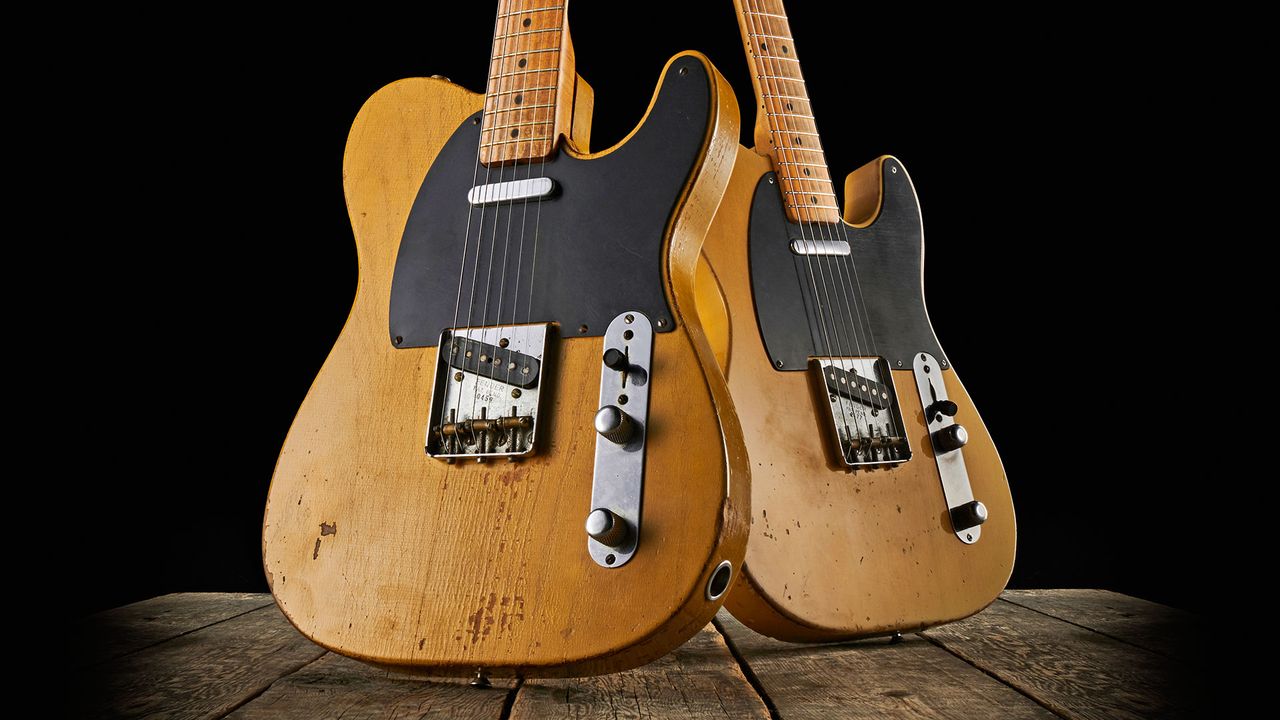

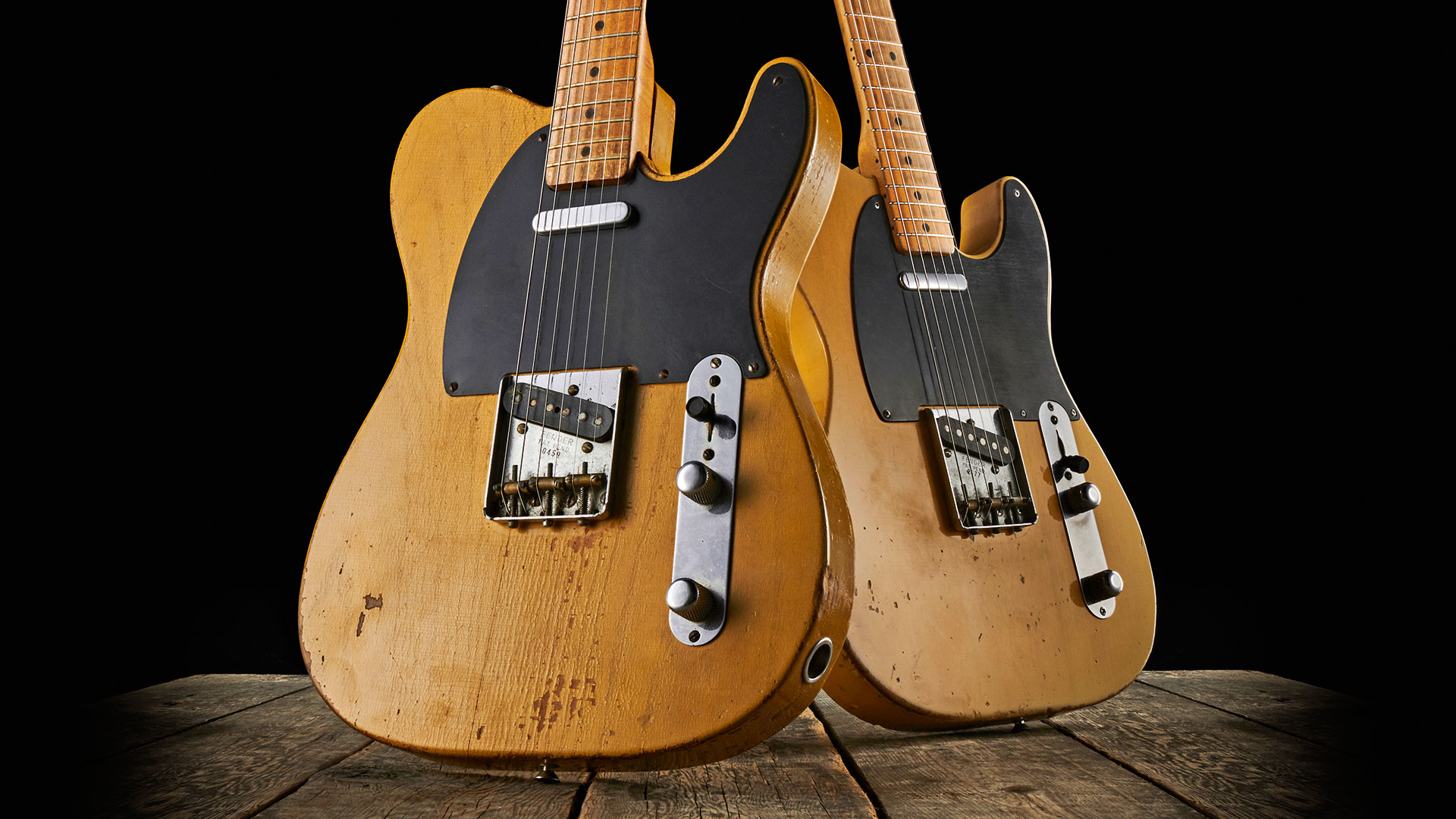
It seems strange to say, but a literal lifetime has passed since the Fender Telecaster (initially named the Broadcaster) debuted at the 1950 NAMM Show. Remarkably, its relevance has only grown during the seven decades that have passed since then.
Perhaps that’s because the Telecaster’s simplicity has always meant that it becomes what you bring to it, meaning it could never truly go out of style.
The Prototypes
In 1943, Leo Fender and his future business partner, Doc Kauffman, built their first lap steel, and applied to patent a pickup design the following year. This instrument is now known as the ‘Radio Shop guitar’, and more refined lap steels followed. Leo assembled his first six-string guitar prototype during the summer of 1949.
The laminated two-piece pine body shape was almost identical to the production models, with a bolt-on neck and top mounted metal control plate.

However, it featured a three-per-side ‘snake head’ headstock that was similar to those of Fender’s lap steels. Leo completed the second prototype around the autumn/winter of that year, complete with the now iconic headstock shape and cut-down bass-side-only Kluson tuners.
Both 1949 Fender prototypes were single-pickup guitars, but Leo gifted a two-pickup prototype with a lap steel pickup in the neck position to Sam Hutton, who was one of Fender’s amp technicians. He apparently kept it hanging on a nail in his workshop for testing purposes.
Production Begins
Fender’s first production guitars were made during the spring of 1950 and the model was dubbed the ‘Esquire’. These days the Esquire is considered a single-pickup Telecaster, but shortly after its release, Fender began offering Esquires with an optional neck pickup.
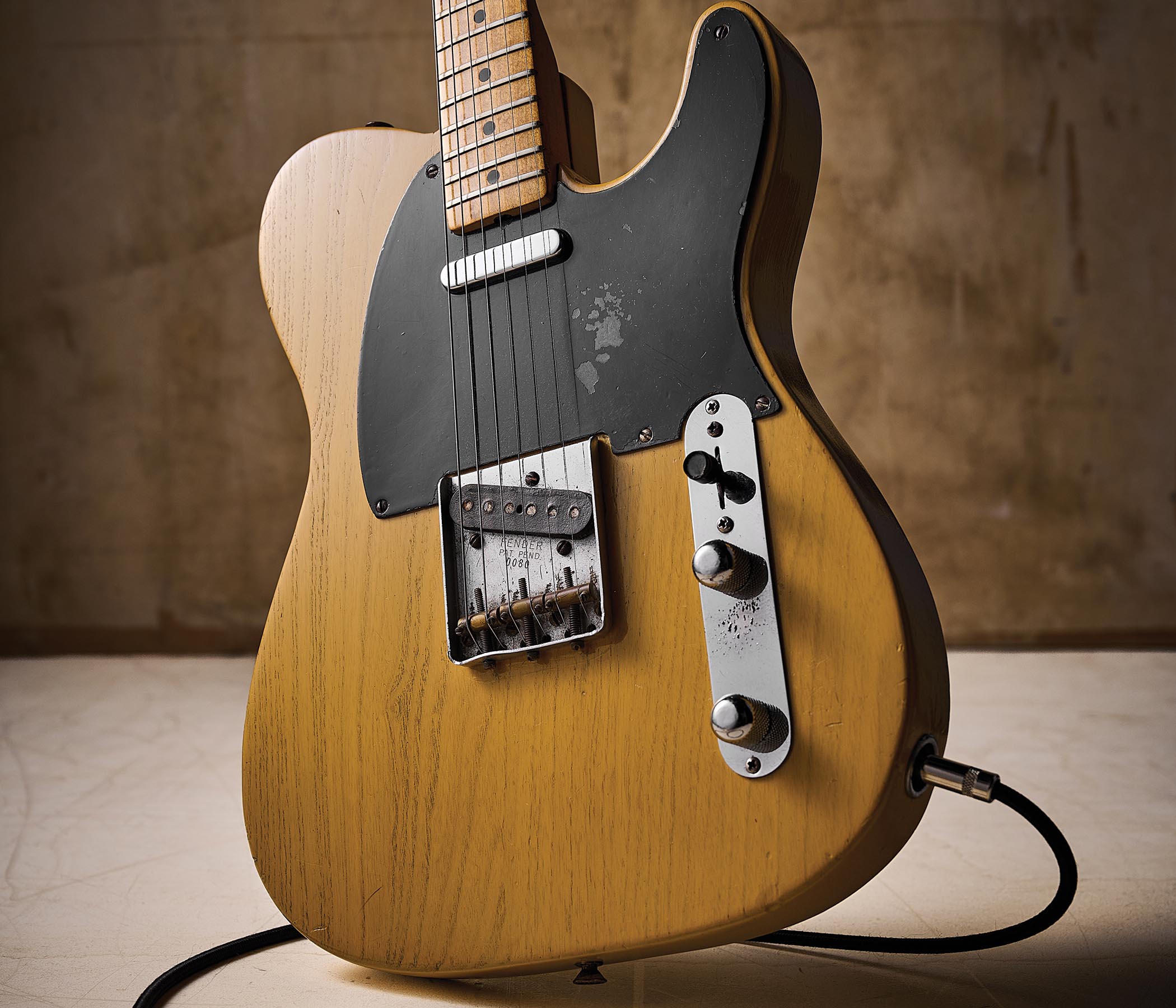
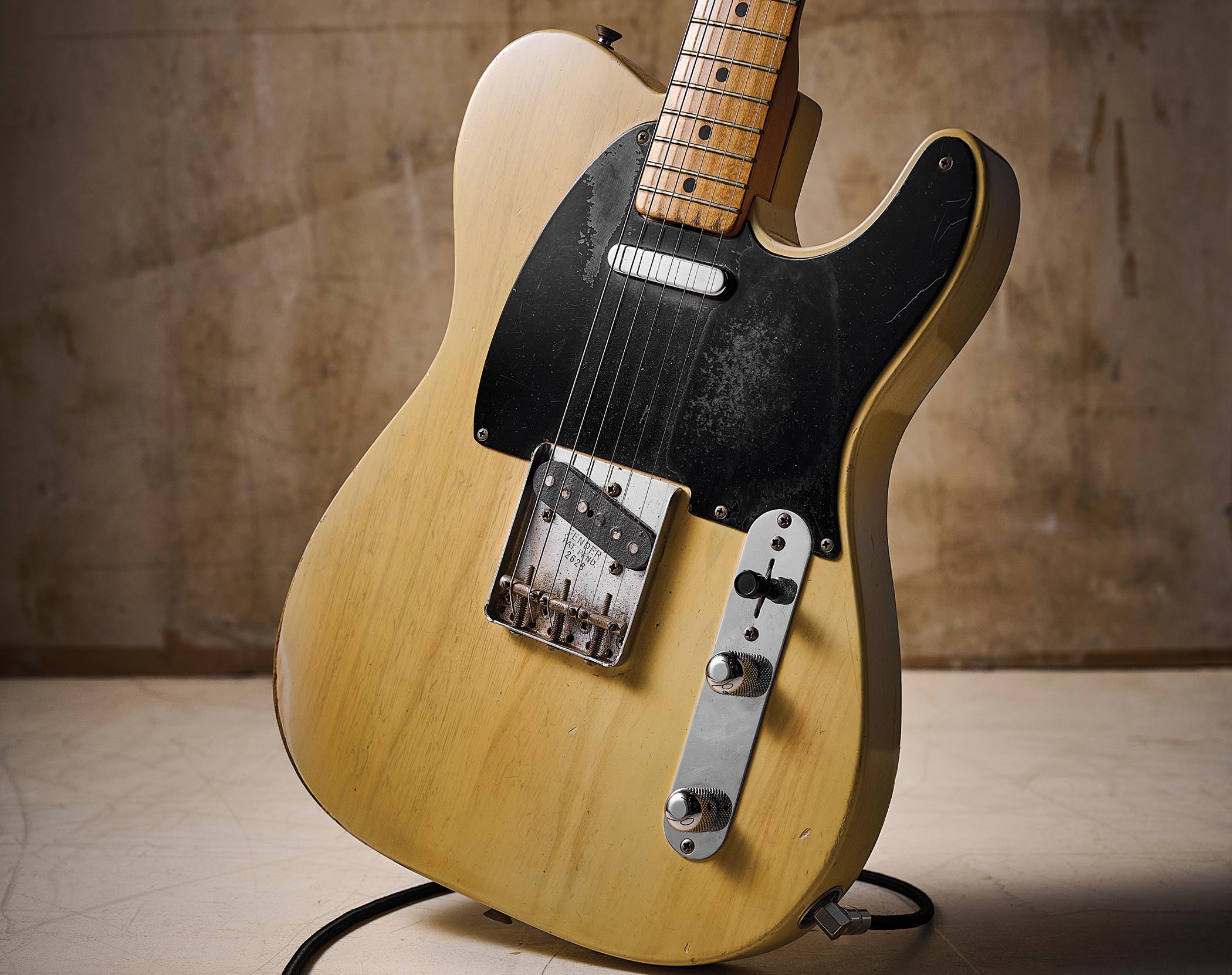
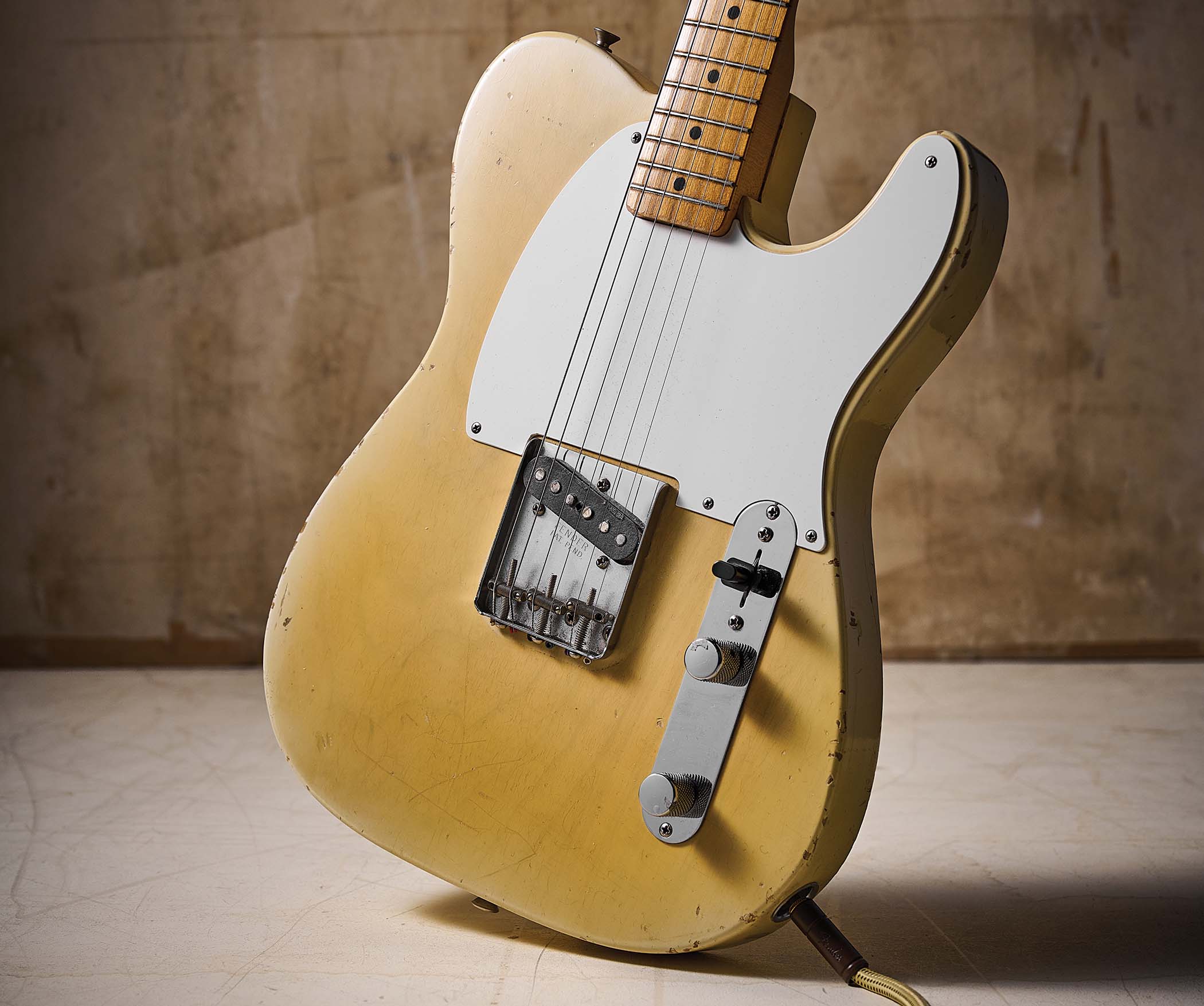
The earliest models had black lacquered pine bodies and white fibre pickguards. By the summer, Fender was using ash for the bodies with a translucent blonde finish and a contrasting black fibreboard pickguard.
Fender sprayed and polished the ’guards, and while the earliest ones were glossy front and back, the team soon realized it was wasting lacquer on the side nobody would ever see. Instead, the ’guards were placed on a paint tin for spraying, leaving a circular lacquer ‘shadow’. The ‘Blackguard’ era lasted from 1950 to 1954.

Spare The Rod
At first, Leo Fender was convinced that chunky maple necks would be sufficiently robust to remain straight under string tension. However, touring musicians who were road-testing the earliest Esquires began reporting problems.
Travelling from the heat of the deep south to the Canadian cold caused the necks to flex, with string action becoming uncomfortably high and buzzingly low, depending on conditions. Leo bowed to the inevitable and purchased truss rod tooling in October 1950.
Name Calling
Esquire production was paused between late summer 1950 and January 1951, and Don Randall came up with the name ‘Broadcaster’ for the dual-pickup model. When Esquire production resumed, the name was reserved for single-pickup guitars.
In his book The Blackguard, Nacho Baños estimates that no more than 250 Broadcasters were produced between October 1950 and February 1951. Fender received Gretsch’s telegram asserting an infringement of its trademark and scissored off the ‘Broadcaster’ section of the remaining decals, rather than waste them.
Guitars with these chopped decals became known as ‘Nocasters’ and, once they had run out, Fender began using decals bearing a new name devised by Don Randall – and the first guitars with ‘Telecaster’ logos appeared during the late summer of 1951.
Joe Bonamassa’s Vintage Telecaster Tone Tips & Tricks – YouTube

Broadcasters, ‘Nocasters’, early Telecasters, and Blackguards continue to occupy top spots for vintage Telecaster fans. We turned to busy session player Eddie Tatton and rockabilly virtuoso James Oliver for some owner insights.
“I ended up buying a ’52 from ATB [guitar shop in Melksham, England],” Tatton recalls. “It was relatively affordable because it’s an Esquire with a factory-added neck pickup. GE Smith also has one like mine, and Fender apparently charged around $15 for the upgrade. It’s an incredible working instrument and it’s probably my favorite guitar.”
Oliver’s ’54 example is his favorite, too, and it’s been his main gigging guitar since its purchase three years ago.
“Although it’s a refinish, the parts are original and it’s fairly light,” Oliver tells us. “The bridge pickup died while I was touring Scandinavia and I finished the tour on the neck pickup.
“Most of what I play is twangy rockabilly and blues, and I like a bright and clean sound. The wiring has been updated, so I use the middle position if I’m playing T-Bone Walker-type stuff, but I’m usually on the bridge pickup and I never use the neck on its own.”
Body Building
Body construction evolved throughout the vintage era. To get the neck pickup wires to the controls, Fender’s first method was drilling a hole from the neck pocket straight through to the bridge pickup cavity. The radio repair guy in Leo Fender must have balked at having to remove the strings and bridge for maintenance.
Towards the end of the Broadcaster run, Fender began making a one-inch ‘doughnut rout’ halfway between the two pickup cavities. One hole was then drilled from the neck pocket to the doughnut, and a diagonal hole was drilled from the doughnut to the control cavity. By this time, Fender was also cutting a notch between the neck pocket and neck pickup rout.

Fender eventually settled on a diagonally routed channel connected to the neck pickup and control cavities by drilled holes. This lasted until 1968, when the company began drilling the wire channel from the corner of the neck pocket through to the control cavity – catching the treble side of the neck pickup cavity along the way.
Fender routing templates were pinned onto body blanks and the holes were plugged with dowels prior to finishing. These plugs were on the rear center line and started out with a 3/16-inch diameter before reducing to 1/8-inch in 1953. Fender also struggled with through-body stringing, and it took a while to get ferrule holes lined up and evenly spaced.
1955 Fender Stratocaster with Joe Bonamassa at Norman’s Rare Guitars | Dec 5, 2018 – YouTube
There was considerable weight variation, and fully assembled Blackguards range from just over 6lb through to 9lb. Finding reasonably light ash in sufficient quantities became an issue during the late 1960s, and Fender tried removing wood under the pickguard area for weight relief. Guitars with these chambered bodies became known as ‘Smugglers’ Teles’.
Immortal Coils
The bridge pickup was basically a Fender lap steel pickup with a three-screw bottom ‘flat’ and an inductance plate to increase output. Early Blackguard bridge pickups read between 6kohms and 9k, but higher values do not indicate overwinding. Fender transitioned from 43 AWG plain enamel wire to thicker 42 AWG during 1951, and thinner wire offers higher resistance for the same number of turns.
Flat-pole Alnico III magnetic slugs were used until Fender changed to Alnico V in 1955. Shortly afterwards, the slugs became staggered, bringing Tele bridge pickups in line with Stratocaster pickups. White parcel string was wrapped around the exposed coils for protection, which turned black in the potting wax.
Unlike the bridge pickups, the neck pickups remained largely unchanged. Plain enamel 43 AWG was the magnet wire of choice along with non-staggered Alnico V slugs. Lacquer was used for potting, rather than wax, and a chrome-plated brass cover protected the coil.
A significant change occurred around 1965, when Fender ceased the practice of hand-guiding magnet wire and fully mechanized the process. This coincided with the appearance of grey bottoms, and during the late 1960s Fender transitioned from wax to lacquer for potting coils, which solidified them and changed the tone.

Control Tweaks
Wiring Esquires with a preset treble-roll off in one position, a tone control connected in the middle position, and no tone control in the back position had a certain logic. It provided owners with the potential for three sounds from a single-pickup guitar, although most found the pseudo ‘bass’ setting excessively dark.
Leo Fender clearly thought otherwise, because he retained the treble roll-off with dual-pickup models. At first, the settings were neck pickup with treble cut, then neck and bridge pickups with no tone control. There was a volume control, but the second knob blended the bridge and neck pickups in the back position.
“My ’52 has the blend knob and it’s a super-cool thing to [use],” Tatton says. “You can just add in a bit of neck pickup to soften the sound. Having the bass setting is fun, but it’s too dark, even for jazz solos.”
Fender introduced a second wiring scheme in 1952 with a conventional tone control that worked on both pickups. But the ‘bass’ setting was retained, and getting both pickups working together meant finding the switch’s in-between position.
Despite widespread unpopularity, this wiring lasted until around 1968. CBS’s management made one of its rare popular decisions and standardized the factory wiring to neck/both/bridge with master volume and tone controls. Unfortunately, they simultaneously changed to bright-sounding 1mega-ohm pots with a treble bleed capacitor on the volume control.
Oliver has reservations: “I have a rosewood-’board ’69, which I don’t think is very good. The neck feels very nice – it’s actually thicker than my Blackguard – but I’d describe it as a harsh and shrill-sounding guitar.”
Blonde On Blondes
Like ’50s Les Pauls, there is no definitive look for Blackguards and much depends on environmental factors and how hard they have been played. Some of their finishes have a dirty and brownish look that is commonly referred to as ‘butterscotch’; others are more of a yellowish cream, and there are all shades in between.
An absence of tan lines under the pickguard on early guitars suggests that Fender sprayed translucent color coats but little or no clear lacquer over the top. The amount of visible grain varied, and the blonde was generally applied more thickly around the edges to disguise body joints.
To my ears, saddle material does have an influence and brass has a really nice smooth sound
Eddie Tatton
During 1954, Fender introduced the Stratocaster, and Forest White was recruited to run the Fender plant and oversee an increase in production.
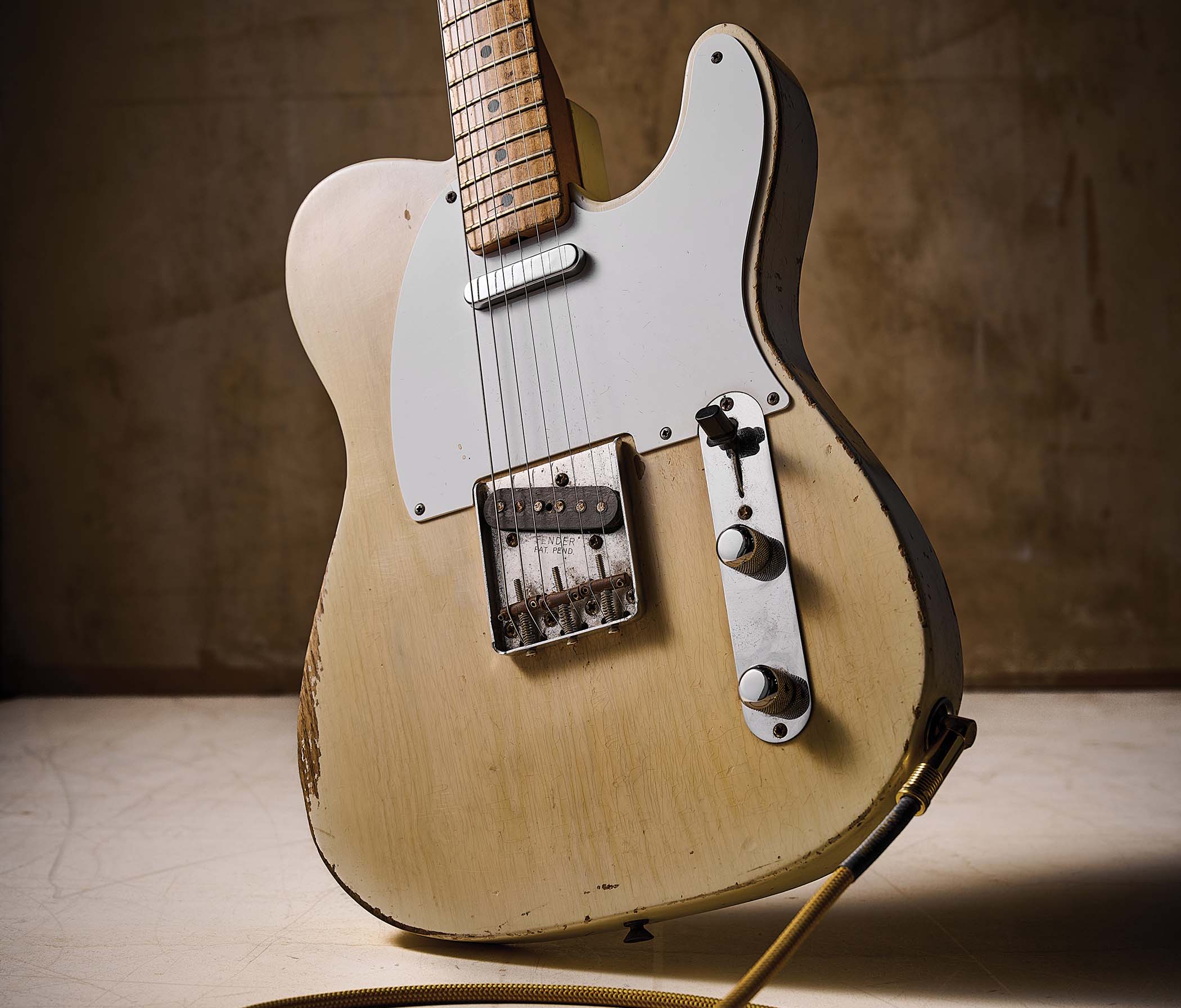
Big changes were made to the Telecaster, too, with a modernized facelift bringing an end to the Blackguard era. With a white blonde finish and a single-ply white plastic pickguard, Esquires and Telecasters from this era became known as ‘Whiteguards’.
Again, Fender sprayed the translucent coats heavier on the sides and edges to create a subtle white ’burst. Not all Whiteguards were blonde, and starting in 1955 Fender would occasionally spray Telecasters sunburst.
1959 Fender Telecaster played by JD Simo – YouTube

Hardware-ing
Early guitars feature flat-head screws throughout – including the truss rod adjuster. Fender began a slow transition to crosshead screws during 1951, and by 1952 it was common to see a mixture of both as the company used up its remaining stock. The transition was complete by the end of 1953.
Fender fitted Kluson tuners from the 1940s until the late 1960s. Those used up to 1951 had ‘Patent Applied For’ stamps on the undersides and the closed shell cover. The following version lost the cover stamp and the single-line Kluson Deluxe lettering, and they were used up to 1952.
Kluson then changed to an open shell cover, with the gear shaft protruding from one side, and the Kluson Deluxe stamp was reintroduced in 1956. A patent number stamp began appearing in 1958 and, starting in mid-1964, the Kluson Deluxe lettering appeared in two lines, rather than one.
Fender stopped using Kluson tuners during 1967 and began having its own ‘F’-stamped tuners manufactured by Race & Olmsted using machinery purchased by Fender.
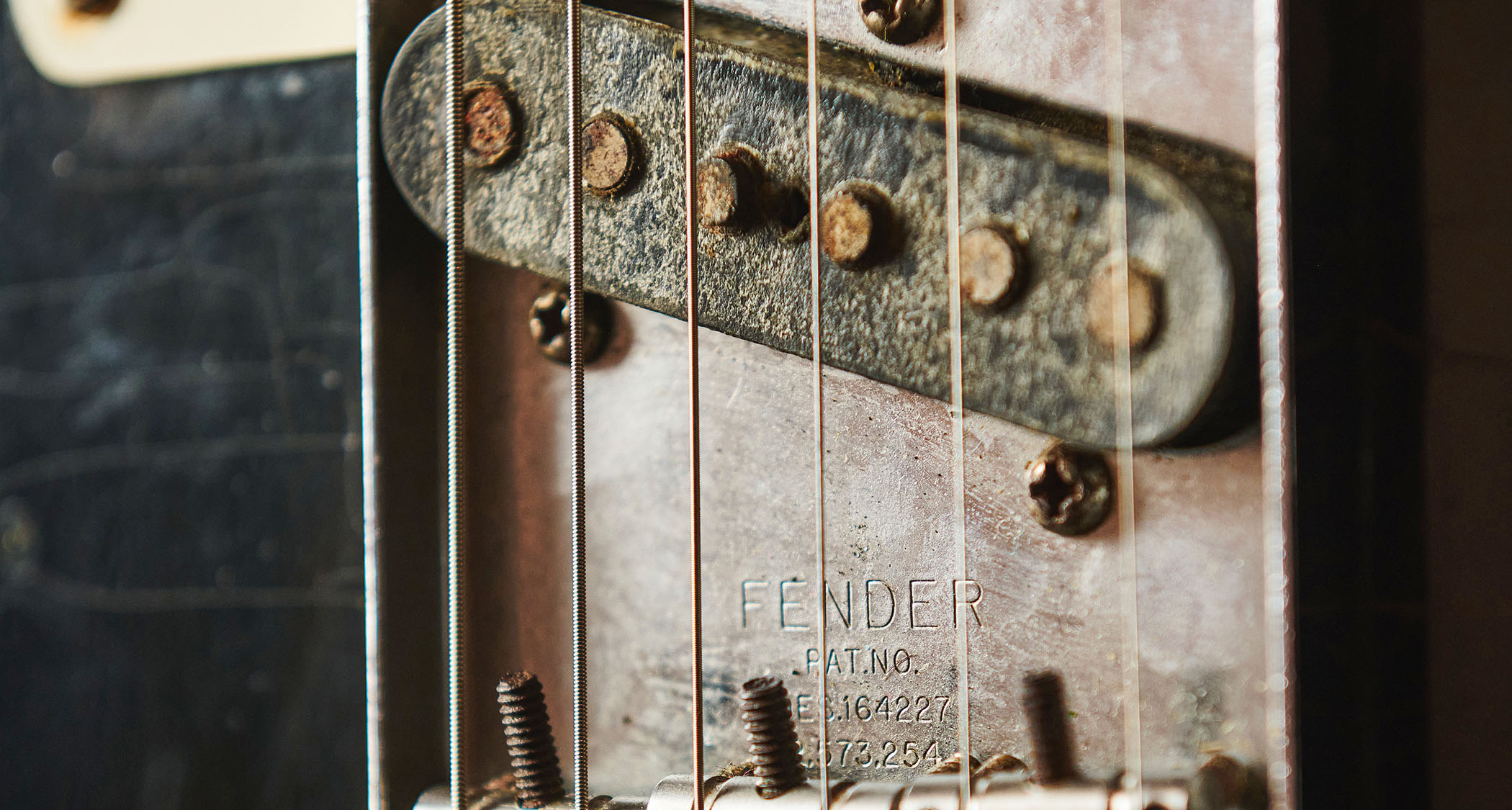

Until mid-1954, ‘Fender’ was stamped on each bridge plate with a serial number. That wasn’t an option for Stratocasters, however, so serial numbers were stamped on the spring covers instead. Eventually, somebody realized that stamping neckplates would resolve the problem for every Fender instrument.
The only significant change Fender made to the chrome-plated cold rolled steel Telecaster bridge occurred between 1958 and ’59, when Fender abandoned through-body stringing. Instead, strings were threaded through holes drilled into the bridge’s rear lip, adjacent to the intonation screws.
Knobs went through several changes, with variations in the knurl, the domed top, and the diameter of the flat spot in the center. These changes were mostly manufacturing inconsistencies, but things settled in 1957, when Tele knobs were changed from milled brass to moulded zamak with flat tops.
1969 Fender Telecaster played by Tyler Bryant – YouTube

The earliest saddles were cut from 5/16-inch steel rod with the bottoms ground flat, but Fender changed to brass around the autumn of 1950. In 1954, Fender reverted to steel saddles, with a ¼-inch diameter, and they lasted until 1958, when threaded steel saddles appeared. Opinions differ regarding their impact on tone.
“A ’63 was my main guitar before I bought my Blackguard,” James Oliver recalls. “I think its steel saddles sound different from my ’54’s brass saddles, but on gigs I barely notice.”
“To my ears, saddle material does have an influence and brass has a really nice smooth sound,” Eddie Tatton observes. “I also have a ’55 with a flat-pole Blackguard-style pickup and steel saddles, rather than brass. It sounds thinner than my ’52, but it has more top-end.”
In 1968, smooth saddles with string grooves appeared. They’re often assumed to be steel, but since they’re non-magnetic, they’re more likely plated zamak.
Looking Rosey
The first significant change in the way Telecaster and Esquire necks were constructed occurred in 1959, when they acquired rosewood fretboards. The necks lost their ‘skunk stripes’ because truss rods were installed from the top, rather than the back – and Tatton is a fan of the era.
“My 1960 is amazing and sounds more like a classic Telecaster than my Blackguard,” he contends. “With Blackguards, there’s something going on that’s just otherworldly, but the 1960 sounds a bit fuller and the top-end is more prominent. It’s not as easy on the ear as the ’52, but the ’60 cuts through very well and it’s nicely balanced with a non-muddy neck pickup. It’s basically the Robben Ford sound.”


In 1962, the fretboards changed from a thick slab to a thin veneer, but maple fretboards remained an option and were applied in the same way as rosewood.
“My maple-cap ’66 Tele sounds a lot twangier than my Blackguard, and it’s really toppy,” Oliver assures us. “A few serious Tele players have told me they think mid-60s maple caps are the best Teles Fender ever made.”
A few serious Tele players have told me they think mid-60s maple caps are the best Teles Fender ever made
James Oliver
From 1956, Fender offered custom colors at a five percent upcharge, but they are rare. Fender’s first color chart appeared in 1960, with 14 options, and it was revamped in 1963. Fashions shifted to natural wood during the late ’60s, and by 1974, there were only six finish options.
From late 1956, Stratocaster bodies were made from alder, but Fender continued making ash Telecasters throughout the ’50s and into the ’70s. Alder Tele bodies were also made, but many would have been concealed under sunburst and custom color finishes.
“Alder-bodied Teles haven’t got that classic Tele sound,” Tatton believes. “They’re a bit darker and more rounded, but they don’t have the sweet top-end zing of the ash-bodied ones.”

The Customs
Telecasters and Esquires with front- and rear-bound alder bodies appeared in June 1959. They also featured the new three-ply green nitrate pickguard and a subtly altered decal reading ‘Custom Telecaster’ in a slightly gothic font. Two ‘Tuxedo’ Customs models followed; Syd Barrett played a black one with white binding. There was also a white version with black binding and some even rarer custom color Customs were made.
“I’ve got an early ’69 Custom with an alder body and a nice thick U-shaped maple neck,” Tatton tells us. “It has an early poly finish and it’s just glorious with a lovely sustain and resonance. Funnily enough, it’s great for jazz because the neck pickup sounds so solid and it isn’t too bright or bold.”
Flower Power
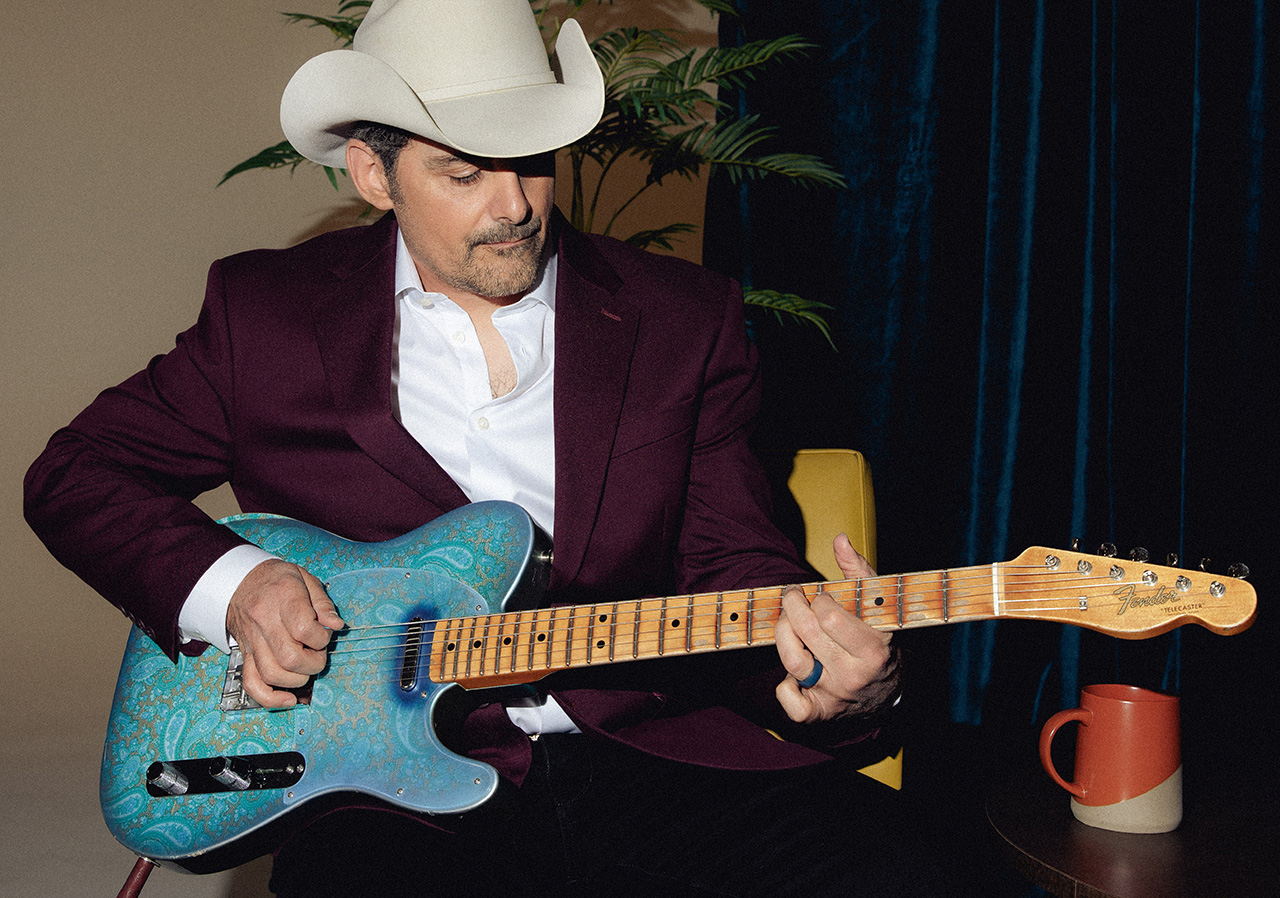

Fender’s response to the hippy era was its ‘Blue Flower’ and ‘Paisley’ models. These were stock Telecasters with patterned paper covering the front and back of their alder bodies. The Blue Flower got metallic blue sides and the Paisley metallic pink, which lipped over the edges for a ’burst effect.
Clear gloss was applied, along with clear pickguards for the patterns to show through. Made between 1967 and ’69, the Blue Flower version is the rarest.
Thinlines
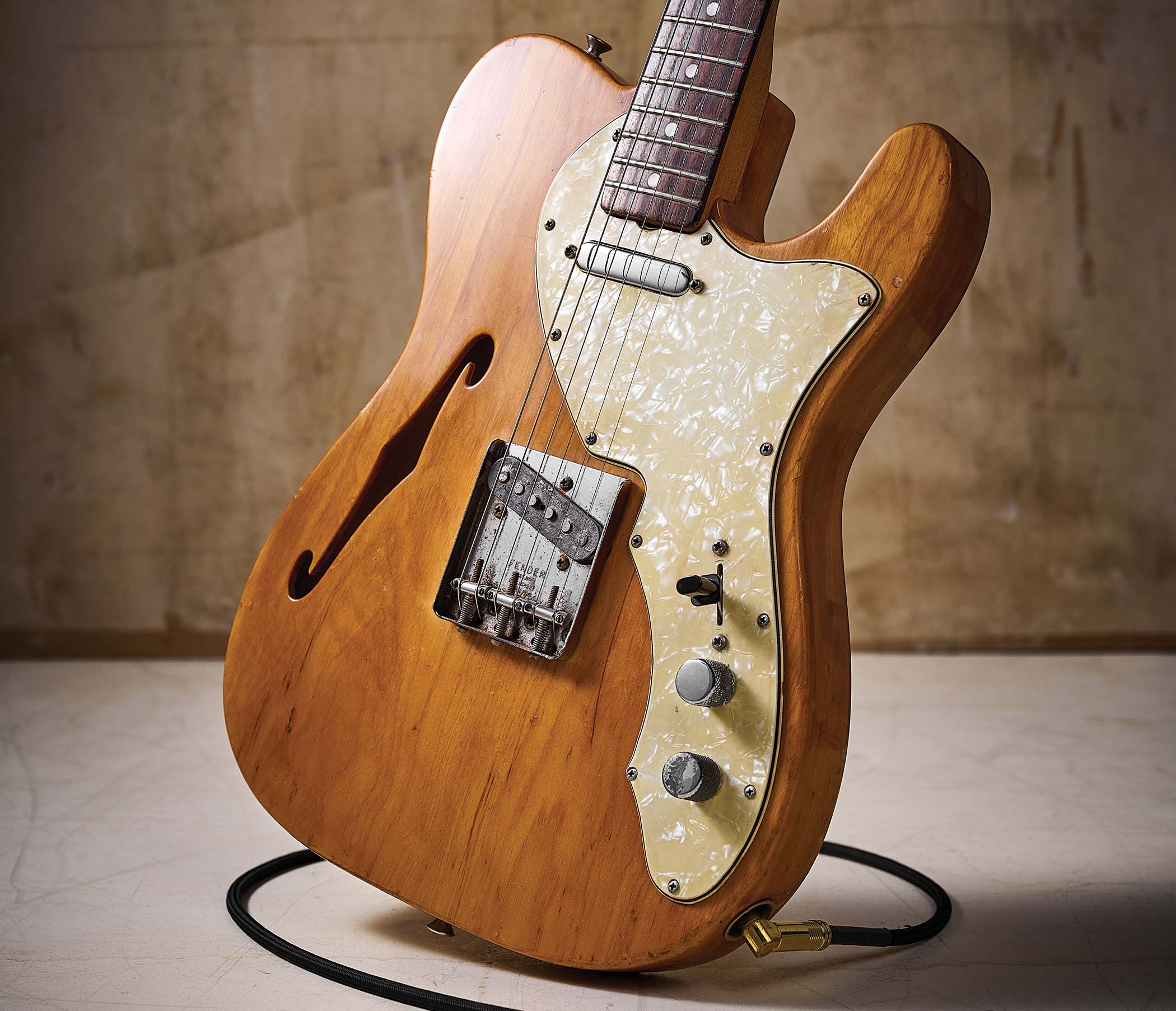
Roger Rossmeisl and Phil Kubicki worked on special projects for Fender and devised a semi-hollow bodied Telecaster to use up heavier ash and mahogany blanks. The Telecaster Thinline appeared in 1968, with a specially designed pickguard, slanted controls, and a single f-hole.
Unlike George Harrison’s solid rosewood Tele, the production versions of these were constructed much like Thinlines, with a rosewood sandwich body and a thin maple filling.
Wide Rangers
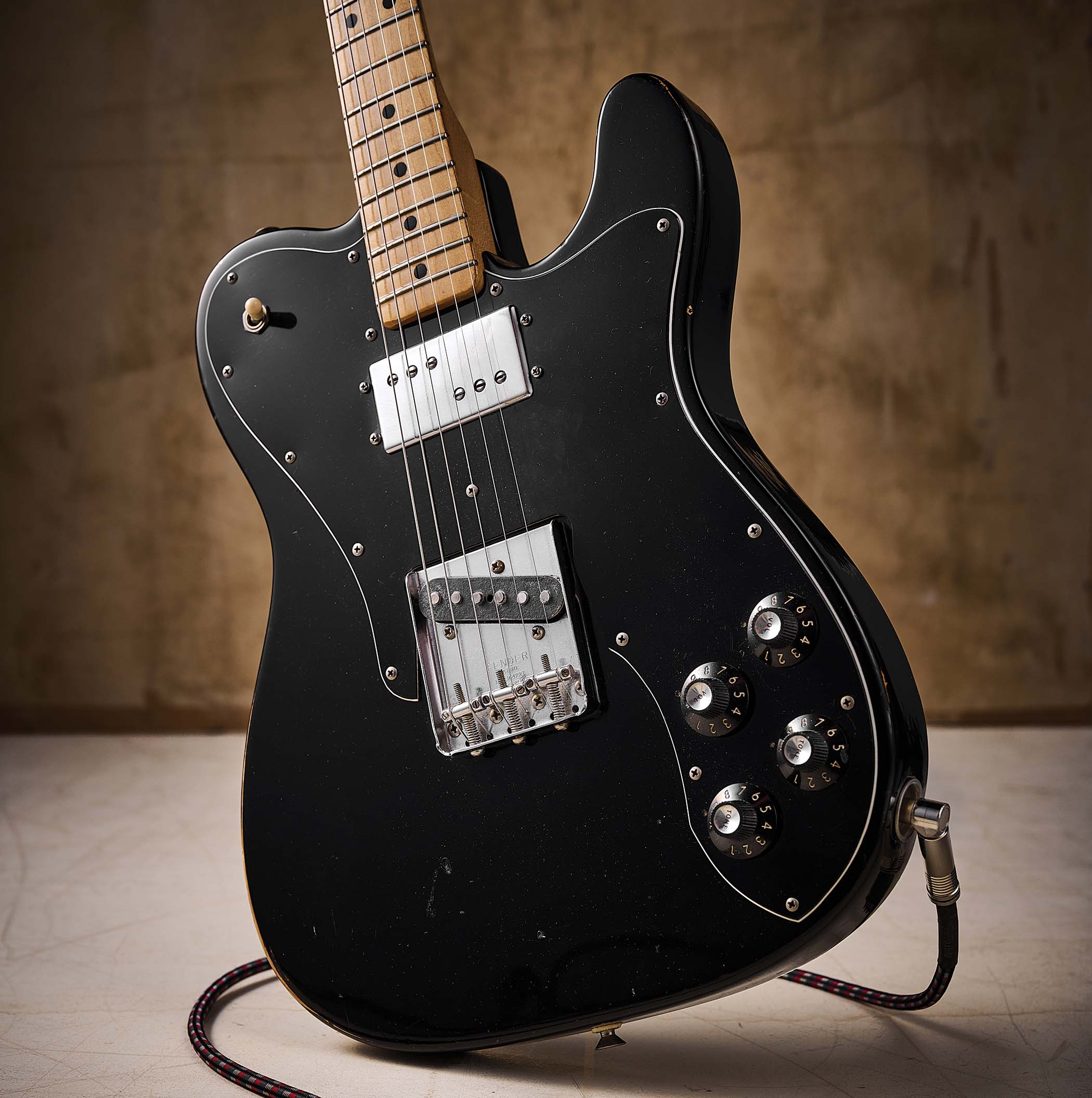

CBS commissioned Seth Lover, the man behind Gibson’s iconic Patent Applied For pickup, to design a humbucking pickup. His ‘Wide Range’ humbucker featured CuNiFe magnets with offset pole screws and first appeared in the double-humbucker version of the Thinline Tele in 1971, featuring in the company’s catalog in 1972, its first full year of production.
Also in 1972, Fender acknowledged the popular preference for humbuckers in the neck position and introduced a redesigned Telecaster Custom with a Wide Range humbucker and a traditional bridge pickup.
A Telecaster Deluxe with two humbuckers, a Stratocaster-style headstock, and a hardtail bridge followed in 1973. These were the final Telecaster variants of the vintage era and, since James Oliver owns both, we’ll leave the last word to him.
“I bought my ’74 Tele Deluxe because of Mick Green from The Pirates. I love it because the pickups sound so clear and bright. Mick actually played a Custom, so I got a ’76, but I don’t like the bridge pickup and the instability of the three-screw neck attachment drives me nuts.”
- With thanks to ATB Guitars, James Oliver, and Eddie Tatton
- This article first appeared in Guitarist. Subscribe and save.