Register for this webinar, for free, today.
Artificial intelligence is moving quickly through marketing departments, reshaping how campaigns are built and delivered.
Much of that adoption has focused on efficiency: automating performance media, accelerating production timelines, optimizing distribution. But as generative AI moves deeper into creative processes—writing copy, generating imagery, shaping campaigns—the questions become more fundamental.
What happens to creativity itself when machines learn to create?
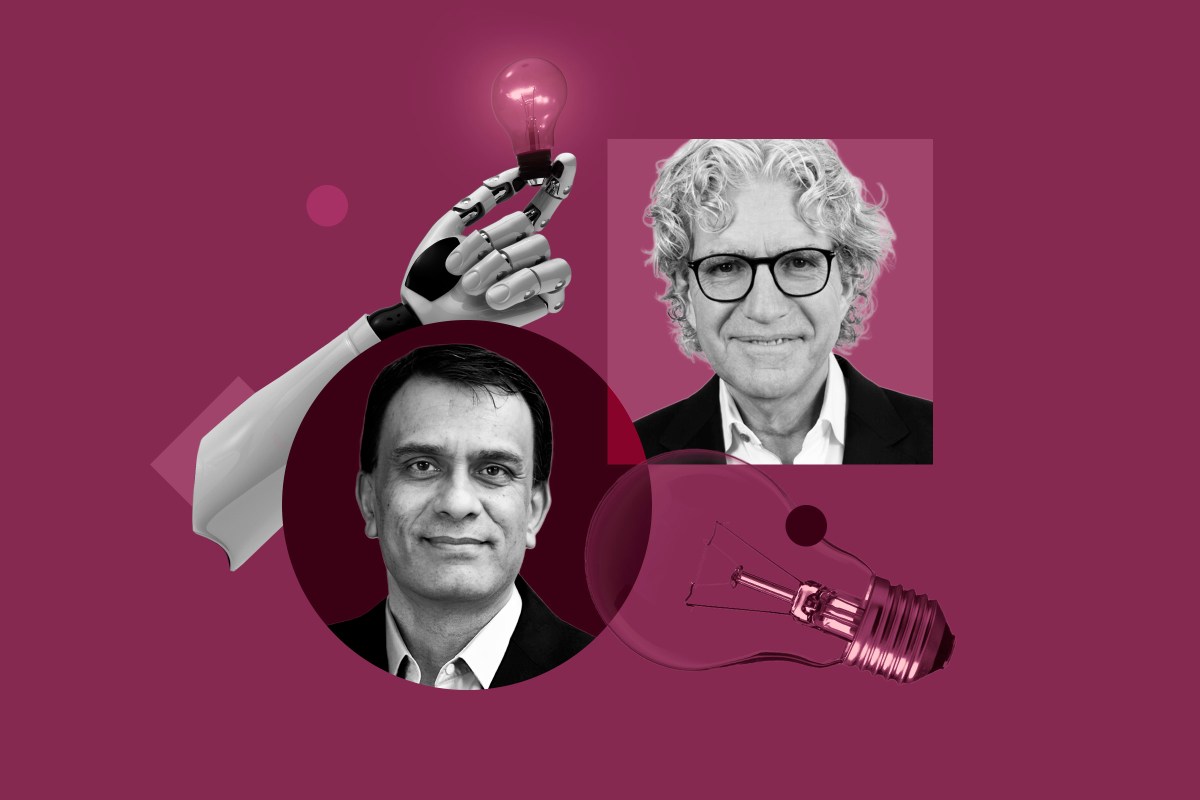
That question frames Newsweek’s upcoming webinar, “AI and the Future of Marketing: Does Creativity’s Definition Change?” scheduled for March 10 at 1:30 p.m. ET, as part of “The AI Agenda” discussion series.

The conversation brings together Suraj Srinivasan, professor at Harvard Business School, and David Sable, vice chairman of Stagwell and one of advertising’s most influential voices, to examine what the rise of generative AI means not just for workflows, but for imagination.
For Srinivasan, the debate begins with a deceptively simple problem.
“First of all, we have to define creative,” he told Newsweek. “What does creativity really mean? And what are we doing when we say we are doing something creative?”
Generative AI can remix styles, merge genres and recombine existing material at extraordinary speed. It can take what already exists and produce variations at scale. But Srinivasan argues that the deeper question is whether replication—even highly sophisticated replication—amounts to originality.
“How far can you get by replicating?” he asked. “AI can do that very well.”
A Harvard Business School case study co-authored by Srinivasan examines Stagwell’s AI strategy and features Sable’s perspective. In it, Sable references two paintings that once hung side by side at the National Gallery of Art: a technically polished academic work typical of its era, and Claude Monet’s Impression, Sunrise—a canvas that helped launch Impressionism. The juxtaposition underscores how breakthrough creativity rarely resembles what came immediately before it.
Sable makes a similar point through what he calls the “Da Vinci factor,” drawing on an experience of seeing The Last Supper in Milan alongside a more conventional fresco painted by Giovanni, the leading local artist of the time. “Imagine there had been AI in those days,” Sable told Newsweek. “What would AI have been trained on? It would have been trained on all of the painting and frescoes that had come up to that time. So I don’t care how you prompt it—the best you could have gotten was that Giovanni. You never would have gotten the da Vinci.”
Whether AI can ever cross that threshold of true creation and invention remains an open question. “There are people who will tell you that AI will get to that level,” Sable said. “Maybe yes, maybe not. I don’t know.”
At the same time, neither Srinivasan nor Sable dismiss the transformative operational power that AI is already exerting on marketing.
Srinivasan points to market research as one example. Traditional persona development can require weeks of interviews and analysis. Now, agencies are experimenting with synthetic personas—AI-generated “living” profiles trained on real-world data that simulate how different audiences might respond to products or campaigns.
“These kinds of synthetic personas are working as well as real personas,” Srinivasan said. “But going to a synthetic persona costs like a thousandth of going to a real persona in terms of cost and time.”
If AI can compress research timelines and dramatically reduce costs, the production function of advertising changes. The issue is less whether AI is useful and more how it reshapes the layers beneath creative work.
“Even in outcomes where there is a lot of creativity, there is a lot of repetitive process,” Srinivasan said. “What can AI do and what [can AI not] do? And if we start using a lot of AI as we are now, what does it do for the way these fields are going to evolve?”
Sable has seen waves of technological disruption across his four decades in advertising. From the rise of digital platforms to increasingly automated media buying, change is constant.
“Since the day I came into the business, all I’ve heard is everything is changing,” he said. “My lesson has always been, just go with the change.”
He also believes this moment carries unusual stakes.
“Right now we have no guardrails,” he said. “This could be the first thing we’ve ever put in place in the history of the world that has zero guardrails.”
The upcoming webinar discussion may yield as many questions as answers.
Is creativity defined by recombination—or by rupture? Can AI do more than replicate what already exists? And as marketing becomes faster and more automated, what happens to the human connection that brands depend on?
As machines learn to generate images, copy and strategy, Srinivasan suggests the implications extend far beyond advertising.
“There is something about what is the marketing function, what is the creative function,” he said. “What is the role of a machine in that?”
Those questions will be central to Newsweek’s upcoming conversation as Srinivasan and Sable explore whether the rise of the creative machine signals a narrowing of imagination—or the beginning of a new chapter in how it is expressed.