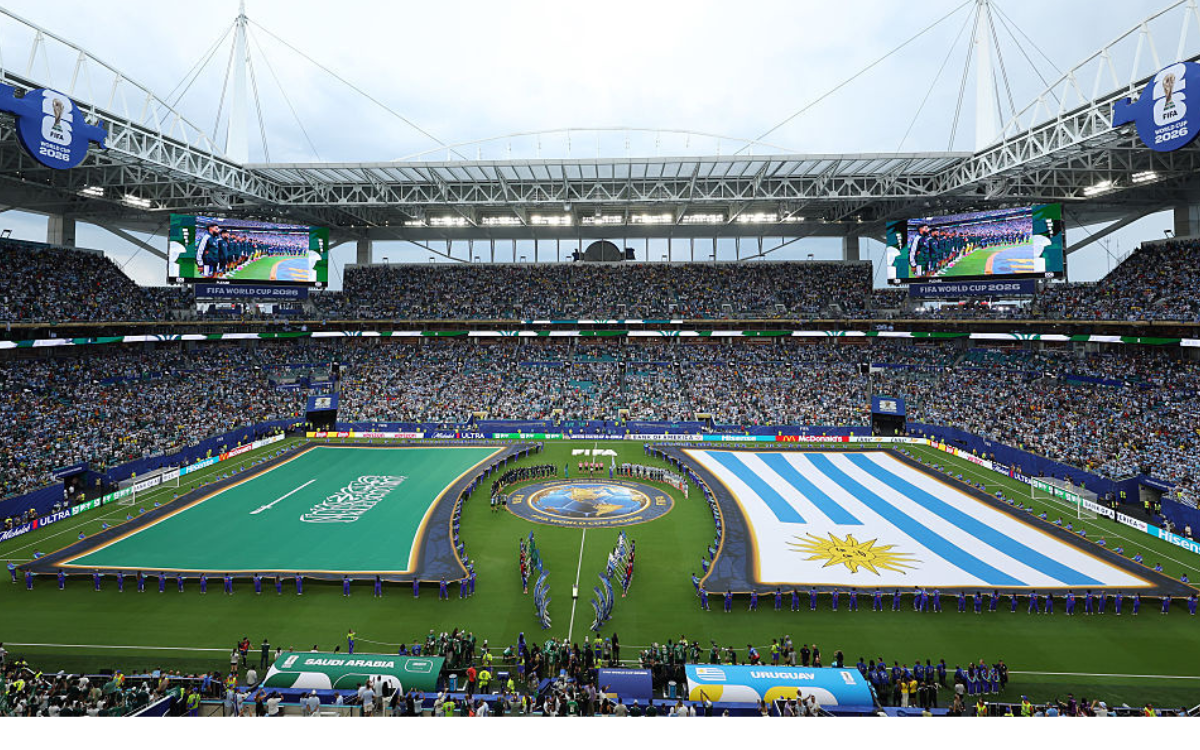
The pre-match ceremony, featuring flags and national anthems, is one of the most recognizable and enduring elements of the FIFA World Cup. It is a powerful visual designed to celebrate identity, unity and global competition, reinforcing the idea that the tournament is a meeting point for nations from around the world—and this time, it’s even bigger.
For the 2026 World Cup, FIFA has redesigned the pre‑match ceremony to place even greater emphasis on national symbolism, with oversized flag banners and all players gathering around the center circle during the national anthems. FIFA says the aim is to create a “unique, immersive experience” that can be enjoyed “from every seat” in the stadium.
In most matches, this involves laying each nation’s flag flat on the pitch, where it briefly becomes part of the spectacle before kick-off. However, viewers have noticed that one country does not follow this same protocol: Saudi Arabia.
Why Saudi Arabia Is Different
Unlike every other participating nation, Saudi Arabia’s flag is never placed on the ground during World Cup ceremonies. Instead, it is always held above the pitch by volunteers.
The reason lies in the flag’s unique religious significance. The Saudi flag features the Shahada—an Islamic declaration of faith—making it more than just a national emblem. Because of its sacred nature, strict rules govern how it can be displayed. It must not be lowered in a way that could be seen as disrespectful, and it is prohibited from touching the ground or any surface below.
This creates a clear conflict with FIFA’s standard presentation format, which typically involves spreading flags across the pitch like giant banners.
How FIFA and Saudi Arabia Found a Solution
Rather than abandoning the visual spectacle entirely, organizers have adapted the ceremony to respect these cultural requirements.
When Saudi Arabia is involved, its flag is kept elevated throughout the pre-match ritual, carried by a group of volunteers so that it never touches the grass. To ensure visual fairness and avoid singling out one team, the opposing nation’s flag is often treated the same way during those matches—also held aloft rather than laid on the pitch.
This compromise allows FIFA to maintain the overall look and feel of its pre-match ceremony while respecting the cultural and religious sensitivities tied to Saudi Arabia’s national symbol.
Why the Detail Has Sparked Attention
The difference is subtle, but in a tournament built on uniformity and symbolism, it stood out and was immediately noticed by fans online during the build-up to Saudi Arabia’s opening game against Uruguay.
Rather than criticize the Arab nation, many of those posting about the difference on platforms like X sought to educate followers on the reasons behind it, explaining the significance of the words written on the Saudi Arabian flag—the foundational declaration of faith in Islam, known as the Kalimah Tayyibah.
US-Arab Relations
The decision to respect Saudi Arabia’s flag protocol during a U.S.‑hosted World Cup can be viewed as a positive signal in U.S.‑Arab relations, highlighting a willingness to prioritize cultural understanding on a global stage.
By accommodating an Arab nation’s religious sensitivities within one of the tournament’s most visible moments, FIFA has helped reinforce an image of inclusivity that extends beyond politics and into shared international spaces. On a small scale, it helps counter longstanding perceptions of cultural disconnect, instead showcasing cooperation and mutual respect in front of a worldwide audience.
In diplomatic terms, it also reflects how soft power—from sport to symbolism—can play a role in strengthening ties, demonstrating that even small, highly visible acts of recognition can contribute to improving trust and rapport between the United States and the Arab world.