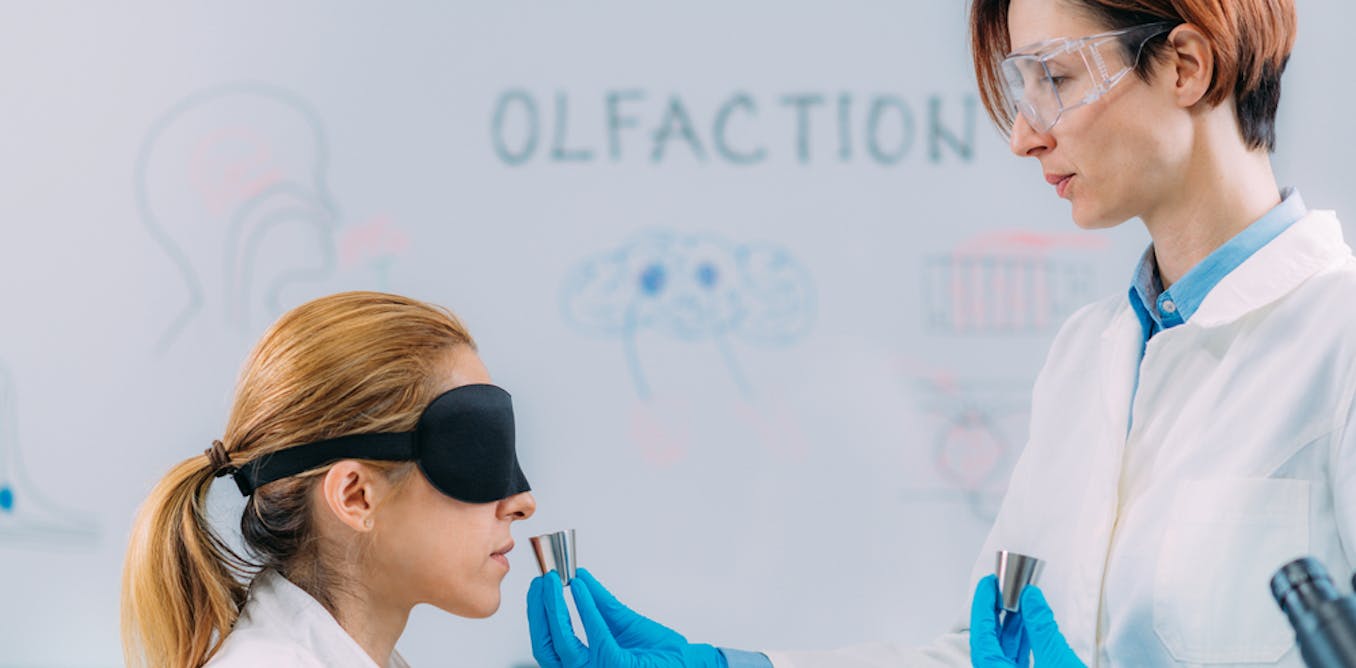
Humans spend a great deal of time trying to smell good. We wash, deodorise and perfume our bodies daily, suggesting body odour must matter. Yet scientifically, the picture is far less straightforward.
In the animal world, smell is a powerful communication tool. Many species use scent to signal readiness to mate, mark territory or warn of danger. Female moths, for example, release chemical cues that attract males over long distances in predictable ways.
Humans also produce body odour through sweat and sebaceous glands. In addition, apocrine sweat glands are concentrated in areas such as the armpits, genitals and around the nipples. These glands release oily secretions that skin bacteria break down into the characteristic smells associated with body odour.
Read more:
The biology of body odour, from sweat glands to skin bacteria
Biologically, the human body is certainly equipped to produce odours that others can detect. Whether these odours carry information in the same way as scent signals do in other species remains uncertain.
Modern hygiene complicates the picture. In many societies, frequent washing and fragranced products mask natural odours. This makes it difficult to study how scent might operate in everyday human interaction under less controlled conditions.
Love stinks? Attraction, pheromones and genes
Smell is often assumed to play a major role in attraction. People frequently report liking a partner’s scent, and some studies suggest partners can recognise each other’s body odour. But the direction of the effect is difficult to untangle. Smell may help shape attraction, but emotional attachment and familiarity may also make a partner’s scent seem more pleasant.
The idea that smell shapes romantic attraction remains popular. Early studies suggested people might prefer the scent of partners with different immune system genes, potentially increasing the chances of healthier offspring.
Results, however, are mixed. Some studies support this pattern, others do not. There is currently no clear evidence that humans reliably use smell to select genetically compatible partners.

Claims about human pheromones are even harder to support. In animals, pheromones are usually understood as specific chemical signals that trigger reliable responses in other members of the same species. In humans, no equivalent system has been clearly demonstrated.
Researchers have examined individual components of human body odour that have been proposed as possible human pheromones. A few molecules, such as androstadienone and estratetraenol, have been studied as possible chemosignals. A chemosignal is a chemical cue that may carry information and influence perception, mood or behaviour. Some studies have reported small effects on mood, attention or social perception, but findings are inconsistent and difficult to interpret. These compounds have not been shown to work as human pheromones in the strong biological sense.
Most scientists agree that clear, animal-style pheromone communication has not been demonstrated in humans.
There are also anatomical differences. Unlike many mammals that rely heavily on pheromone communication, humans do not appear to have a clearly functional vomeronasal organ, a sensory structure that detects pheromones in many animals, or an accessory olfactory bulb, the brain region that processes those signals. These play central roles in scent communication in species such as mice.
Read more:
There’s no evidence human pheromones exist – no matter what you find for sale online
So while humans clearly produce and detect body odour, evidence for a precise biological signalling system is limited.
Cultural learning also shapes odour perception. Babies show relatively few strong preferences early in life, but over time people learn what is pleasant or unpleasant through experience and social norms. Foods considered delicious in one culture can seem intolerable in another.
Beyond attraction, smell may have a more basic function: helping us decide whether to approach or avoid things. We use it to judge food, environments and other people, often as a rapid safety check.
We quickly adapt to familiar scents and stop noticing them. New or unexpected smells, particularly unpleasant ones, capture attention because they may indicate risk.
Can we smell emotions or illness?
Growing evidence suggests body odour carries information about physical and emotional states.
Emotional experiences can alter the chemistry of sweat. In experiments where participants watched films designed to evoke fear or happiness, researchers collected sweat samples from their armpits. When others later smelled these samples, their facial muscles responded in ways consistent with those emotions, suggesting a form of low-level communication with little conscious awareness.
Body odour also changes during illness. In laboratory studies where participants’ immune systems were temporarily activated using compounds that trigger an immune response, their scent shifted within hours. Smellers described these samples as slightly more sweaty or less pleasant, despite the differences being subtle.
This suggests the human nose may detect some early signs of illness before obvious symptoms appear, although this does not mean people can reliably diagnose illness by smell in everyday life.
Historical accounts hint at this connection. Before germ theory, illness was often associated with “bad air” under what became known as the miasma theory. The explanation was wrong, but it reflected a real observation that illness and infection are often associated with distinctive odours.
Today, trained dogs can detect certain cancers and infections through scent. But humans may also pick up some sickness-related cues. In a study I was involved in, volunteers whose immune systems had been temporarily activated produced sweat that others rated as more intense, unpleasant and unhealthy.
Exposure to unpleasant odours may even prime the immune system. In one study, people exposed to strongly disgusting smells showed increased inflammatory responses in saliva, suggesting the body prepares for potential infection when encountering cues linked to disease.
The same biological richness that makes smell difficult to study also makes it promising, but challenging, in medicine.
Interest is growing in scent as a diagnostic tool. Illness alters the chemical composition of breath, sweat and skin oils, and researchers are working to identify the molecules responsible.
If reliable patterns can be established, electronic “noses” could detect disease early through non-invasive testing. This approach is already being explored for several cancers.
The difficulty is that body odour contains hundreds of molecules, and isolating meaningful signals is hard. Still, the potential is substantial. A simple device capable of detecting disease through scent could transform screening and diagnosis.
Smell helps us navigate risk, detect possible illness, recognise familiarity and interpret our surroundings, often without conscious awareness. That is powerful, but it is not the same as a proven human pheromone system.
Future research may reveal more about this overlooked sense. Scientists are exploring technologies that can capture and reproduce smells digitally, potentially allowing odours to be transmitted remotely, alongside medical applications such as scent-based diagnostics.
For a sense that rarely demands attention, smell exerts a constant influence on how we respond to the world and to each other.
Strange Health is hosted by Katie Edwards and Dan Baumgardt. The executive producer is Gemma Ware, with video and sound editing for this episode by Anouk Millet. Artwork by Alice Mason.
In this episode, Dan and Katie talk about a social media clip via YouTube from Alexandrasgirly.
Listen to Strange Health via any of the apps listed above, download it directly via our RSS feed or find out how else to listen here. A transcript is available via the Apple Podcasts or Spotify apps.