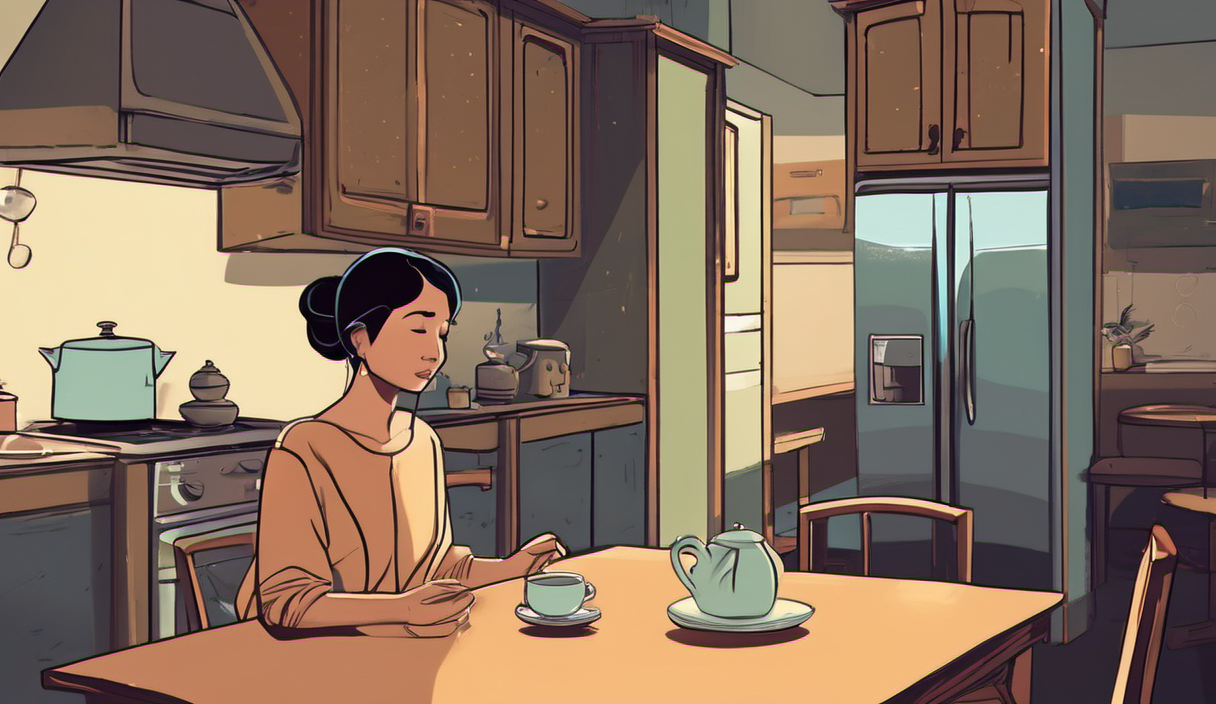
Vojo shares a personal journey of emotional misreading. For years, she monitored others’ moods to anticipate reactions, often interpreting silence or hesitation as personal failure.
What Happened: A Night of Misreading
One evening, her partner texted: ‘Can’t talk tonight’—no period. Vojo noticed the absence of punctuation and immediately began analyzing it.
She typed ‘Is everything okay?’ and deleted it. Then ‘No worries!’—and erased that too. The exclamation point felt false.
For three hours, she moved through the house, washing a clean mug, opening and closing a jar of olives. She checked if he was online. Each action became evidence in a story about her own failure.
By midnight, she sent: ‘Did I do something?’ The next morning, her partner replied: he had a headache, went to bed at nine, and hadn’t thought about her at all.
Relief came first. Then embarrassment. Underneath was a quieter truth: she had lost an entire evening to a feeling that wasn’t hers, and a story no one had told her.
Roots in Childhood
Vojo traces this behavior back to childhood. As a kid, she learned to predict moods from small sounds—keys at the door, a cupboard closing, a clipped answer.
She didn’t learn this from anyone. She figured it out on her own. The sensitivity became a survival tool. But in adulthood, it stopped protecting her and started running her.
She adjusted her tone when someone shifted in a chair. She softened opinions before objections. The more she watched others, the harder it became to feel her own emotions.
How the Pattern Hurt Relationships
When her partner came home after a bad day unrelated to her, she kept asking, ‘What’s wrong?’ in softer and softer voices.
Eventually, he ended up comforting her about his own day. She wanted closeness. But her monitoring blocked real connection.
She was in a relationship with her predictions—not with the person in the kitchen.
What Changed: Small, Practical Shifts
The first shift was naming feelings instead of assuming others’ states.
- Instead of ‘He’s ignoring me,’ she tried ‘I feel anxious.’
- She gave herself ten minutes before sending any text—no scrolling, no rereading.
- She asked clean questions: ‘You seemed quiet earlier. Is something on your mind?’
These small steps helped her feel more grounded. The anxiety in her chest stayed real. The story about rejection didn’t demand action.
One day, her closest friend left a flat tone voice message: ‘I’ll call you when I have a minute.’
Vojo did the ten-minute pause. She mentally rehearsed apologies. At eleven minutes, she called. The first sentence was: ‘Are you upset with me?’
She wasn’t. Her mother had been admitted to the hospital. She’d been on the phone with doctors since six.
Vojo realized then: she had turned her friend’s worst week into a referendum on her.
She said it aloud: ‘Sorry, ignore me. Tell me about your mom.’
It wasn’t graceful. But it was a different ending than the one she used to get.
Why This Matters
Vojo’s story shows how emotional sensitivity can become a trap. It turns ordinary pauses into personal judgments.
When we assume others’ actions reflect our worth, we lose the ability to feel our own emotions and build real connection.
True empathy isn’t about reading others’ moods. It’s about recognizing one’s own internal state without assigning blame.
As Don Miguel Ruiz wrote: ‘Don’t take anything personally. Nothing others do is because of you.’
This insight is vital for emotional health. It helps people stop projecting their fears onto others and begin listening to themselves.
For those who feel anxious in silence, or interpret pauses as rejection—this reflection offers a path forward.
It’s not about becoming emotionally detached. It’s about learning to feel without needing to prove one’s worth to others.
Vojo continues to work on this. She still notices moods fast. She still catches a smile that doesn’t quite reach. But now, she pauses before assuming.
She has learned to ask for support—not proof.
Support sounds like: ‘I’m having a tough day. Can we talk when you have a minute?’
Proof sounds like: ‘Tell me we’re okay right now.’
Nothing anyone says to the second one lasts. The calm it buys is gone by the next delayed reply.
She still struggles. But the shift—from blaming others to feeling oneself—is real. And it’s a step toward emotional freedom.
For more on personal growth and emotional awareness, explore Vojo’s work at Tiny Buddha. For free birth chart tools, visit astrologylo.com.
Sources & further reading
AI-generated illustration.
-

-

-

-