When Randall Restiano left Gramercy Tavern as beverage director to open a place of his own last year, his first instinct was to look somewhere in Manhattan. Then he ran the numbers. “The expense, return on investment, and volume of investors needed to make it a reality did not make sense,” he says. “I thought, Maybe it’s time to do something new.”
Restiano took a space in the Westchester suburb of Bronxville with chef John Poiarkoff, another Union Square Hospitality Group alum, to open La Chitarra, a pasta bar and wine studio. “When I was deciding to do this, it was an emotional battle,” Restiano says. “I thought, Am I ready to give up the city? What does that mean for me?”
The promise of lower blood pressure and lower costs was a tonic more powerful than his ego. “The amount of money you need to run a restaurant in Brooklyn or Manhattan at this point is so crazy. If you fail, the loss is massive,” he says. “Here we were able to do a major renovation, we have a 100-bottle wine list, and we can use the ingredients we want and serve them at a decent price point because our overhead is not as bad.”
Big cities are great places for a chef to step into the spotlight and garner press and accolades. But they’re also places of high burnout, mounting costs, and staggering rents. Which is why a lot more big city chefs—from New York, Chicago, and Philadelphia and beyond—are opting to jump ship and swim in a smaller pond, many moving back home where they can turn the volume down on the chaos. The return has become such a phenomenon, it’s even got its own slang, “boomerangs,” a term coined by food writer Adam Reiner in Bloomberg on the changing face of Buffalo’s dining scene.

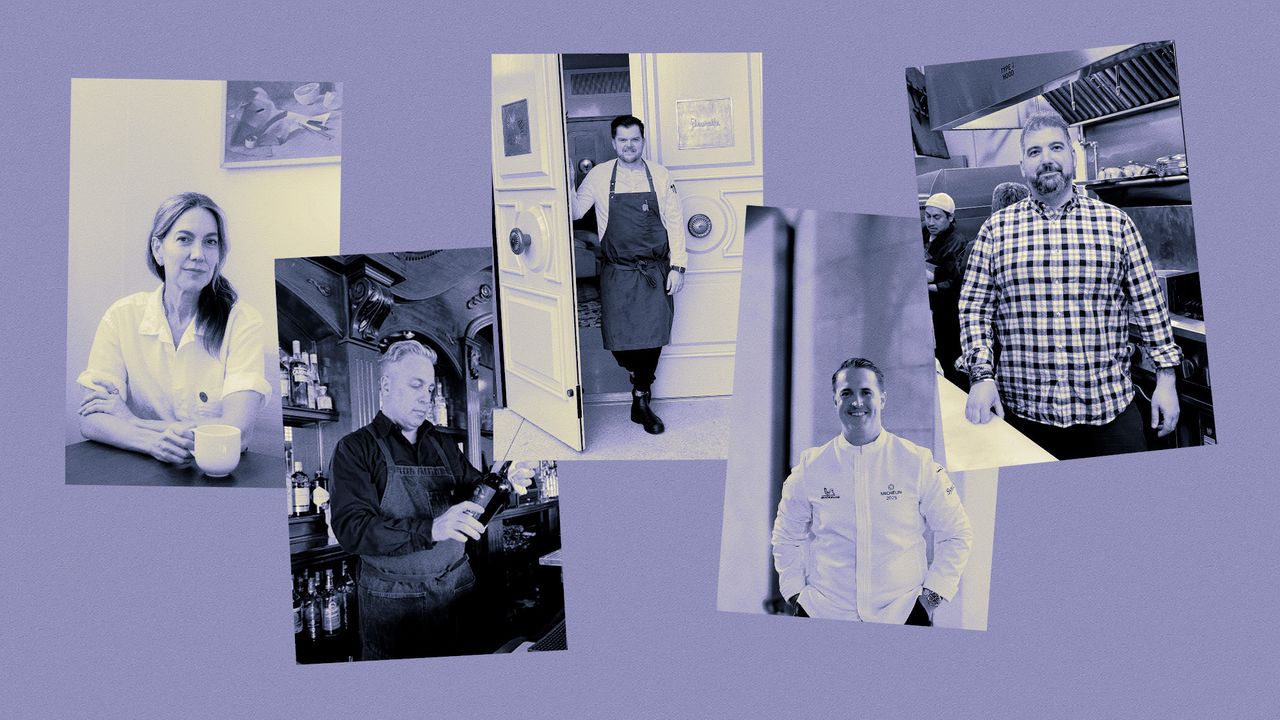
Chef Joe Cash cooked at Per Se, Noma, and The Pool before returning to his hometown of Greenville, South Carolina, to open the Michelin-starred Scoundrel in 2022.
“I think that people are getting real about all the hard work this business takes,” says chef Joe Cash, who cooked at Per Se, Noma, and The Pool before returning to his hometown of Greenville, South Carolina, to open the Michelin-starred Scoundrel in 2022. In the spring, he will open Dootsie’s, an Italian restaurant named for his grandmother. “There is no profit and so much blood sweat and tears, and people are reaching a breaking point. Gavin [Kaysen, who left NYC in 2014 to open Spoon and Stable in Minneapolis] had wisdom. He understood the future was not in Manhattan.”
The Money Pit
Less stress and more reward (and the birth of her third child) led Tía Pol’s Mani Dawes to return home to New Orleans, where she opened Cafe Malou late last year. “There is no way to do an independent mom-and-pop restaurant like we did at Tía,” she says. “The math does not work.”

The restaurateur Mani Dawes left New York City to move home to New Orleans, where she opened Cafe Malou in 2025.
The headaches opening outside New York City are considerably less, and goes beyond more generous margins. “New York City is outright hostile to businesses,” says Harris Mayer, the chef behind Creamline in Chelsea, who recently opened hyper-local Italian restaurant Cornerstone in Pawling, New York. “We reached out to apply for a Certificate of Occupancy, and our health inspector offered to take a look at our drawings to make sure we had everything before we started building,” he says. “That would never happen in New York. They would rather have you build first and fine you after. They make it impossible with insane regulations, taxes, and laws.”
Time for Creativity
Chef Lane Regan ran Michelin-starred Elizabeth, a fine dining restaurant in Chicago, before moving to Michigan’s Upper Peninsula in 2019 to open The Milkweed Inn, to return to what they loved most—being in the kitchen, nature, foraging, and cooking.
“I grew up in a rural area and always knew I wanted to return to that way of living,” they say. “After experimenting with expansion and seeing firsthand that ‘bigger’ wasn’t the answer for me, I realized I needed to distill my work down to its most essential parts. Milkweed became that answer: a much smaller, more intentional operation rooted in land, seasonality, and time.”
Milkweed hosts just 12 guests a weekend, with one or two staff members, which gives Regan time to focus on the back end of the business and on their writing. “Building a food system from land outward; foraging, fermenting, preserving; and hosting guests inside that system are the dream for many chefs, but one they rarely see realized,” they say.
Family First
Balancing work and family is always challenging for working parents, but a chef-owner lifestyle can make it nearly impossible when simultaneously battling the barrage of pressures commonplace to big city dining. In October 2025, Jon Nodler and Samantha Kincaid, the husband-and-wife team of acclaimed Philadelphia restaurant Cadence, relocated to New Glarus, Wisconsin, a small town about 40 minutes from Madison to open Canter Inn.
copy.jpg)
Jon Nodler and Samantha Kincaid, the husband-and-wife team of acclaimed Philadelphia restaurant Cadence, relocated to New Glarus, Wisconsin to open Canter Inn last year.
The restaurant offers an approachable menu of dishes like sweet-and-sour pork short ribs, hot-honey-glazed chicken, and even a kids menu, something Nodler never considered at Cadence. The move home was motivated by both personal and professional reasons, a trail of breadcrumbs they’ve observed others in the industry following as well. “COVID made us realize that it was a crucial time to be near our families in the Midwest,” Nodler says. “We had to make a choice, and ultimately landed on moving back with the goal of making time for family in a familiar landscape in the Madison area.”
For Joe Cash, who has two young children, being home allows for space and peace of mind. “Greenville is giving me a family life,” Cash says. “I love having a backyard and space. I don’t have to fight for a train to get home. I can be home in 10 minutes.”
The lure of his own beachside childhood led Travis Swikard back to San Diego from Manhattan, where he was Daniel Boulud’s culinary director. “We had a couple of kids; my family was there and that was a big part of it,” he says. “I wanted my kids to have the life I had growing up under the sun.”

Chef Cruz Goler cooked for luminaries like Jean-Georges Vongerichten and Mark Ladner before moving home to Rhode Island where he will open Prudence.
Cruz Goler, who worked for nearly every great chef in New York City, from Jean-Georges Vongerichten to Mark Ladner, followed the same path: got married, planned to start a family, and boomeranged back home to Bristol, Rhode Island. “Being a dad in New York would have been impossible,” he says. “I have a two-year-old. I have a new respect for chef-owners who are new dads.”
Trade-Offs
There’s less red tape in Tiny Town, USA, but also a lot less room for the kind of tweezer-forward food Cash was doing at Noma and The Pool. “The original concept was more high-end and cheffy,” he says. “I would dream up dishes on a big whiteboard, but I wasn’t sure if folks down here would buy it.” Cash revised the menu, turning more toward a bistro format, with relatively simpler plates: a beef tartare, a Caesar salad, steak frites, and dry-aged duck.
Staffing can also be a hurdle. Nodler says that a lack of density means challenges that bigger cities don’t have. “We have fewer potential diners and a smaller skilled labor pool,” he says. Swikard opened his second restaurant, Fleurette in La Jolla, in December. “I knew the talent level was going to be different so I decided to hire anyone with a good attitude and train them.” He has found mentoring rewarding. “The first employee I ever hired was a dishwasher and he is now my chef de cuisine.”

The lure of his beachside childhood led chef Travis Swikard back to San Diego from Manhattan, where he was Daniel Boulud’s culinary director.
Used to being tightly wound in high-pressure kitchens, many chefs ultimately feel a huge weight lifted when they decide to do business in a small town. “I built up a hard shell and I had just become a hard-ass,” Swikard says. “I had to learn to shed some skin when I first moved home.”
Goler says the community is one of the most rewarding parts of moving back home. Locals buoy new restaurants in unique and meaningful ways. “Everyone is really excited about it. A local coppersmith made the check presenters for me, a boat maker is helping me fabricate an old ferry boat for the interior. That’s harder to find in New York City, that community.”
For smaller markets, new restaurants are not just another flash in the pan. “In NYC, you get your five minutes of fame, then it’s onto the next,” says La Chitarra’s chef Poiarkoff. “It’s not like that here.”