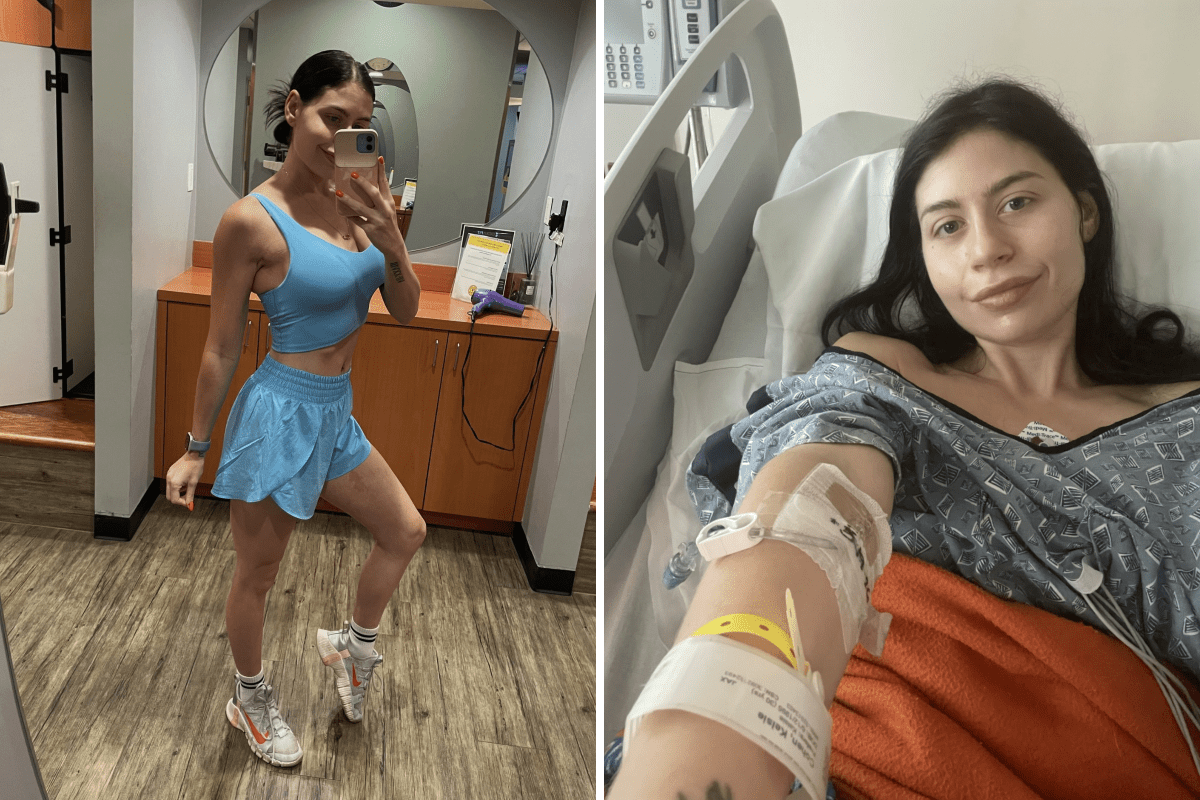
A bodybuilder who noticed her hands and feet were going numb during workouts thought she was just low on electrolytes, but after her condition continued to deteriorate, an MRI scan changed everything.
Kelsie Cohen, 31, has always lived an active lifestyle. From being a bodybuilder, a personal trainer and a single mom to a toddler, her routine was non-stop. Cohen, from Long Island, New York, told Newsweek that she was “incredibly regimented” and she did not allow anything to get in the way of her goals.
“Each day was about training clients, getting my own lifts in, getting my steps in, meal prep, all while making sure my son was happy and healthy. Looking back, I think I was putting more stress on my body than I realized,” Cohen said.
As her routine was so habitual, Cohen found it easy to explain the numerous symptoms she started to experience in early May 2026. It started with noticeable loss of strength during workouts, but Cohen brushed that off as a normal part of her bodybuilding preparation as she was getting lower calories and doing more cardio.
Before long, Cohen also started to notice weakness and cramping on the left side of her body.
“The symptoms came on fast and furiously. The most distressing were episodes of numbness in my left hand and foot, which only lasted about a week before I ended up in the hospital,” Cohen continued.
“Honestly, the symptoms were easy to explain. It’s common to feel exhausted when you’re dieting and doing a lot of cardio, and on top of that I was raising my toddler. The numbness episodes were more concerning, but I convinced myself I had an electrolyte imbalance.”
The episodes gradually became more frequent and severe, to the point where Cohen could no longer ignore them. The symptoms would occur multiple times a day, causing her to feel unsafe when driving. She would lose sensation on the left side of her body whenever she stood up, and if she did not have anything to hold onto, she often fell over.
Cohen initially went to urgent care about the numbness in her hands and feet. They warned her that it could be serious and told her to go straight to the emergency room.
At this point, she still believed it was just an electrolyte imbalance that required IV fluids at most.
“It never crossed my mind that there could be something wrong with my brain. When you’re young, healthy, and training like an athlete, you feel invincible,” Cohen said.
Doctors at the hospital did bloodwork and requested a CT scan, if only to rule out anything neurological. When the results came back an hour later, Cohen was pleased to hear that her bloodwork and electrolytes were fine, unfortunately, the CT scan revealed something far more shocking. It uncovered a mass on the right side of Cohen’s brain which was initially believed to be cancer.
Cohen was transferred to a larger hospital for further assessment. Within hours, she went from thinking she just needed electrolytes, to thinking she had brain cancer.
An MRI scan showed numerous lesions on the brain, shifting the diagnosis from cancer to a demyelinating disease. This led to an MRI of Cohen’s spine, revealing even more lesions and a diagnosis of multiple sclerosis (MS) in late May.
Cohen said: “When the doctors told me, they were relieved because it wasn’t cancer, and they expected me to feel relieved too. Instead, I was devastated. They were telling me I had an incurable disease that caused significant pain and took me away from the things I loved most.”
In the hospital, Cohen’s condition deteriorated rapidly. She experienced severe dizziness and frequent leg spasms. Medication was eventually prescribed and Cohen saw noticeable improvement.
She still experiences flare ups but is gradually learning how to manage her MS and the triggers. She is also taking Kesimpta, a disease-modifying injection designed to slow the progression of MS.
Physically, Cohen can do everything she could before, but she has modified her workouts to respect her body’s needs.
Cohen told Newsweek: “Before my diagnosis, I pushed my body no matter what. Now I understand that some days my body is ready to train, and some days it needs rest. I take a much more nervous system-friendly approach, which means less volume, fewer drop sets and more rest between.
“I’ve experienced how quickly I can go from being completely independent and healthy to needing help with the simplest things. The most difficult part is the anxiety. There’s always a small part of me wondering if today is the day my body will betray me again,” she continued.
In the past, Cohen used social media (@kelsie.fit.model on TikTok) to share her fitness regime, but now she uses it to raise awareness for MS. Following her diagnosis, she hopes to show just how capable a person with MS is and inspire others to listen to their body.
“I want people to know that listening to your body isn’t weakness,” she said. “I used to believe that pushing through everything made me stronger. If your body is giving you every clue that something isn’t right, don’t ignore it.
“I’m incredibly grateful for how far I’ve come in such a short amount of time. My hope is that by sharing my story, someone else will feel less alone, trust themselves to seek medical attention when something doesn’t feel right, or realize that life after an MS diagnosis isn’t over.”
Is there a health issue that’s worrying you? Let us know via health@newsweek.com. We can ask experts for advice, and your story could be featured on Newsweek.