The sell-off hit Wagyu’s XMR1 token, separate from Monero and Hyperliquid’s XMR futures market.
What Happened
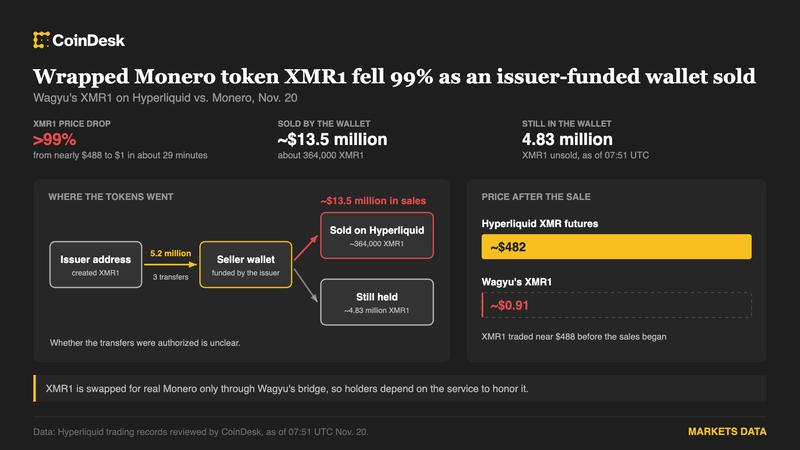
The sell-off began when a single transaction sold $13.5 million worth of XMR1 tokens through an issuer-linked wallet.
That transaction was routed through a wallet tied directly to Wagyu, the company that launched the token.
Key Facts
- The token is called XMR1 and is a wrapped version of Monero, not a native cryptocurrency.
- The sale occurred via a wallet linked to Wagyu, the token’s issuer.
- The transaction volume was $13.5 million, one of the largest single sales in the token’s history.
The sell-off did not affect Monero’s native price or Hyperliquid’s XMR futures market, which remains separate.
Background: How XMR1 Works
XMR1 is a token built on blockchain platforms to represent Monero, allowing it to be used in DeFi protocols and exchanges.
It is not Monero itself, but a tokenized version that enables interoperability with other systems.
Wagyu, a decentralized finance (DeFi) platform, launched XMR1 to allow users to access Monero through tokenized assets.
Users can stake, trade, or use XMR1 in liquidity pools, but the token does not represent direct ownership of Monero.
Why It Matters
The event highlights risks in tokenized assets, especially when issuers control the primary wallet.
It raises concerns about market manipulation and the potential for large, unannounced sales to trigger cascading price drops.
Regulators and investors may now scrutinize how token issuers manage access to their own wallets.
Limitations and Open Questions
There is no public record of prior sales or price history that would show a pattern before this event.
It is unclear whether the sale was part of a planned strategy or an unexpected move.
Wagyu has not issued a public statement explaining the transaction or its implications.
Market data shows no broader market collapse, suggesting the issue was isolated to the XMR1 token.
Experts note that such events are rare but not unprecedented in DeFi token ecosystems.
What to Watch Next
Investors should monitor future transactions from issuer-linked wallets.
Regulatory bodies may begin reviewing token issuance practices that grant issuers direct control over wallet access.
DeFi platforms may revise their governance models to prevent similar events in the future.
The incident underscores the need for transparency in token sales and wallet access protocols.
For more on DeFi token dynamics, see the original report.
Sources & further reading
Featured image: original publisher image. Via original publisher. Image source