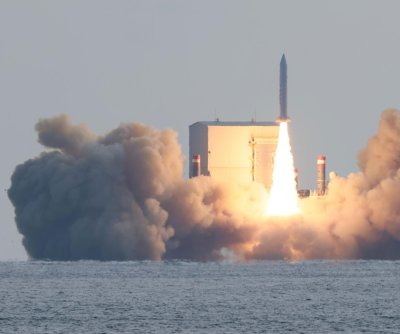
South Korea postponed the launch of a solid-fuel space rocket due to safety concerns, the Defense Ministry said Tuesday. This December 2023 photo shows the third launch of a solid-fuel rocket from a barge floating in waters off Jeju Island. File Photo by Yonhap/EPA
South Korea on Tuesday postponed a plan to launch a solid-fuel space rocket due to safety reasons, the defense ministry said, pushing back what would have been the first launch of a fully assembled four-stage vehicle.
The Mir space rocket was scheduled to lift off at 2 p.m. from a sea barge off the southern coast of Jeju Island, but the launch plan will be rescheduled.
“The planned launch of the solid-fuel space rocket has been canceled out of safety concerns as a set of issues was detected during final launch preparations,” the ministry said in a message to media.
“The rescheduled launch plan will be announced at a later date,” it said.
If launched, it would have marked the rocket’s first test launch in a fully assembled four-stage vehicle, after a series of trials conducted in 2022 and 2023 that each evaluated partial three-stage configurations.
The last launch took place in December 2023.
South Korea has been developing the solid-propellant space launch vehicle since 2021 to place small observation and surveillance satellites into a sub-500 kilometer low-Earth orbit.
The program aims to boost the country’s independent spy satellite capabilities to better monitor North Korean threats.
Solid-fuel rockets are simpler in structure than liquid-fuel counterparts and can be stored for years, enabling rapid responses when a launch is required.
The solid-fuel space vehicle program has run in parallel with the military’s spy satellite launch initiative that has successfully put five reconnaissance satellites into orbit atop SpaceX‘s Falcon 9 rockets as of November last year.
Under the Mir program, South Korea plans to domestically deploy up to 60 small spy satellites into space by 2030 to complement its cluster of five larger military spy satellites.
It would help create a tighter surveillance network to watch adversary targets and reduce its reliance on U.S. satellite intelligence.
Copyright (c) Yonhap News Agency prohibits its content from being redistributed or reprinted without consent, and forbids the content from being learned and used by artificial intelligence systems.