
KEY TAKEAWAYS
-
Last May, the Trump administration launched a website designed to track down and arrest undocumented migrants across the United States.
-
Playing on the ambiguity of the term ‘aliens’, the online platform portrays Washington’s anti-immigration policy as a system combining science-fiction entertainment with large-scale surveillance.
-
A linguistic analysis of this website highlights a digital process of dehumanising undocumented migrants, who are portrayed as hidden threats that need to be flushed out and deported.
Launched on May 29 2026, the White House webpage Aliens.gov appears to belong to the world of science fiction. Its visual universe evokes secrecy, extraterrestrial life, government files, hidden truths, and UFO mythology.
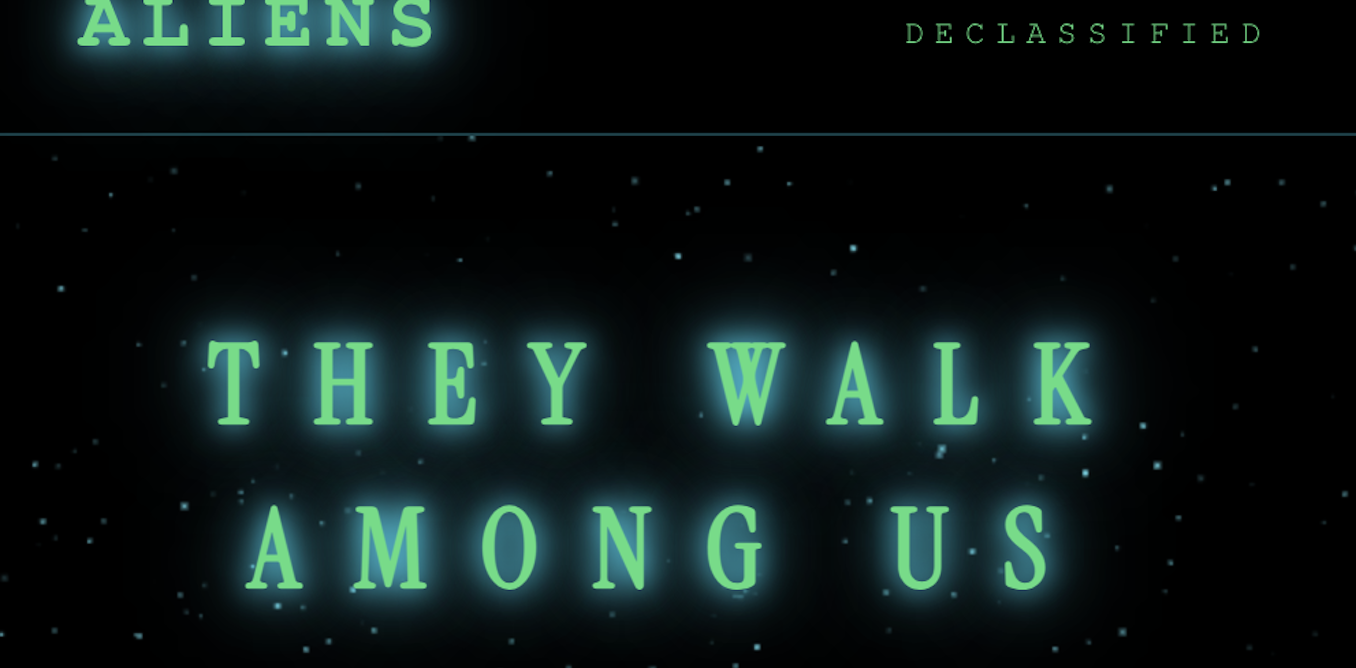
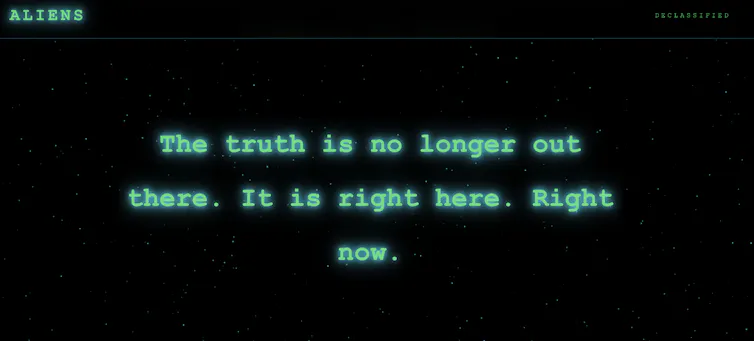
The page uses dark colours, luminous green lettering, references to “declassified” information, and the dramatic sentence “They walk among us”. The reader is invited to scroll through what looks like a playful, conspiratorial, X-Files-style interface.
Then comes the twist: the object of the page is not declassified information about the existence of extraterrestrial life. The aliens in question are migrants described as “illegals”.
This shift is the page’s central rhetorical mechanism. It plays on the double meaning of alien: a legal term for a non-citizen, and a popular term for a being from another planet. By activating the second meaning before redirecting it toward migrants without regular status, the page turns a legal category into a scene of strangeness, secrecy and threat.
From non-citizen to non-human
Before the page makes any explicit argument, one word has already shaped the meaning.
Call someone an “undocumented migrant” and the reader may think of law, paperwork, or border policy. Call the same person an “alien”, surround the word with UFO imagery, and a different picture appears: not a person with a story, but a strange and dangerous presence to be detected.
That is where the dehumanising work begins. The page does not need to state that undocumented migrants are less than human. It weakens their personhood by making them appear first as a category of threat rather than as people with names, voices, families, motives or histories.
Nick Haslam’s work on dehumanisation helps explain this mechanism. Dehumanisation can deny people full human recognition by representing them as animal-like, machine-like, object-like, or as lacking the qualities associated with ordinary human personhood. On Aliens.gov, undocumented migrants appear through precisely this kind of reduction as aliens, arrests, map points, suspicious presences, and objects of return.
The result is both anti-immigration rhetoric and multimodal dehumanisation. Words, colour, visual genre, mapping, pronouns and institutional links all work together to produce the same figure: the undocumented migrant as an alien presence inside national space. The question is no longer only “What legal status does this person have?” It becomes “How do we find them?”
Not just a joke: when policy speaks in pop-cultural form
The humour of the page is part of its political efficiency.
In an NBC10 Philadelphia In Depth with Lena Tillett segment on Aliens.gov, political and media historian Brian Rosenwald notes that Trump’s supporters are likely to read this style as “tongue-in-cheek” humour: provocative, amusing, and deliberately irritating to critics. In that reading, the joke does more than entertain supporters. It also shapes opponents as humourless or excessive – people “going crazy” because they supposedly cannot take a joke.
Humour gives the message a protective layer. If critics object to the page’s dehumanising imagery, the response is already available: they missed the joke. Political disagreement is recast as emotional overreaction.
But the opposition to the page is not only a matter of taste. NBC10 Philadelphia reported that immigration advocates in Philadelphia condemned the site, with the Pennsylvania Immigration Coalition describing it as “an embarrassment” and “taxpayer-funded Internet trolling”. The same report notes concern over the site’s tip-line logic, which advocates read as encouraging neighbours to turn on neighbours.
This is where the joke becomes strategy.
The page condenses a wider official grammar already present in Trump’s immigration discourse: invasion, emergency, protection, criminality, removal and national restoration.
Executive orders signed in January 2025 describe undocumented migration as a “large-scale invasion”, an “unprecedented flood of illegal aliens”, and a “grave threat” to the nation. The border is shaped as a place of emergency, territorial defence, and military support. Another order, titled “Protecting the American People Against Invasion,” links immigration enforcement to national security, public safety and the economic well-being of Americans.
The Aliens page translates this official grammar into another language.
The executive orders provide the doctrine. The webpage provides the spectacle.
What appears in executive language as emergency, sovereignty, and enforcement reappears on the page as a viral form of political entertainment. This is policy discourse redesigned for a digital attention economy.
That is why the shareability of the page matters. Virality is not separate from ideology, as it is one of the ways ideology travels. The page borrows the entertainment value of UFO culture, then attaches it to arrests, reporting, and deportation. It becomes an official interface of deportability.
‘They walk among us’
“They walk among us” is the sentence that turns the page from a joke into a warning.
Its force comes from the word “among”, via which the border disappears. The imagined threat is no longer arriving from outside, but it is already inside the everyday spaces of national life.
It may be in the street, at work, next door, in the crowd, as the sentence describes an unsettling intimacy.
It also creates, in four words, a political community. There is a “they” and there is an “us”. The “us” is never defined, because it does not need to be. It is the presumed national public: innocent, addressed, endangered, and entitled to protection. The “they” are physically present, but symbolically expelled. They are close enough to be feared, but never close enough to belong.
This is the classic grammar of “othering”. As Teun van Dijk argues in his work on ideology and discourse, political language often organises the world by enhancing the virtues of “us” and the dangers of “them.” Ruth Wodak’s work on the politics of fear shows how this opposition becomes especially powerful when a group is turned into a scapegoat for social anxiety. The White House page performs that operation with unusual visual efficiency, as it both names an out-group and teaches the in-group to search for it and inform about it.
The quiet violence of “it”
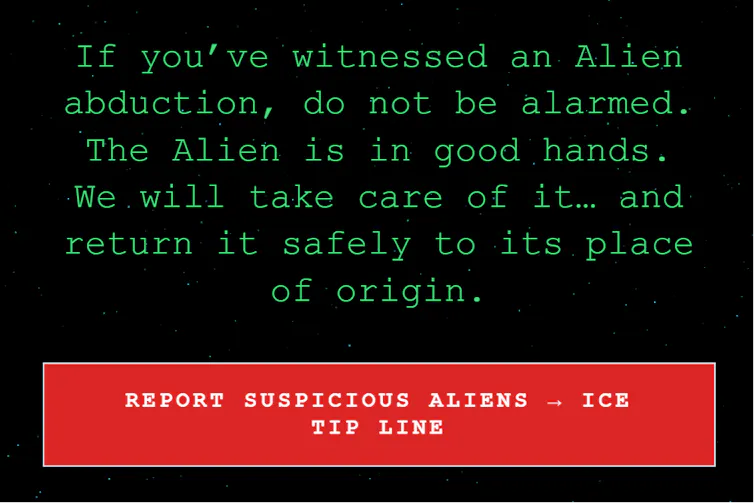
One of the page’s most revealing sentences reads: “The Alien is in good hands. We will take care of it… and return it safely to its place of origin.”
The sentence sounds almost gentle. “In good hands.” “Take care.” “Safely.” These are words denoting protection.
But the grammar tells another story. The Alien is “it”. In English, “it” is used for objects, abstractions, animals in some contexts, and non-human beings. On a page already designed around extraterrestrial imagery, the pronoun extends then fiction into grammar. The person is not he, she or they. The person becomes “it”.
The phrase “return it safely to its place of origin” replaces biography with origin. There is no home, no family, no fear, no legal claim, no community, no history. There is simply an origin to which the object can be returned.
This is not the loud violence of insult. It is the quieter violence of administrative objectification. Removal is made to sound like care. Deportation is phrased as safe handling. The state appears calm, almost benevolent, while the person is grammatically reduced.
The map and the making of a neighbourhood watch
whitehouse.gov/aliens
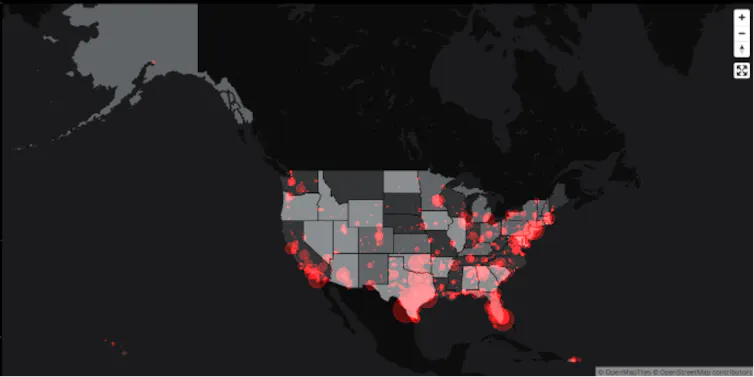
The Alien Arrest Map is one of the page’s most consequential features.
Maps carry a quiet authority. They seem factual, almost self-explanatory. In this case, the map does not show migration routes, labour patterns, asylum claims, family separation, court backlogs or community life. It shows arrests. The undocumented migrant enters the visual field through the moment of enforcement.
Therefore, a person becomes a point. A life becomes a location. A legal situation becomes a trace on a dashboard.
whitehouse.gov/aliens
The page then goes further by linking to an ICE tip line where users can report “suspicious aliens”. This changes the reader’s role. The visitor is no longer simply receiving a government message. The visitor is invited to become an informer.
whitehouse.gov/aliens
The word “suspicious” is elastic. Most people cannot know someone’s immigration status by looking at them. Suspicion can attach itself to accent, language, skin colour, workplace, neighbourhood, clothing, movement, or simply to the perception of foreignness. A page like this risks making suspicion feel like civic participation.
This is the most serious political effect of the interface. It turns the public gaze into part of the enforcement apparatus as it builds the perceptual world in which deportation feels obvious. It makes an old vocabulary of exclusion feel contemporary, clickable and official. Once a human being has been redesigned as an alien presence, removal can be made to look less like a political choice and more like common sense.
From illegality to invasion
The page’s final movement is from “alien” to “invader”. It declares that these “Aliens” are “illegals” who “invaded” the country.
Once undocumented migration is described as invasion, the political imagination changes.
One can debate policy toward undocumented migrants: due process, border administration, asylum, labour, regularisation, detention, deportation, family unity, local economies. But invasion belongs to another register. Invasions are not managed; they are repelled. This is how fear becomes policy logic. The page does not only construct “Aliens” as a danger to “every American family, every community, and the future of our nation”. It also turns Trump into the figure who recognised the threat first: “President Trump was the first to call out the real danger Aliens pose.” The result is a familiar rescue narrative: a hidden danger, a vulnerable people, a leader who dares to name it, and removal presented as protection.
The page compresses a whole politics into a short sequence. First, undocumented migrants are made strange through the figure of the alien. Then they are brought close through “they walk among us.” Then they are visualised with the help of a map. Then they are made reportable through the ICE link.
Finally, they are named as invaders and assigned the remedy:
“Deport them all.”
