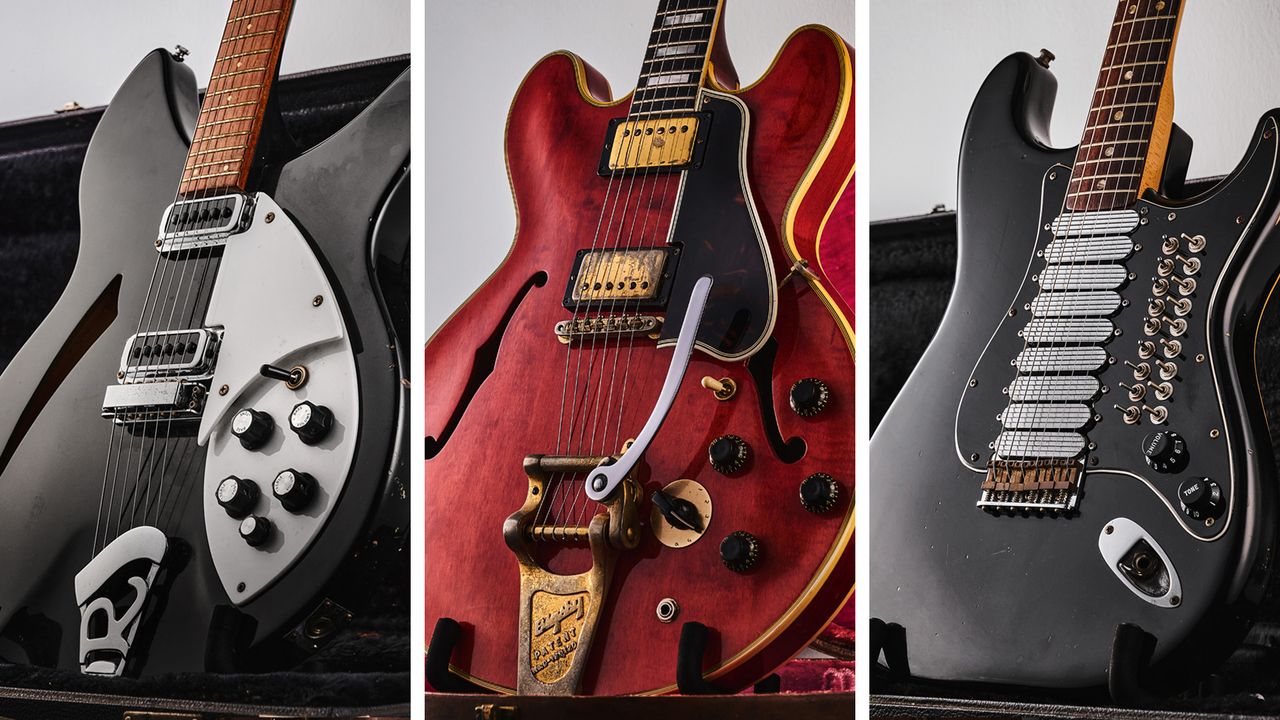

The sale of a great player’s guitar collection is sometimes lamented by fans, however, it’s something we are seeing more often as celebrated musicians reflect on the road travelled and the road yet to come.
As a player always ready to embrace the future, Marr is clearly no servant to his own backstory. But why is he choosing to sell some of the most important guitars, amps and even the gold and platinum discs that he’s picked up over the years?
“He found the process of writing and publishing the book Marr’s Guitars in 2023 quite a cathartic experience,” says Amelia Walker, Christie’s Head of Private and Iconic Collections, who is overseeing the sale.
“In the process of writing the book about the guitars, he was getting them all out, holding them… finding the muscle memory of all these amazing songs that he’d written on them – particularly some of the earliest guitars – and then going out after the book was published and speaking about them…
“And then when that whole tour wrapped up, and it was time to put them away, the impression I got was that he didn’t want them just to get put away in cases again.
“With his [signature] Jag, he’s basically created an instrument that does everything he needs – so he doesn’t see as many opportunities to use a lot of these instruments in the future.
“And yet he wants them to be played, he wants them to find new owners and I think he really loves the idea of people coming up to him in years to come and saying, ‘I’ve just written a song on your D-28’, or ‘I’ve just played your Rickenbacker on stage,’ or whatever it might be. Or even if it’s not someone who performs, just ‘I love your guitar,’” Amelia says.
Johnny Marr, Noel Gallagher and the stories behind Marr’s Guitars | Christie’s – YouTube

“The final lot count is 111,” she continues. “There are about 90 guitars and we’ve got about 10 gold records… actually gold, silver and platinum. Mainly Smiths, but also one for Electronic’s [eponymous debut] 1991 album and a recording he made with Bryan Ferry, which are all being sold for charity.
“And then there’s a collection of concert posters and promo posters, which again are all being sold for charity. There are about 10 amps as well – no pedals – and I think most of them are amps that he’s had for his whole career.”
It’s an impressive collection even when viewed simply as vintage instruments – but when you consider the music made with them, it adds real depth to Marr’s decision to let them go, and pass the proceeds of around 20 lots on to his chosen charities (The Guide Dogs for the Blind Association and the National Autistic Society).
Before they go under the hammer, we took the opportunity to take a close look at the most important (and distinctive) of his guitars, with Amelia as our guide.
Johnny Marr – It’s Time (Official Video) – YouTube
1963 Epiphone Casino

“Compositionally, a lot of his songs start on acoustics, but How Soon Is Now was written on the Casino, over what sounds like the most prolific songwriting weekend of all time, when he wrote William, It Was Really Nothing and Please, Please, Please Let Me Get What I Want and then How Soon Is Now as the third, just to top it off [laughs]. The fact he wrote the song on the Casino and then also used it to record that riff makes it very, very special.
“He used the Casino at Glastonbury in 1984 which, by all accounts, was the moment that the festival kind of shed its hippie roots and went into pop because [The Smiths] were in the pop sphere by that year.
“Then everyone rushed the stage and there were these guys trying to climb up the sheet metal in front of the stage, while he’s playing that guitar. Casinos have such a strong association with the music that he loved from the ’60s that he was listening to. So yeah, it’s a really cool thing, and everyone loves that song.”
1959 Gibson ES-355

“So this guitar is probably the one guitar – other than the Rickenbacker – that is most associated with the Smiths. I think it was probably the third guitar he owned in that band: he had a Gretsch [Atkins Super Axe], the Rickenbacker and then this.
“He got it because the Smiths went to New York between Christmas and New Year in 1983, and they were due to play their first show and to sign to Sire Records with Seymour Stein – they were already signed to Rough Trade in the UK but they were going to do their US deal [with Sire]. Johnny had heard about Sire doing a similar deal with Brian Jones, so he cheekily said, ‘We’ll sign to Sire if you buy me a guitar.’
“So they played their show on New Year’s Eve at Danceteria, and then on 2 January, Johnny marched Seymour to 48th Street and bought this guitar, which is a thing of beauty. He got back to the hotel and I think before even sitting down he wrote Heaven Knows I’m Miserable Now.
“Johnny talks about songs ‘falling out of him’ and sort of just coming to him, as well as guitars giving him songs – and it seems that this guitar inspired him to do that. He then used it to record a lot of the Smiths’ second album [Meat Is Murder] and it’s seen on stage throughout 1984 and 1985.”
Johnny Marr in conversation about the Gibson ES 355 (part 1) – Manchester – 6 November 2023 – YouTube

“He made a few modifications to it. It was, obviously, originally a stereo [output] guitar but he didn’t want it to be stereo so he switched it to mono. And then I think at some point in the late ’80s, Bill Puplett replaced the wiring harness but unfortunately we can’t date that because everything’s shielded and it’s really hard to see.
“But we still have the original [wiring harness] that he took out and from that we can tell the original pots must have been taken out before he bought the guitar as the harness that was in there dates to ’83 – all the pots are ’83. But it’s still got these lovely [original] Patent Applied For pickups.
“The Varitone must have been switched out as well because that dates from a bit later than 1959. The guitar’s factory order number dates it to late ’59, but then it was shipped on 2 February 1960. So it’s a bit of a hybrid, crossing over ’59 and ’60.”
1992/93 Rickenbacker 330

“When you think Johnny Marr, really you think Rickenbacker. This particular guitar also appears on the front cover of Supersonic by Oasis – just lying on the floor. That says a lot about Johnny’s generosity in lending instruments to other musicians and further underlines that he wants his guitars to be played. He wants them to give songs to other people.
“The Rickenbacker is [the sound of] This Charming Man and so many other songs. It’s his jangly sound and I think it was a deliberate choice at the time – he wanted his playing to go in a certain direction and that’s what the Rickenbacker did for him. His melodic arpeggio playing and picking out the individual strings of the chord, rather than just strumming, is so intertwined with the Rickenbacker.

“He got it in ‘83 and he used it to record the single This Charming Man, which was tracked along with a Telecaster that belonged to producer John Porter. I think Johnny only had two guitars at the time [this and the Gretsch Super Axe], and John thought he needed another one on that track.
“He then used it on most of the Smiths’ first record as well. I think a lot of that record was written on the Gretsch because he didn’t have the Rickenbacker at the time, but the recording itself is a lot of Rickenbacker with the Tele added in. It’s really so connected with the Smiths emerging and their whole story.”
Custom Roger Giffin T-Style

“That guitar was custom-made by Roger Giffin. I think having played John Porter’s Tele, Johnny really wanted one. So Alan Rogan, who worked with The Who, Keith Richards and George Harrison, put [Marr’s then girlfriend, now wife] Angie in touch with Roger Giffin and she bought the guitar for him.
“It’s heavy – it weighs around the same as Tiger [Jerry Garcia’s custom electric built with exotic woods by Doug Irwin], around 10lbs. But the Roger Giffin guitar is iconic because of its unique look, and so many fans will remember it as the guitar he played on Top Of The Pops with the Smiths.
“Johnny switched out the neck humbucker after a while because originally it had a Mighty Mite zebra-coil pickup fitted. But now it’s got a different humbucker with these very distinctive hexagonal pole pieces – a Bare Knuckle ‘Juggernaut’. We don’t know when that mod was done but again the work was completed by Bill Puplett.
1963 Lake Placid Blue Fender Stratocaster

“That was a John Entwistle guitar, so that came from him, via Alan Rogan. There were about seven or eight guitars that came from John, who seemed to have the most amazing, huge collection of guitars… there’s a fantastic photograph taken around 1977 of him in his living room, literally surrounded by guitars – and we managed to spot one of Johnny’s in the photo, which is pretty cool [a Gretsch 6120].
He used it on Strangeways Here We Come, for the solo in Paint a Vulgar Picture – which is notable because it’s his first proper solo on a Smiths record
“It’s actually composite – it’s got a ’65 neck, and the body is ’63, which is why he would have wanted it. He used it on Strangeways Here We Come, for the solo in Paint a Vulgar Picture – which is notable because it’s his first proper solo on a Smiths record.
“We don’t know what neck it had on it originally, but at some point in the late 1980s he took the neck off his sunburst Strat – which had this really beautiful bird’s-eye maple neck, and is really distinct because it has particular wear on the first and third fret, and switched it onto this Lake Placid Blue guitar.
“In late 1989 he was photographed with it for the cover of the January 1990 issue of Guitar Player magazine, with the maple neck. I don’t know when he put this [current] 1965 rosewood neck on it – we’re still verifying that.”
1977 Gretsch Atkins Super Axe

“This was Johnny’s only guitar for I don’t know exactly how long. It’s pre-Morrissey, pre-Smiths and I think – until he got the Rickenbacker– it was the only guitar he had. I think it was some sort of part-exchange when he sold his [prior] Les Paul. And it’s interesting that he chose this model.
“I don’t know if it was literally what was available in the shop, or if he was on the lookout for a Gretsch… but he was clearly looking to move away from the Les Paul when he swapped it for this. He wrote the whole of the first album on this, and recorded Hand In Glove on it.”
1984 Gibson Les Paul Standard

“He got this new in 1984. Again, I’m not sure of the exact date, but it was probably around September. When he bought it, it didn’t have a Bigsby – he put that on himself in about the summer of ’85, because we have photos of him with the Les Paul without a Bigsby on in December ’84 and March ’85. But then by the time the Smiths were on Top Of The Pops in October ’85, it had the Bigsby on. He’s said that if the building was on fire, this would be the guitar he’d grab.
“Because I think he’s done more on that guitar than any other in terms of consistent use throughout his career, even up until his current record that’s about to come out [The Age Of Everything], there are parts on that record that have been played with this particular Les Paul.”

“It’s got Seymour Duncans in now and I think they were double blacks originally, but they always had covers on them during his time in The Smiths, and then at some point they got swapped out again by Bill Puplett.
“We’re still investigating when the Seymour Duncans were fitted but, again, I think it would have been late ’80s, because he used the Les Paul in the music video for The The’s track Dogs Of Lust and you can very clearly see there’s a zebra in both positions – and that was in 1993.”
1978 9-Pickup Modified Fender Stratocaster

“We initially had no idea who created this, but we had another look at the instrument when we took some of the guitars to New York for an exhibition in late June. And we found a label indicating who [had carried out the major modifications]. It seems as though the idea was the concept of one brother, Stephen Liddard, with the work itself done by a Richard Liddard in 1991.
“So that would have been just before Johnny bought it from Music Ground in Doncaster. He bought it on a trip there with Noel Gallagher, just a day or two after they first met… Noel remembers Johnny saying, ‘Let’s go for a sandwich. Never buy guitars on an empty stomach.’
“But anyway he bought the 9-pickup Strat and, much later on, it was used in the video for his solo record Spirit Power And Soul. It’s amazing, just about the maddest thing you’ll ever see, and it was the concept of the Liddard brothers in, I presume, somewhere near Doncaster.”
1963 Gibson J-160E

“I think [he acquired this guitar] at the same time he bought the Casino when he was very Beatles-focused, and wanted that Beatles sensibility in his playing. This was around the time The Smiths moved to London just after they released their first record, and that was when he met Alan Rogan. This was when he started to have a bit of money to buy guitars and when his guitar-purchasing really sort of started taking off.
“He went from only having two to suddenly having three… five… seven guitars, and wanted them so he could do different things for specific reasons and sounds. He used it, as I mentioned before, when he wrote three of the most epic Smiths songs on a quiet weekend when the band had nothing on – William, It Was Really Nothing and Please Please Please Let Me Get What I Want were both written on that guitar.”
- Marr’s Guitars: The Johnny Marr Collection will go under the hammer on September 17. See Christies for more details.
- This article first appeared in Guitarist. Subscribe and save.