Ellen Goldfarb and Tracy Buttrick share three autumn container designs that use dried plants and seasonal materials to create visual interest without requiring watering. These arrangements honor nature’s rhythms, emphasizing simplicity, sustainability, and minimal maintenance.
Design Principles for Waterless Fall Containers
The core idea is to work with nature’s cycles, not against them. Instead of growing live plants that need daily care, these designs use dried flowers, seedpods, and other mature plant parts.
Each piece responds to its physical setting. A narrow doorway in Ridgewood needed a slim form to avoid blocking traffic. A column-mounted bowl was built to be seen from a large window. A grand entrance in Saddle River required a strong, stable structure to hold visual impact.
Materials are chosen for durability. They stay vibrant and intact through fall months. This approach supports sustainable gardening by cutting water use and reducing upkeep.
First Arrangement: A Narrow Doorway Display
This pot was made for a fall engagement party in Ridgewood, New Jersey. The space was tight due to traffic, so the design is slender and elegant. It balances texture and color with a mix of natural plant elements.
Pampas grass plumes (Cortaderia selloana) add grace and movement. Ellen Goldfarb says they ‘capture the grace of wind-blown grasses in autumn.’ Bittersweet vines offer a flowing, natural element that mimics garden vines at rest.
Pumpkins-on-a-stick (Solanum aethiopicum) bring a playful, seasonal feel. Tracy Buttrick notes they ‘add harvest joy,’ connecting the design to autumn traditions. Balloon plant seedpods (Gomphocarpus physocarpus) provide soft, rounded shapes that contrast with rigid forms.
A small garden mum (Chrysanthemum × morifolium) adds color and structure. Ornamental cabbage and kale (Brassica oleracea cvs.) bring crinkled, leafy textures. These plants offer a range of surfaces—smooth to rough—enhancing the sensory feel.
Ornamental peppers (Capsicum annuum cvs.) add bright reds and oranges. They stand out against cooler tones. Together, the elements form a balanced, organic composition.
Second Arrangement: A Column-Top Display
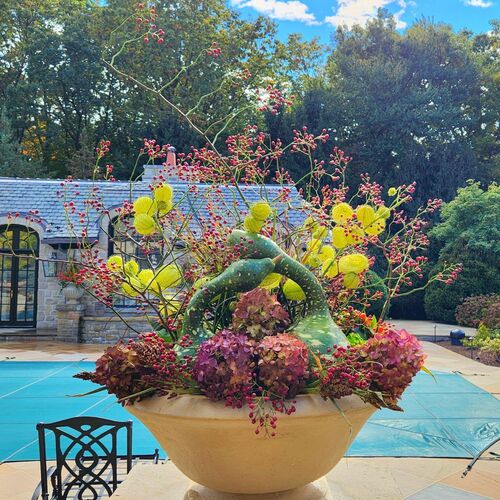
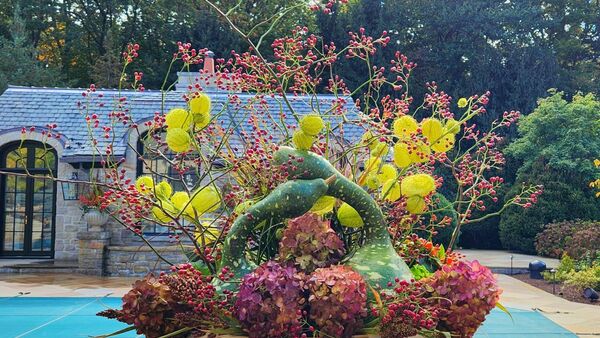
This bowl sits on a column and is visible from a large sitting room window. It uses dried plant parts to create a sculptural, balanced presence.
Bottle gourds (Lagenaria siceraria) have a natural, flowing curve. Ellen Goldfarb says they ‘feel like they belong in a garden,’ adding depth and dimension. When placed on a column, they draw the eye upward.
Wild rose hips (Rosa multiflora) offer texture with a hint of warmth. Tracy Buttrick says they ‘retain a subtle warmth’ that shows the season’s shift from summer to fall.
Balloon plant seedpods add soft, rounded shapes. Panicle hydrangea flowers (Hydrangea paniculata) bring structured elegance with tiered, branching forms. Broom corn (Sorghum bicolor) adds a classic, grounded presence. Ellen says its golden stems ‘balance softer elements’ with strength and timelessness.
Third Arrangement: A Client-Focused, Water-Resistant Design
This pot was made for a client who travels often and can’t water plants. Stability and low maintenance were key. A wooden dowel holds the arrangement upright. Stems are wired to it, making the design sturdy without live plants.
Broom corn gives a strong, upright base. Its dense stems provide structure. Northern sea oats (Chasmanthium latifolium) add soft, grassy texture without weakening the design.
Dried eucalyptus (Eucalyptus cvs.) adds a woody, fragrant element. Tracy says it ‘reminds us of open forests and wild spaces.’ Drumstick flowers (Craspedia globosa) bring bright yellow color, even when dried. Foxtail millet (Setaria italica) adds fine, feathery detail.
Red brunia (Brunia albiflora) offers bold reds that stand out. Panicle hydrangea flowers and seeded eucalyptus stems add structure and depth. This design shows how beauty and function can work together in real life.
Why These Arrangements Matter
These designs offer a sustainable alternative to traditional container gardening. They don’t need daily watering or care. They work well in cities or for busy households.
They stay visually engaging through fall. No seasonal replacement or daily attention is needed. This makes them ideal for people without time or resources to care for live plants.
They highlight natural forms—seedpods, dried stems, gourds—without live growth. These elements are already mature and ready to be displayed. They offer a sense of finality and completion.
Limitations and Considerations
These arrangements work best in fall and early winter. They don’t offer the growth or change that live plants provide. Gardeners who value evolving plant life may find them less engaging over time.
Some materials, like bottle gourds or dried eucalyptus, need protection from extreme weather. Gourds can crack in cold. Eucalyptus stems may lose shape in sun or moisture.
The designs are not for year-round use. They are best as seasonal features that fit into a broader garden plan. When paired with live plants, they bridge the active and passive parts of a garden.
What to Watch For in Future Designs
As lifestyles and climates change, more gardeners may want low-maintenance, waterless solutions. These designs could inspire trends in minimalist, sustainable container gardening.
Future versions might use native plant materials already adapted to local weather. Combining dried elements with live plants could offer both beauty and growth. This hybrid approach would let gardeners enjoy plant evolution while keeping low-maintenance appeal.
Designers may explore new materials or regional species. Using dried native grasses or wildflowers could improve ecological relevance and visual variety.
These arrangements prove that garden beauty doesn’t need daily care. They offer a practical, elegant alternative to traditional container gardening—showing nature’s elegance can be captured without watering or constant attention.
For more inspiration, explore Autumn Arrangements Inspired by Nature on the Fine Gardening website.
Share your own garden photos or plant collections with the Garden Photo of the Day Submission Form.
For a deeper look at resilient garden design, see Planting in a Post-Wild World by Thomas Rainer and Claudia West.
Sources & further reading
Featured image: THUMBNAIL-1×1. Via original publisher. Image source