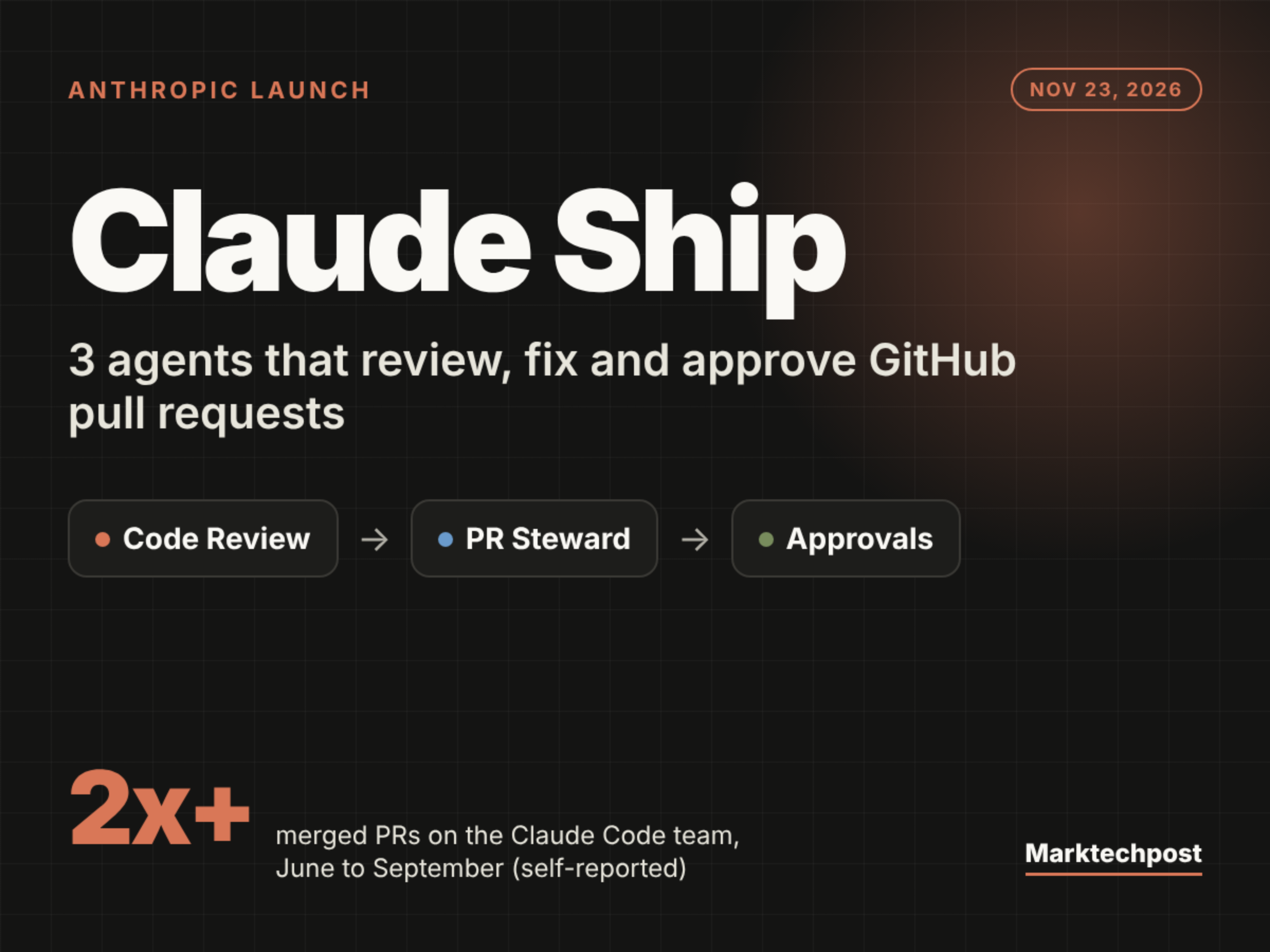
Anthropic has introduced Claude Ship, a suite of AI agents designed to automate key stages in the GitHub pull request workflow. The tool integrates three specialized agents—Code Review, PR Steward, and Claude Approvals—each performing a distinct function to move code from initial submission to final merge, without replacing human judgment or overriding established team governance. Source: marktechpost.com.
What Is Claude Ship?
Claude Ship operates within the existing GitHub pull request lifecycle. It does not replace developers but enhances their workflow by automating evaluation, fixing, and approval processes. The system is built to work alongside current development practices, allowing teams to maintain control while leveraging AI to improve code quality and review efficiency.
- Code Review analyzes pull requests for logic errors, security vulnerabilities, and edge-case failures. It generates inline comments, prioritized by severity, enabling developers to quickly identify and address critical issues. This agent is currently in general availability.
- PR Steward monitors failing checks, merge conflicts, and unresolved review comments. When issues are detected, it automatically pushes targeted fixes to the branch and leaves detailed comments explaining the changes. Developers can intervene at any time using commands such as
@claude stopor@claudeto pause or resume the process. This agent is currently in public beta. - Claude Approvals evaluates pull requests against a policy defined in a file named
.claude/approvals.yml. Anthropic refers to this file as a ‘smarter CODEOWNERS’ file, allowing dynamic rules such as requiring two approvals for billing code or one for test fixtures. Rules can reference PR metadata and classifier outputs, but cannot access CI pipeline results or test coverage data.
Repository owners can enable each agent individually, allowing for a gradual and controlled rollout. The suite is available exclusively to Anthropic’s Team and Enterprise customers on GitHub, with no access for individual or free-tier users.
How It Works in Practice
When a developer runs the /ship command in the Claude Code CLI, the process begins. The agent commits the changes, pushes them to the repository, and opens a pull request. Code Review then evaluates the code, flagging issues with severity ratings. If problems are found, PR Steward intervenes by pushing targeted fixes. Each fix triggers a new review cycle, enabling iterative improvements. The developer can manually stop the process at any point using the @claude stop command.
After PR Steward completes its fixes, the pull request is passed to Claude Approvals. This agent checks whether the PR meets the defined policy. If it does, the PR proceeds to the next stage. The final merge is governed by the team’s existing GitHub branch protection rules, ensuring that no automated actions override established safety protocols.
It is important to note that when Claude acts alone, it blocks commands such as merge, approve, auto-merge, and force-push. This restriction ensures that only human-verified actions can finalize changes, preserving code integrity and accountability. However, users still authenticate with their own GitHub and git credentials, maintaining security and access control.
Performance and Impact
Anthropic has shared internal performance metrics from its own engineering team’s use of Claude Ship. These figures, though self-reported and not independently verified, indicate measurable improvements in workflow efficiency.
- The share of reverted changes decreased by over 40% during the same period, suggesting fewer failed PRs due to incomplete or incorrect changes.
- PRs with substantive review comments increased from 16% to 54%, indicating a rise in meaningful and actionable feedback.
- 78% of PRs passed after one review-and-fix cycle, up from 65%—a clear sign of improved feedback loops and faster resolution.
- The average number of reviews needed to pass fell from 2.08 to 1.32, demonstrating a reduction in review overhead and faster convergence on code quality.
While these metrics reflect positive outcomes, no precision or recall data is provided. This means the system’s ability to correctly identify actual bugs versus generating false positives remains unknown. Without such metrics, it is difficult to assess the accuracy or reliability of the AI’s diagnostic capabilities.
Deployment and Pricing
Claude Ship is available only to Anthropic’s Team and Enterprise customers on GitHub. Repository owners can enable agents one at a time, enabling a phased adoption strategy and minimizing risk.
Usage is billed in tokens. Code Review costs scale with the number of pull requests, their size, and the depth of the review. Administrators can set spending limits to manage costs. PR Steward has no base charge until an owner configures one. Approval rules are billed even when in ‘observe mode’—meaning that classifier runs and policy evaluations are charged regardless of whether they result in an action.
Eligible Enterprise organizations can claim up to $10,000 in usage credits by January 15, 2027. These credits expire 30 days after claiming and are intended to support early adoption and testing.
Comparison with Competitors
Anthropic has not published direct performance comparisons with tools such as GitHub Copilot, Bugbot, or CodeRabbit. Competitor data comes from vendor documentation, verified as of November 23, 2026. While these tools offer code suggestions or bug detection, Claude Ship provides a more comprehensive workflow automation by combining review, fix, and approval in a single pipeline.
Notably, Claude Ship does not offer ZDR (Zero Data Residency), HIPAA compliance, or CMEK (Cloud Machine Encryption Key)—features critical for organizations handling sensitive data or operating under strict regulatory standards. As such, it is not suitable for environments with stringent data governance or compliance requirements.
Limitations and Open Questions
The system has several known constraints. It does not evaluate CI results or test coverage, meaning it cannot assess whether a PR passes automated tests or meets build requirements. Approval rules are static and cannot adapt to real-time context or evolving project needs. Additionally, the absence of public benchmarking data makes it difficult to evaluate the AI’s accuracy or reliability in real-world scenarios.
Despite these limitations, Claude Ship represents a significant step forward in AI-driven software engineering. It enables faster, more consistent code reviews and reduces rework. However, developers remain responsible for final decisions, and human oversight remains essential.
For more details, see the official Claude Ship launch post, the Code Review documentation, and the PR Steward guide.
Sources & further reading
Featured image: Anthropic Launches Claude Ship for GitHub Pull Request Review and Fixes. Via original publisher. Image source