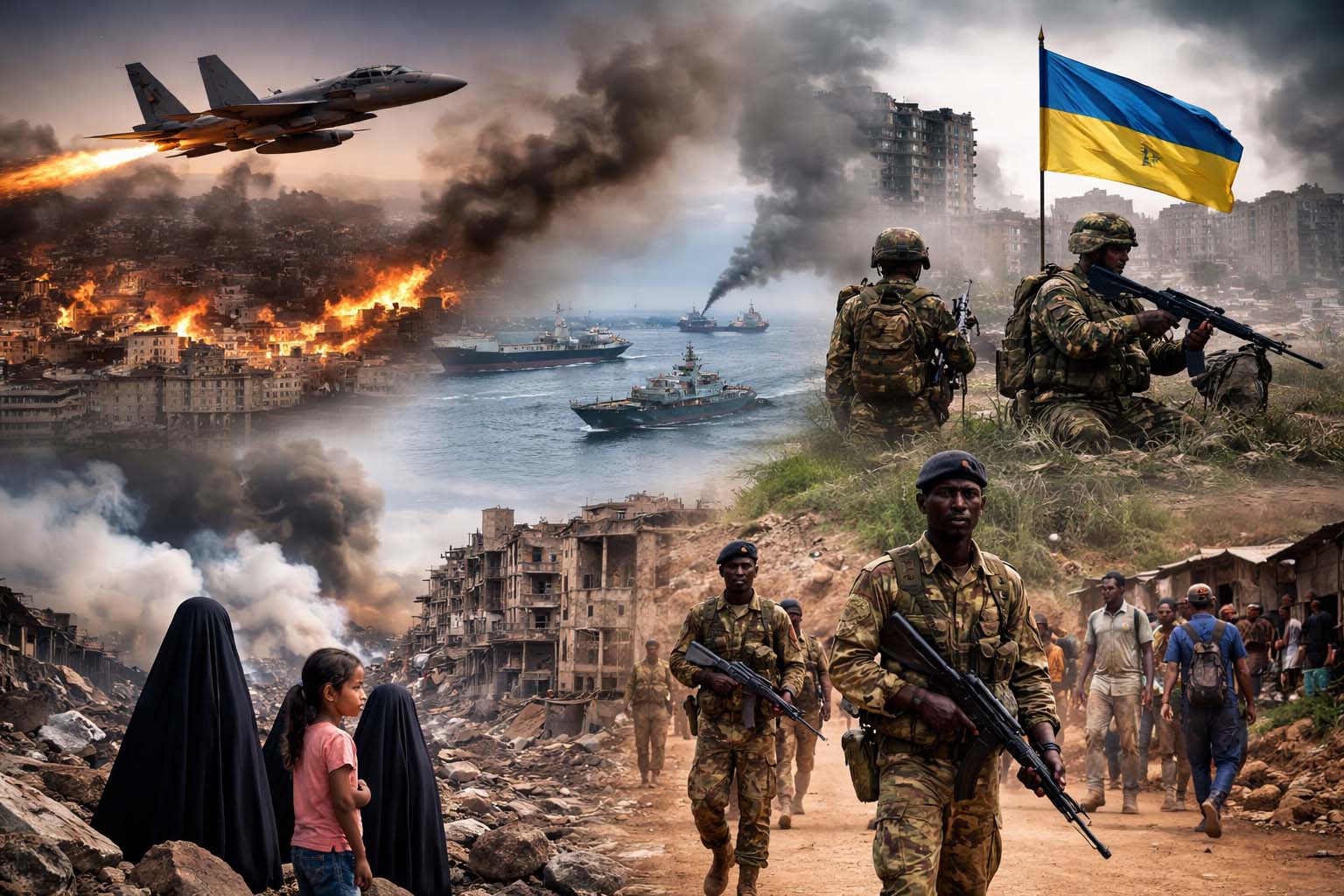
This week’s global picture shifted fast: a major Middle East escalation (US–Israel strikes on Iran), continued war diplomacy around Ukraine, and worsening pressure on civilians from Gaza to Sudan to eastern Congo. Below is a practical “what happened / why / who wants what / what to watch next” guide—focused on the conflicts currently driving the biggest humanitarian, security, and economic ripple effects worldwide.
Quick scan: the conflicts shaping the week
- Middle East: Iran–US–Israel escalation + spillover risk to shipping, energy, and regional proxy fronts.
- Europe: Ukraine–Russia war continues, with talk of security guarantees but no clear breakthrough.
- Africa: Sudan’s war grinds on; eastern DRC sees shocks tied to M23 violence; Sahel attacks rise; South Sudan violence spikes.
- Asia: Afghanistan–Pakistan fighting escalates; Myanmar’s civil war persists under heavy repression.
1) The week’s pivot point: US–Israel strikes on Iran
What happened (past week)
Israel said it launched a “pre-emptive” attack on Iran, with reporting tying it to long-running disputes over Iran’s nuclear and missile programs; the situation escalated quickly into regional retaliation and wider disruption.
Shipping and energy markets were hit hard: multiple firms reportedly suspended shipments via the Strait of Hormuz after Iran declared it closed, raising global supply-chain risk.
Air routes across the region were disrupted, with major knock-on effects for global travel corridors between Europe and Asia.
Why it’s happening (root drivers + immediate trigger)
- Immediate trigger: escalating security logic around Iran’s nuclear/ballistic programs and repeated warnings that force would be used if Iran advanced them.
- Structural driver: a decade-long regional “shadow war” (missiles, drones, proxies, sanctions) that can tip into open interstate conflict once deterrence breaks.
Who wants what (stated goals vs. strategic incentives)
- Israel (stated): remove “threats” and degrade nuclear/ballistic capability.
- US (incentives): protect regional forces/partners, contain escalation, and shape Iran’s strategic capabilities—while limiting spillover to global energy and trade routes.
- Iran (incentives): re-establish deterrence, preserve regime stability, and raise costs via retaliation (including pressure on shipping/energy chokepoints).
What to watch next (next 7–30 days)
- Hormuz reality-check: whether disruption becomes sustained (insurance costs, rerouting, tighter naval postures).
- Escalation ladder: attacks on bases, cyber operations, and proxy activation (Yemen, Iraq, Syria/Lebanon) if the conflict broadens.
- Diplomatic channel: emergency UN and back-channel mediation; also domestic politics in all capitals influencing “off-ramps.”
2) Gaza/Israel: aid access tightens as regional war pressure rises
What happened
Israel closed crossings into Gaza (including routes used for humanitarian access and medical evacuations), according to an Israeli government agency, amid the wider Iran escalation.
Why it’s happening
- Immediate: security posture changes during a larger regional military crisis.
- Structural: Gaza’s dependency on controlled crossings makes any regional escalation instantly humanitarian.
Who wants what
- Israel: border control and security; avoid multi-front pressure while escalating elsewhere.
- Gaza civilians/humanitarians: consistent aid corridors and medical movement.
- Regional actors: use leverage (aid, crossings, ceasefire phases) to shape negotiation outcomes.
What to watch next
- Aid throughput: whether closures become prolonged or partial, and how quickly shortages show up.
- Spillover: Red Sea and regional proxy dynamics as pressure on Gaza grows again.
3) Ukraine–Russia: diplomacy on “security guarantees” but war continues
What happened
Ukraine’s leadership said Russia signaled willingness to accept a US proposal framework for post-war security guarantees at talks in Geneva—while both sides still described negotiations as difficult and without a breakthrough.
Why it’s happening
- War durability: both sides seek advantage on the battlefield and at the table; guarantees are central because “ceasefire without enforcement” is unstable.
Who wants what
- Ukraine: binding guarantees that deter renewed attack.
- Russia: security architecture that limits Ukraine’s alignment options, plus territorial/political outcomes favorable to Moscow.
- US/EU: end large-scale war in Europe without incentivizing future aggression (hard balancing act).
What to watch next
- Guarantee design: what enforcement actually means (troops, weapons, treaty language).
- Summit question: whether leader-level talks become viable or remain blocked.
4) Sudan: war brutality + international warnings keep rising
What happened
UN-linked reporting warned of extreme abuses in Sudan (including findings pointing to genocidal patterns in some areas), while international bodies called for an end to violence, including in Kordofan/Darfur.
Why it’s happening
- Core driver: a power struggle that fractured the state, with armed actors financing themselves through territory, trade routes, and external support networks.
Who wants what
- SAF: reassert monopoly control of the state and army hierarchy.
- RSF: preserve autonomous power, revenue networks, and political leverage.
- External players: stability on borders and trade routes—often while backing preferred clients.
What to watch next
- Atrocity-risk zones: where civilians are trapped and aid is blocked.
- Negotiation windows: whether regional diplomacy can lock in humanitarian corridors.
5) Eastern DR Congo (M23): targeted killing + mass grave shock
What happened
A senior M23 figure (their spokesperson) was reported killed in an army drone strike near Rubaya, a strategic coltan-mining hub; days later, officials reported mass graves found after rebel withdrawal in Uvira, while circumstances remained hard to independently verify.
Why it’s happening
- Structural: a long-running mix of insurgency, regional rivalries, and mineral-linked war economics.
Who wants what
- DRC government: territorial control and authority over resource regions.
- M23: leverage, territory, and political concessions; alleged external backing is repeatedly disputed.
- External actors: influence + access to minerals + border security.
What to watch next
- Ceasefire credibility: whether monitoring mechanisms hold or unravel.
- Protection of civilians: investigations into reported abuses and accountability pressure.
6) Afghanistan–Pakistan: cross-border conflict turns into open fighting
What happened
Reuters and AP reported heavy escalation: Pakistani strikes, Afghan retaliation, and exchanges over Kabul—described as the heaviest fighting in years across the border, with international calls for restraint.
Why it’s happening
- Immediate: disputes over militancy and cross-border sanctuaries (Pakistan pointing to TTP), plus retaliatory logic once airstrikes began.
- Structural: unresolved border security, weak trust, and competing internal legitimacy needs.
Who wants what
- Pakistan: reduce militant threat and force compliance/security guarantees.
- Taliban-led Afghanistan: defend sovereignty and deter further strikes while denying hosting militants.
- Regional mediators: prevent another multi-front regional war amid Iran escalation.
What to watch next
- De-escalation talks: whether mediation produces a face-saving pause.
- Civilian risk: strikes near cities and infrastructure, plus refugee pressure.
7) Sahel + South Sudan: “silent” crises with rising violence
Sahel (Niger/Benin/Nigeria border zone)
Reuters reported militant incidents rising sharply in the tri-border region, highlighting how governance gaps and porous borders accelerate insurgent expansion.
South Sudan
The UN warned South Sudan is at a “dangerous point” as killings surged and the 2018 peace deal strains under renewed violence.
8) Myanmar: a civil war that doesn’t stop because the world looks away
Myanmar’s military has used controlled political processes and propaganda to project “normality” while airstrikes and armed resistance continue; observers describe a deepening, long-running civil conflict dynamic.
Why does it feel like “everything” is happening at once?
There isn’t one mastermind or one cause. But three repeatable mechanisms explain why so many wars “cluster” in time:
- Great-power competition raises the temperature (security guarantees, sanctions, arms flows, vetoes at the UN).
- State fragility creates armed marketplaces (militias, war economies, smuggling, resource capture—coltan is a clear example in eastern Congo).
- Chokepoints globalize local wars: Gaza crossings, Hormuz shipping, and air corridors turn regional conflict into worldwide price and mobility shocks.
What to expect next (practical watchlist)
- Middle East: whether Hormuz disruption persists; whether retaliation expands beyond “military-to-military” targets.
- Gaza: duration of crossing closures and knock-on humanitarian impacts.
- Ukraine: details and enforceability of any security guarantee package.
- Sudan/DRC: whether international pressure translates into protected aid corridors and credible monitoring.
- Afghanistan–Pakistan: whether mediation can stop an escalation spiral.
- Global economy: shipping reroutes, insurance costs, and fuel price volatility hitting households and businesses.
FAQ (WordPress-friendly)
Are there really “wars everywhere,” or does it just feel like it?
Both: there are dozens of active armed conflicts globally, but attention clusters on those with major humanitarian tolls or global spillovers (energy, migration, security).
Is this the start of World War 3?
“World war” implies direct, sustained great-power war. What’s more plausible (and still dangerous) is regional wars that cascade through alliances, proxies, cyber, and economic chokepoints.
Why do leaders keep choosing escalation?
Because they often believe escalation improves deterrence or bargaining position—until it doesn’t. Wars frequently expand through miscalculation and domestic political pressure.
What conflict is most likely to hit everyday life in the UK/EU quickly?
Energy and travel disruptions are the fastest pathways—especially via Hormuz shipping and regional airspace closures.
What’s a reliable way to follow updates without misinformation overload?
Use a small “stack”: one wire service (Reuters/AP), one regional outlet you trust, and one conflict tracker (for background). Limit refresh checks to set times.
Who “wants” all this to happen?
Different actors benefit in different ways (power, survival, territory, leverage). But most wars persist less because one party “wants chaos” and more because ending the war requires compromises that key actors fear.