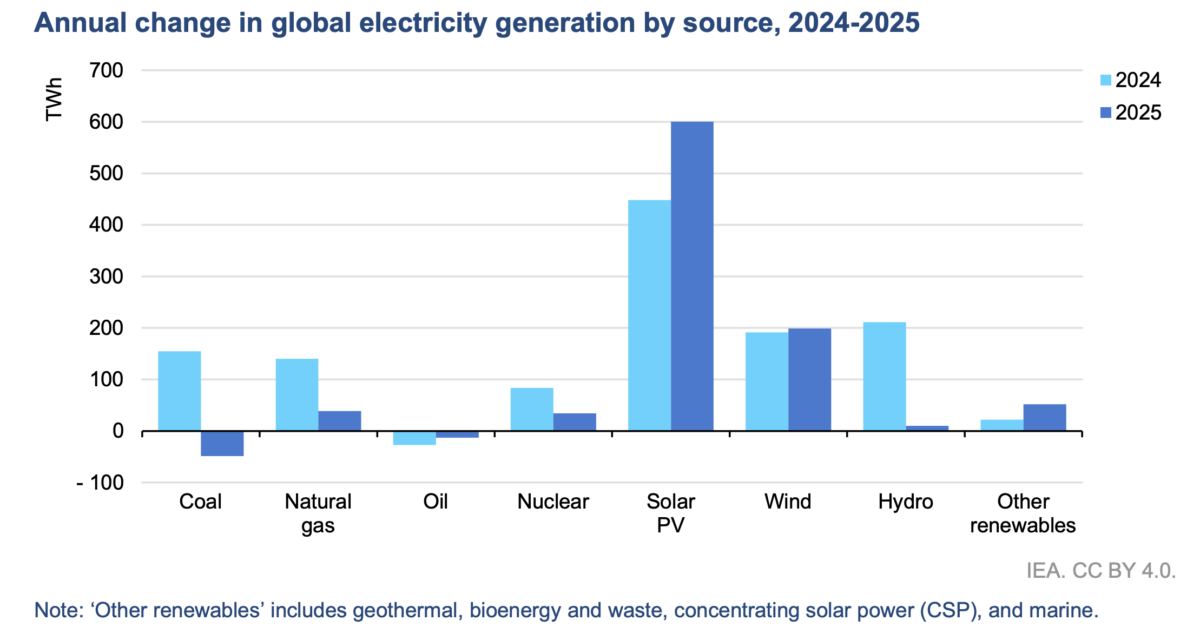
Latest report from the International Energy Agency says last year’s 600 TWh increase in solar PV was the largest-ever electricity generation increase by any source in one year, outside of periods of post-crisis recovery.
Solar generated an additional 600 TWh of electricity in 2025, taking its total generation to around 2,800 TWh, according to the latest report from the International Energy Agency (IEA).
The agency’s Global Energy Review 2026 says solar’s total generation in 2025 was more than double its output in 2022, bringing solar’s share of total global electricity generation to over 8%.
IEA adds that the absolute increase of solar PV generation in 2025 is the largest ever observed for any source, excluding years marked by rebounds from global economic shocks such as Covid-19.
Global annual renewable capacity additions reached 800 GW last year, IEA’s findings continue, a 16% year-on-year increase and the 23rd consecutive year that renewables set a new expansion record. Solar covered 605 GW of new renewables capacity, with wind making up 159 GW and other renewables accounting for the remaining 33 GW.
Headline figures from IEA’s report reveal that overall global energy demand slowed to 1.3% year-on-year, just below the average of the previous decade, with slower economic growth, slow growth in energy-intensive industries in some regions and lower cooling demand all contributing to slower demand growth.
Solar met more than 25% of higher demand, which IEA says marks the first time a modern renewable source contributed the largest share of global energy demand growth. Low-emissions sources, comprising solar, wind, nuclear, hydropower and other renewables, contributed nearly 60% of the growth in global demand.
Demand for electricity grew at nearly 3% year-on-year, which IEA’s report says “reaffirms the world has entered the age of electricity.” The report explains the increase in electricity demand was driven by a wide range of end uses in building and industry. It adds that while electricity demand for electric vehicles and data centres increased by 38% and 17% respectively, their shares of total electricity growth remained relatively slim.
Elsewhere in the report, IEA says battery storage is the fastest growing power technology today, deploying 108 GW of new storage capacity last year for a 40% increase on 2024. Lithium-iron phosphate batteries now account for around 90% of deployments, the report says, up from a market share of well below 50% five years ago.
Around 80% of new battery capacity last year was utility-scale, with the remaining accounted for in commercial and residential behind-the-meter installations.
IEA’s report also notes that battery storage durations are gradually increasing. “While most projects still cluster around two hours, an increasing number can be deployed for four hours or more, reflecting the growing value of flexibility in systems with rising shares of PV,” it explains.
This content is protected by copyright and may not be reused. If you want to cooperate with us and would like to reuse some of our content, please contact: editors@pv-magazine.com.
Popular content