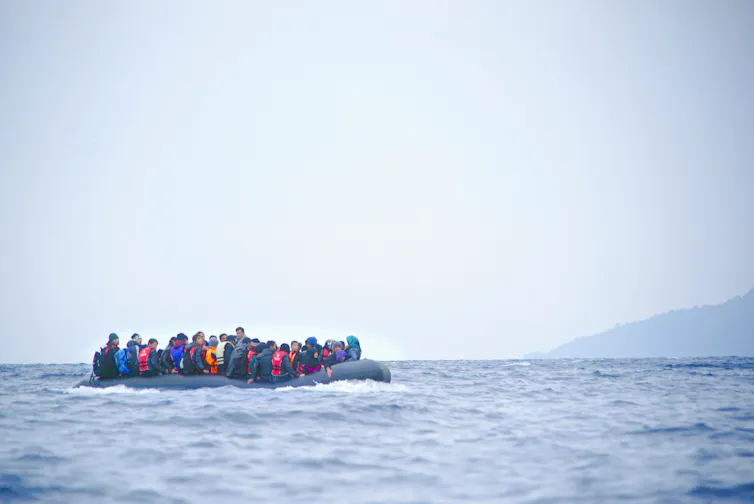
At the height of the 2015 refugee crisis, a moment of human kindness captured the world’s attention. A young Syrian mother, newly landed by small boat on a beach in Greece, was struggling to feed her child when Militsa (Emilia) Kamvisi, who was then 83, offered to help. The two friends Kamvisi had been sitting with on a nearby bench – Maritsa Mavrapidou and Efstratia Mavrapidou, 85 and 89 respectively – joined in.
A photographer recorded the scene and the three grannies from Lesbos, as they came to be known, became instant symbols of hospitality and welcome. As Kamvisi put it at the time: “What did I do? I didn’t do anything. I just wanted to help the girl, who was wet and tired.”
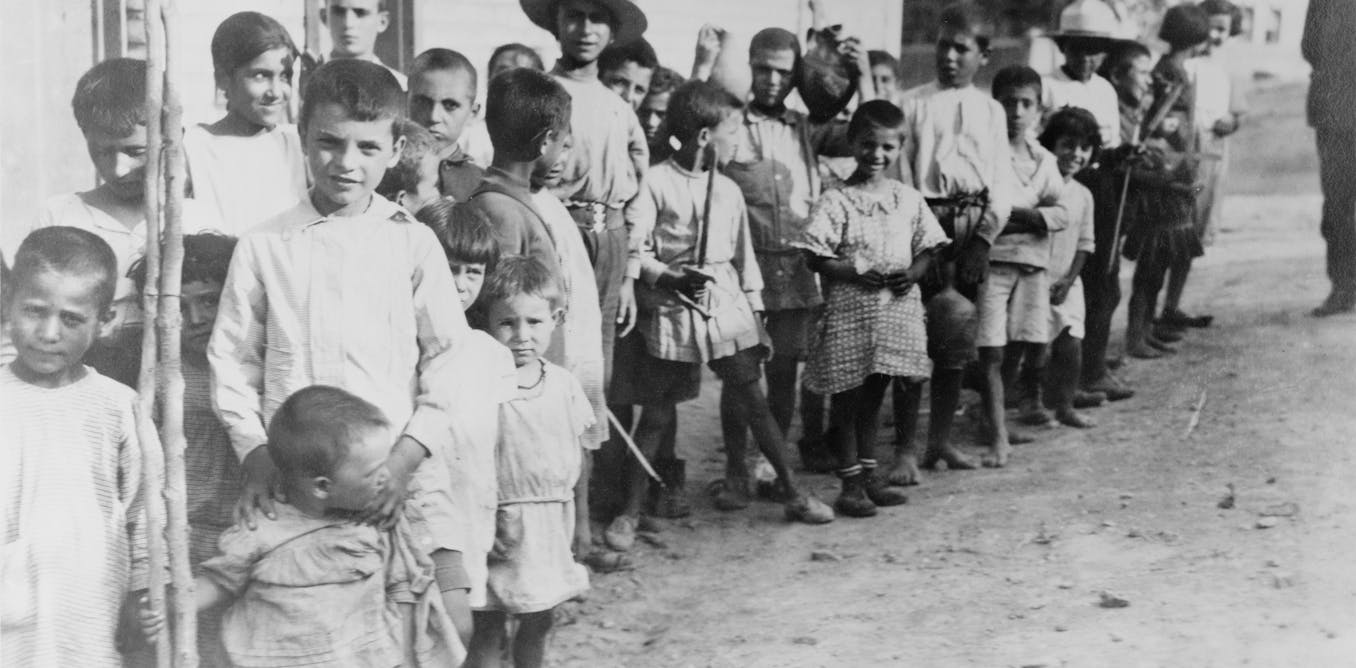
The poignancy of their gesture was underscored by the fact that all three women were themselves children of refugees. Maritsa Mavrapidou later explained: “Our mothers came here as refugees from Turkey, just across the way, and they were just girls at the time. They came without clothes, with nothing. That’s why we feel sorry for the migrants.”
Their mothers arrived in Greece as part of what historians call the 1922-24 Asia Minor forced displacement. Following the collapse of the Ottoman empire and the Greco-Turkish war that ensued, Greece and the newly founded state of Turkey agreed to the exchange and compulsory displacement of their religious minorities. Around 1.2 million people were expelled from Turkey to Greece and 360,000, from Greece to Turkey.
In my new book, A Century of Asia Minor Refugees in Greece: Flight, Fight, and Fraternity, I show how refugee memory and identity changes through time as it passes from one generation to the next. Refugee memories pass through the different stages of trauma, from silence, to long periods during which memories remain dormant and, ultimately, to a reawakening.
Silent witness
Between 2019 and 2020, I travelled throughout Greece conducting over 260 oral history interviews with refugees from Asia Minor and their descendants of the second, third and fourth generations. Asia Minor, also known as Anatolia, refers to the landmass that makes up the major part of western Turkey today.
Among other questions, I wanted to examine how older migrants define their own identities. I was also interested in how they think about new arrivals.
In 2019, I visited the village of Skala Loutron on Lesbos, a settlement originally built in 1931 for 25 refugee families. Nobody spoke of being from Asia Minor.
Dimitris Papachrisos, a second-generation descendant born in 1952, is the president of the local refugee association and the 1922 Refugee Memorial Museum. He recalled the silence and ignorance of his parents’ generation, describing the history of the village as a well-kept secret among traumatised refugees.
“There was no discussion about who is from Asia Minor and who isn’t, it was something forgotten that nobody talked about. Each person would look to survive,” he explained.

Mstyslav Chernov/Wikimedia, CC BY-SA
The Greek civil war, which lasted from 1946 to 1949, resulted in entrenched political divisions and social tensions. Refugee descendants struggled to integrate into Greek society. Government policy pushed refugees to give up their own languages and dialects, subsuming their different histories into one national narrative. This silenced any public expression of that past. As a result, until the 1960s, refugee memory only existed in the family.
Neos Milotopos is another village established in 1924 by Cappadocian refugees, most of them from the same village in Turkey. One third-generation descendant, Sophia Kosmoglou, told me her great-grandparents had been massacred in a church in Cappadocia. Her grandparents survived. But nobody spoke of it.
She described how food and culture carried what words could not. “The cuisine is active, meaning we didn’t ever have any pauses,” she said. The Cappadocian food tradition, and her later involvement in the cultural association, led her to discover her family history. The second generation – her parents – threw themselves into the task of surviving; they had to find a way to live, to eat and to raise kids. It was trauma and silence, not stories, that marked this turbulent historical period.
Generational trauma
Between 1967 and 1974, Greece was ruled by a military junta. In 1974, a junta-backed coup against the president of Cyprus triggered the Turkish invasion of Cyprus, which brought the regime to its knees. This ushered in a new era of democracy, and saw the Third Hellenic Republic established.
Shaped by this era of ever-increasing social unrest, mobilisation and the international “memory boom” of the 1980s, third-generation refugee descendants began to dig into their families’ histories. Reflecting on this collective reawakening, Kosmoglou said that the “trauma is still present”.
This chimes with what Stratis Balaskas, whom I interviewed on Lesbos, told me. His father had arrived on the island as an unaccompanied minor at the age of six in 1922. Balaskas is Lesbos-born and yet he told me that still today, he feels he is only on the island because “the boat brought us here”.
In the 1980s, Balaskas went to Turkey to find his ancestral home. Within a day, he had found his ancestral home and recovered belongings his family had left behind. The caretaker of his grandfather’s fields, the current owner of the house, had kept them for years. When Balaskas brought them back to Lesbos, his father said: “Take them, keep them, they are yours, they are not mine. I don’t want you to tell me anything again.”
Between 1930 and 1975, scholars at the Centre for Asia Minor Studies in Athens conducted 5,000 interviews with refugees, a selection of which is recorded in the five-volume Greek language book, Η Έξοδος (The Exodus). Many said the same thing: they didn’t wish to talk about or hear of what they had experienced. Living through it was enough.
Younger generations, by contrast, feel a greater urgency to collect stories before they are lost. Niki Chontronikola, who was born on Lesbos in 1992, began building her family tree at the age of 14. From her father, she told me she had “gotten the message, to feel proud”.
By the time her generation came of age, Greece’s membership of the European Union and the country’s abrupt shift from an emigration to an immigration country in the 1990s, through to Europe’s 2015 migration crisis, had created an environment of globalisation, secularisation, Europeanisation and multiculturalism. Old distinctions no longer had the same strength; hybrid identities were emerging.
Reflecting on this multiplicity, Chontronikola said: “When I’m here, I want to say I’m from Asia Minor. When I’m in the rest of Greece, I say I’m from Lesbos. And when I’m abroad, I’m forced to say Greece and then Lesbos.”
Almost 60 years her senior, Vasos Vogiatzoglou captured this same century-long journey in a single confession. As the “oglou” suffix of his surname makes clear, he was born in 1935 in Nea Ionia, one of Athens’s best-known Asia Minor refugee settlements, to refugee parents.
“When I was a kid at school,” he told me, “I used to mutter my last name. I was ashamed to say ‘oglou’. I’m proud of it now.”
The afterlife of the Greek-Turkish population exchange can be traced in other cases of forced displacement, from the 1947 Partition of India to the 1948 Israeli-Palestinian conflict. In light of ongoing wars, migration crises and climate displacement, the question of whether or not to remember – and quite how memory and identity are shaped and reshaped – echoes with new urgency
-

-
-

-