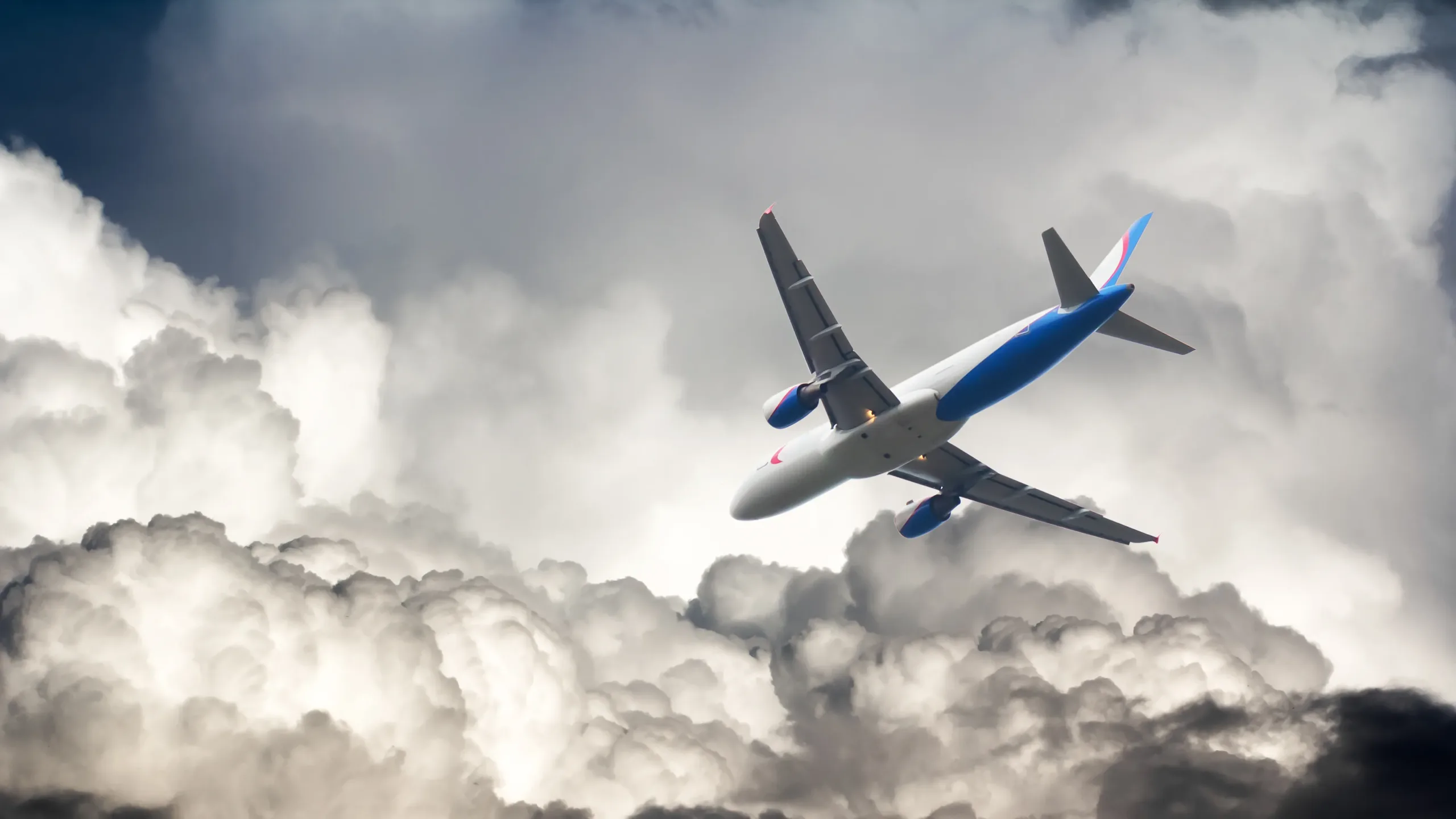
For decades, turbulence has remained one of the most intractable problems in classical physics. It’s the chaotic, unpredictable movement of air that makes flights jolting and passengers anxious. Source: wired.com.
What Is Airplane Turbulence?
Turbulence occurs when air flows unevenly, creating swirling eddies. These eddies form at multiple scales—large, medium, and tiny—each interacting with the others in complex ways.
The phenomenon isn’t limited to the atmosphere. It appears in blood flow, ocean currents, and superheated plasma in fusion reactors. In aviation, turbulence is common during ascent, descent, or flight through weather fronts, mountain ridges, and jet stream boundaries.
One of the most dangerous forms is clear-air turbulence. It happens in stable, calm air with no visible signs. Pilots have historically relied on anecdotal reports—like passengers being thrown against seats or hearing cabin shudders—to detect it.
Why Is Turbulence So Hard to Predict?
Mathematical models of turbulence have long struggled. The Navier-Stokes equations—key to fluid dynamics—break down under real-world conditions of chaotic, multi-scale eddies.
At every scale, air breaks into smaller eddies. These interact in ways too complex for traditional physics to model. A small wind shift can trigger a cascade that amplifies into large-scale turbulence.
Perfect prediction would require a complete, real-time picture of the atmosphere. That’s currently impossible due to vast variables and rapid changes. Satellites and weather stations miss large portions of the atmosphere.
How Is AI and Data Changing the Game?
Machine learning and crowdsourced data are now helping predict turbulence. Many planes already have sensors that track motion and transmit data to satellites.
Researchers use this public data to detect turbulence patterns without new hardware. Every aircraft sends position, altitude, and speed data. By analyzing thousands of flights, AI models spot patterns that show turbulence—even when weather maps don’t.
When one plane jolts, its sensors record a sudden acceleration. If many planes in a region report similar shifts, it signals turbulence. This method—called crowdsourced sensing—creates a real-time, distributed map of air conditions.
Key Projects and Collaborations
In September, the National Science Foundation awarded $30 million to nine universities. The grant funds a new center: Transformative Explorations in Multi-Physics and Engineering of Scientific Turbulence (Tempest).
Tempest studies turbulence in three areas: flight conditions in the atmosphere, plasma in fusion reactors, and gas clouds in space.
In fusion reactors, superhot plasma loses heat due to chaotic swirling. This prevents materials from reaching fusion temperatures. Solving this could unlock nearly limitless energy—but turbulence remains a major barrier.
Michael Murillo, a professor at Michigan State University and Tempest’s lead, says turbulence has long been a problem only human minds could solve. Now, with AI, that’s changing. He notes: ‘Turbulence has been a problem only human minds could work on; as of this year, that’s no longer true.’
Real-World Applications: SkyPath and Pilots
SkyPath, an Israeli company, uses in-flight electronic flight bags to collect and share data. Over 40,000 devices are installed on commercial planes, including American Airlines flights.
Each device uses an accelerometer to detect motion. The data is anonymized and shared between planes, even across airlines. This reduces competition and privacy concerns.
Machine learning combines this data with weather forecasts to predict turbulence 10 to 15 minutes ahead. Pilots can adjust flight paths or altitude to avoid turbulent zones, improving comfort and safety.
Pilot Eric, who uses SkyPath, says the app helps warn passengers about upcoming choppiness. He notes: ‘It’s like any crowdsourced software. It only works if everyone uses it, and no one wants to use it until everyone else is.’
Limitations and Challenges
Experts remain cautious. Larry Cornman, a physicist at the National Center for Atmospheric Research, says predictive accuracy is far from perfect. He emphasizes: ‘No matter what people say, we’re not getting close to 80 percent, 90 percent [predictive accuracy] anytime soon.’
Turbulence is inherently chaotic and sensitive to small inputs. A minor change in wind or temperature can trigger cascading effects that are hard to model.
Success depends on widespread adoption. If only a few planes use the tech, data remains incomplete. A flight over a remote area might go unnoticed if no other aircraft are nearby. The system’s effectiveness grows with participation.
What to Watch Next
As AI models grow more advanced, turbulence prediction may improve. But perfect forecasting remains out of reach.
The aviation industry doesn’t need to eliminate turbulence. It only needs to avoid high-risk flight paths.
With better data and machine learning, smoother flights are within reach—without removing the skies’ unpredictability. The future of flight safety may not be about eliminating turbulence, but about learning to navigate it with real-time intelligence and shared knowledge.
Sources & further reading
Featured image: original publisher image. Via original publisher. Image source