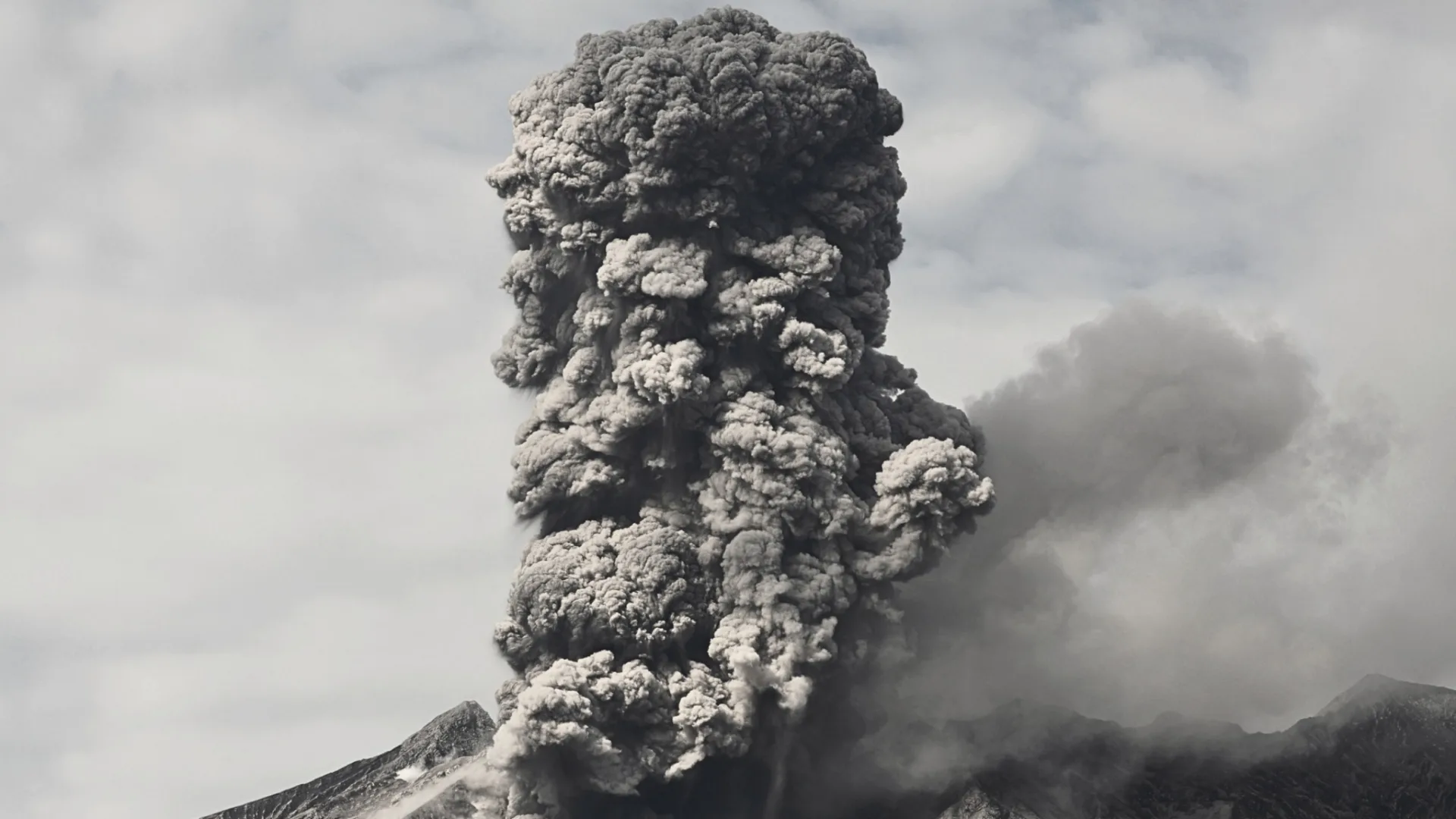
A massive volcanic eruption off Japan’s southwest coast 7,300 years ago left a trail of destruction. The event, known as the Kikai-Akahoya eruption, was one of Earth’s most powerful in history.
What Happened: A Cataclysmic Eruption
Around 5,250 BCE, a volcano beneath the sea near modern-day Japan erupted violently. This eruption scored 7 out of 8 on the Volcanic Explosivity Index, indicating extreme power.
The blast released vast amounts of magma and volcanic material. It triggered powerful earthquakes and massive tsunamis that swept across the Japanese islands. The seismic activity alone would have been felt over hundreds of kilometers, shaking the foundations of any settlements in the region.
Volcanic ash blanketed the landscape in meters thick. This ash cover not only destroyed immediate habitats but also disrupted food chains, affecting both terrestrial and marine ecosystems.
The eruption occurred in a geologically active zone, where tectonic plates converge and volcanic activity is common. However, the suddenness of the event—without prior warning signs—makes it particularly striking. The lack of pre-eruption seismic activity or gas emissions suggests that the magma chamber beneath the seabed ruptured unexpectedly, possibly due to a sudden pressure buildup.
Human Response: More Resilience Than Thought
For the Jomon people—hunter-gatherers who lived in Japan at the time—the eruption was a disaster of incomprehensible scale. These early societies had no written records or tools to document such events, making their response entirely dependent on oral traditions and material remains.
Scientists have long debated how human societies recovered. A new study in Science Advances analyzed 540 archaeological samples from Japan, spanning 8,000 to 6,500 years ago. These samples include charcoal fragments, animal bones, tools, and hearth remains, all of which provide clues about human activity over time.
By comparing radiocarbon-dated finds before and after the eruption, researchers assessed population activity across regions. The data reveals a complex picture: while some areas, especially southern Kyushu, saw long-term abandonment, others demonstrated remarkable adaptability.
Some Areas Became Uninhabitable
Parts of southern Kyushu, closest to the eruption, saw long-term abandonment. The ash cover and environmental damage made living conditions unsustainable. Evidence suggests that entire villages were buried under volcanic debris, with no signs of human activity for centuries.
Other Areas Showed Adaptation
In contrast, communities in northern Japan continued to grow before and after the eruption. This suggests a shift in human behavior—some groups moved away from the disaster zone. The resilience of these northern populations may have stemmed from earlier social networks or access to more stable environmental conditions.
Survivors appear to have adapted by relocating to coastal areas and developing new subsistence strategies. The shift from inland foraging to coastal fishing may have been driven by both necessity and opportunity, as marine ecosystems began to recover earlier than terrestrial ones.
Marine Life Recovered First
Marine ecosystems rebounded quickly. This likely encouraged people to move to coasts, where fishing and other marine-based activities could resume. The recovery of fish populations and shellfish beds would have provided a reliable food source, especially in areas where land-based hunting had failed.
Researchers believe inland groups may have transitioned to coastal lifestyles, using new skills and social networks to survive. This adaptation may have involved learning new techniques for processing fish, building boats, or organizing cooperative hunting groups.
Why This Matters Today
Understanding how ancient societies responded to natural disasters offers valuable insight into human resilience. As climate change increases the frequency of extreme weather and natural events, such historical examples provide a baseline for how communities adapt.
Archaeologist Peter Jordan from Lund University says: ‘Even in the most impossible situations, survivors and communities have choices, however limited. They need to act and make decisions; they need to adjust, collaborate, and find new connections and social networks.’
Limitations and Open Questions
Not all regions show clear recovery patterns. In some distant areas, like Ise Bay, population growth stopped or declined after the eruption. Scientists suggest possible causes: short-term cooling from volcanic aerosols, or a loss of food sources. For example, ash-covered land may have worn down deer and boar teeth, shortening their lives and reducing food availability.
These effects may have been more severe in certain ecosystems. However, the exact causes remain under investigation. The study does not prove that all communities recovered. Some areas may have remained depopulated for centuries, and the full extent of human displacement and cultural transformation is still being uncovered.
Further research into Jomon-era societies and their environmental interactions is ongoing. Scientists hope to uncover more about how prehistoric people managed crises and evolved in response. This research not only deepens our understanding of ancient Japan but also offers a model for how human societies can respond to sudden environmental shocks in the modern world.
The research has been published in Science Advances. For more, see the original article at ScienceAlert.
Sources & further reading
Featured image: A Huge Earthquake in Japan 7,300 Years Ago Pushed The Limits of Human Resourcefulness. Via original publisher. Image source