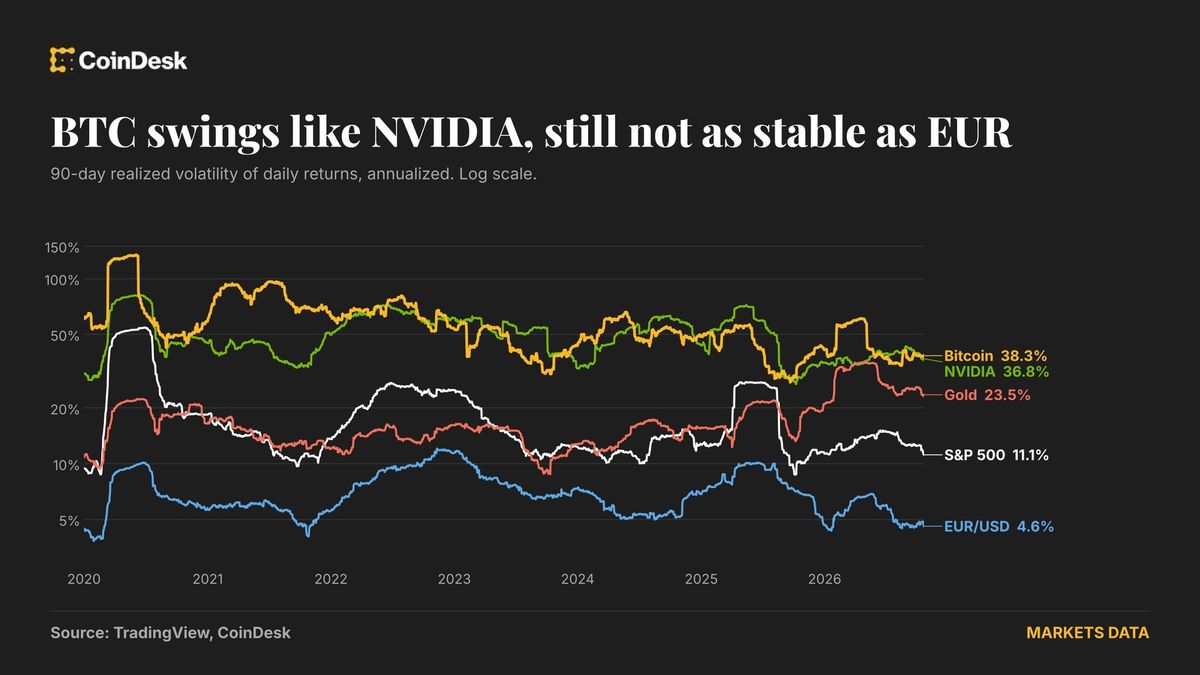
Bitcoin’s price volatility remains significantly higher than traditional assets, according to CoinDesk’s analysis. This is measured by realized volatility—how much an asset’s price moves over 30 or 90 days, based on daily returns. Source: coindesk.com.
Bitcoin’s Volatility Compared to Major Assets
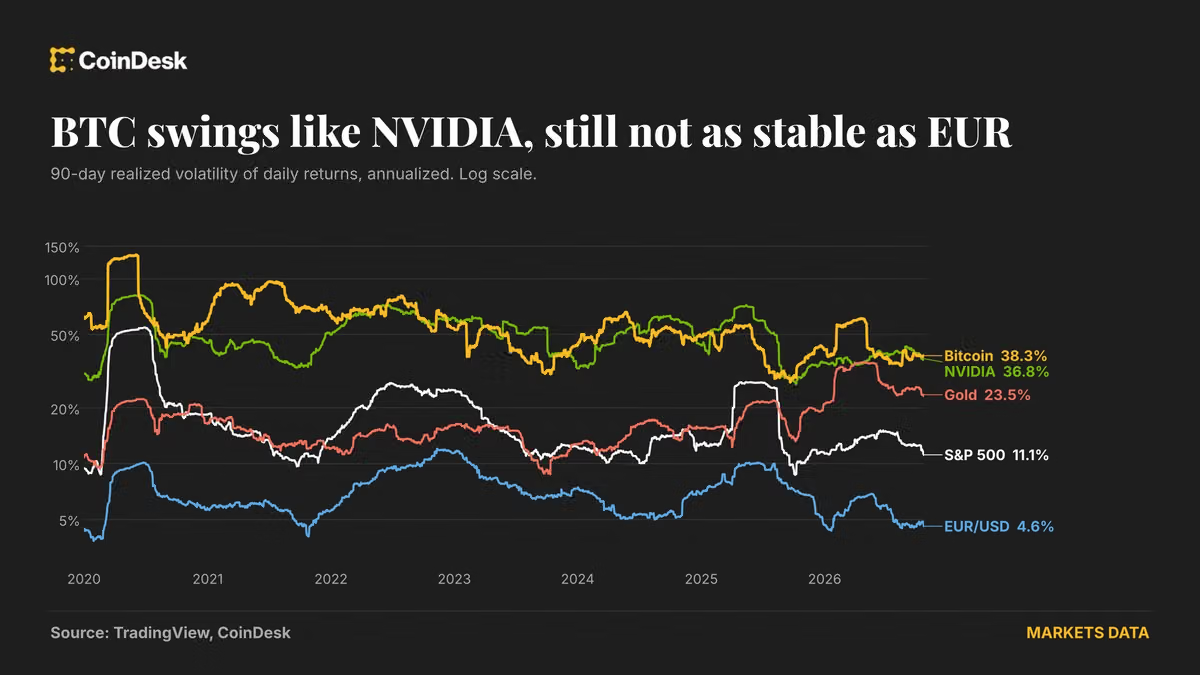
Bitcoin is more volatile than gold, which has a 90-day realized volatility of 23.5%. This means gold’s price has fluctuated less than Bitcoin’s over the past 90 days.
Bitcoin is over three times as jumpy as stocks. This matters for investors choosing diversification tools.
Bitcoin is roughly eight times more volatile than the EUR/USD exchange rate. Despite economic uncertainty in Europe, its volatility stays in single digits.
Most fiat currency pairs have volatility below 10%. This shows traditional currencies remain far steadier than Bitcoin.
Bitcoin’s Volatility Has Declined Significantly
Since January 2020, Bitcoin’s average 90-day volatility has been about 58%. This is a big drop from its peak of 134% in June 2020.
Its calmest reading was 27.5% in September 2025, when prices rose above $100,000. This period saw more institutional interest and better risk management tools.
Market analysts say Bitcoin is now seen as a mature asset, not just a speculative one. The decline in volatility reflects real shifts in investor behavior.
Bitcoin Now Rivals Nvidia in Price Swings
Bitcoin’s volatility now matches Nvidia (NVDA), the largest stock by market value. This means Bitcoin moves like a major tech stock.
AI-driven equities have grown stronger in recent years. Bitcoin’s price swings now align closely with AI-related stocks.
Market Indicators Show Relative Stability
The BVIV index tracks expected volatility in Bitcoin over 30 days. As of now, it remains below its 200-day average, suggesting stable price expectations.
The VIX index, which tracks expected volatility in the S&P; 500, has topped its 200-day average. This signals rising uncertainty in equities.
Traders see a gap: equities face higher risk, while crypto is viewed as more stable.
What This Means for Investors
Bitcoin still hasn’t matched the stability of gold or national currencies. Its volatility remains a key risk factor.
For diversification, Bitcoin still carries high risk compared to traditional assets. But improved behavior suggests it’s becoming a more mature investment.
Key Limitations and Open Questions
The data doesn’t cover long-term stability or performance during crises. There’s no record of how Bitcoin reacts during inflation spikes or financial downturns.
Volatility could spike again under stress. The trend may not last, and future events could trigger sharp price swings.
What to Watch Next
Watch Bitcoin during economic downturns or interest rate shifts. AI-related corrections or central bank moves could affect volatility.
News on new stablecoins—like HSBC’s RedCoin on PayMe—could offer more stable digital assets.
India’s largest exchange, CoinDCX, denied a hack after investigations found $16 million in suspicious outflows. Analyst ZachXBT said this may point to legacy address compromises, not a full breach.
Senate investigator Richard Blumenthal is examining Tether payments to Bo Hines’ firm. The inquiry checks for possible conflicts of interest or transparency issues.
Bitcoin’s journey toward stability continues. But it still lags behind traditional assets in volatility. Market perception will evolve with future conditions.
Sources & further reading
Featured image: original publisher image. Via original publisher. Image source