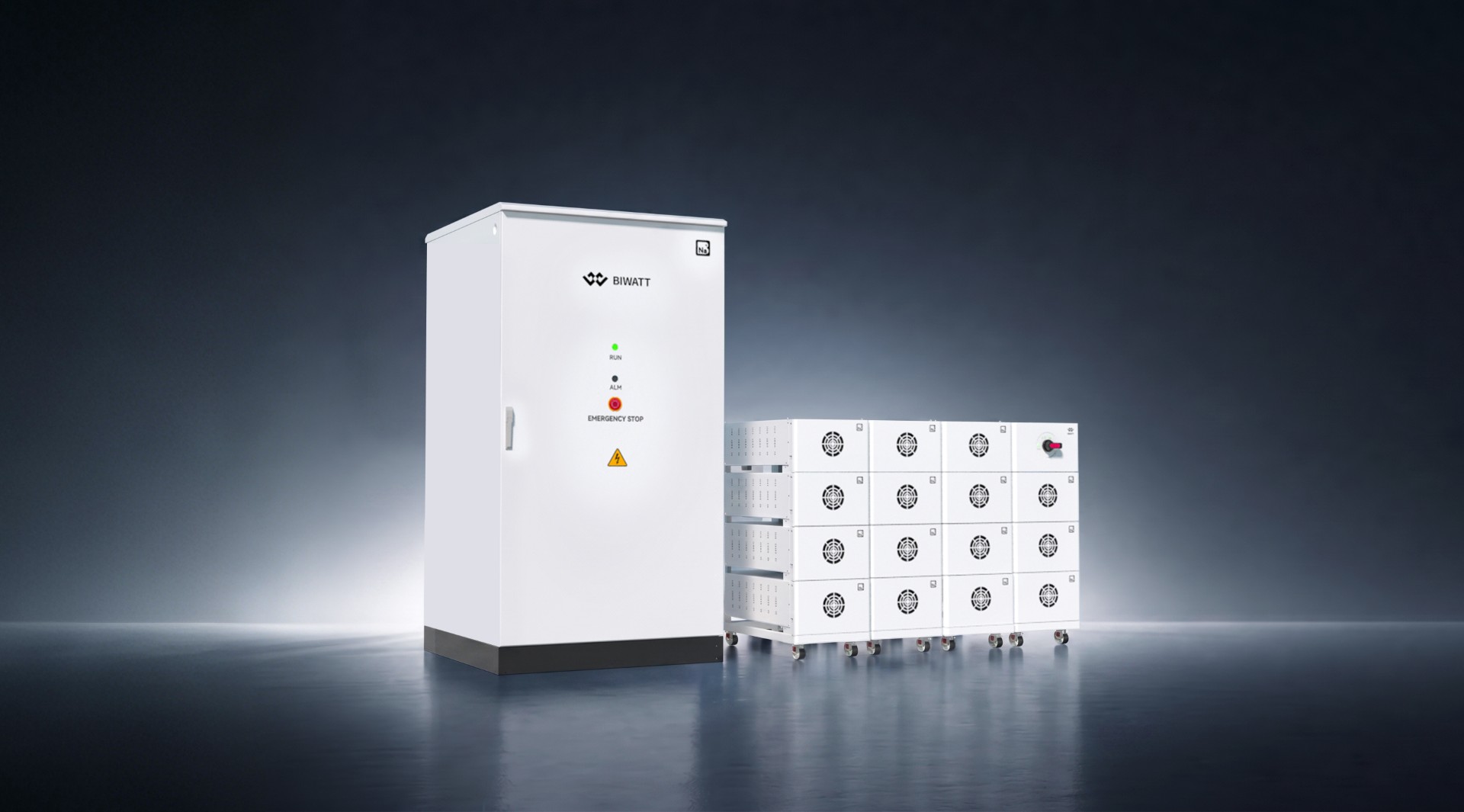
Biwatt launched the modular PowerLake I3 sodium-ion storage system for C&I applications, offering 43.6 kWh–2.09 MWh configurations using NFPP cells. Available as indoor racks or IP55 outdoor cabinets, it delivers up to 65.5 kW per 130.8 kWh unit and is rated for 8,000 cycles.
Chinese energy storage system manufacturer Biwatt has unveiled a modular sodium-ion battery energy storage system for commercial and industrial (C&I) applications.
The PowerLake I3 platform spans configurations from 43.6 kWh to 2,092.8 kWh and is offered as an indoor rack or an outdoor cabinet. It is built around 8.72 kWh packs using 170 Ah sodium-ion cells with sodium iron phosphate pyrophosphate (NFPP) chemistry.
Five to 15 packs can be assembled into an indoor cluster, corresponding to 43.6 kWh to 130.8 kWh. At system level, the 130.8 kWh rack can be deployed in groups of up to five, while as many as 16 outdoor cabinets can be connected in parallel, according to the company. That puts the respective maximum capacities at 654 kWh and 2,092.8 kWh.
Both 130.8 kWh variants have a rated voltage of 769.5 V, a battery voltage range of 540 V to 918 V and rated power of 65.5 kW. Standard charge current is 85 A, while maximum continuous charge and discharge current is 170 A. Biwatt recommends operating at 90% depth of discharge.
The datasheet lists 8,000 cycles under test conditions of 25 C plus, 0.5 C charging and discharging, and 80% depth of discharge. It does not state an end-of-life capacity threshold for that cycle figure.
The indoor PLR-130-40 rack uses natural convection cooling and carries an IP20 rating. It measures 1,780 mm x 1,210 mm x 920 mm and weighs less than 1.82 tons. Charging is specified from 0 C to 55 C, while discharge is supported from -30 C to 55 C.
The outdoor PLC-130-40 cabinet uses air cooling and has an IP55 enclosure. It measures 1,144 mm x 2,172 mm x 1,446 mm and weighs 2.002 tons. Biwatt specifies both charging and discharging across a temperature range of -30 C to 55 C.
The two formats are rated for operation at up to 4,000 meters altitude and at 5% to 95% relative humidity. For controls and integration, the outdoor cabinet supports RS485, CAN, USB and Ethernet communications, while the rack lists CAN connectivity.
Biwatt says the system is compatible with mainstream inverters and energy management platforms and supports remote maintenance and over-the-air updates via Ethernet.
The manufacturer lists IEC/EN 61000, IEC/EN 62477, UL 1973 at cell level, UL 9540A and UN 38.3 among the applicable standards and test references.
Pricing, warranty terms and commercial availability were not included in the product materials reviewed.
This content is protected by copyright and may not be reused. If you want to cooperate with us and would like to reuse some of our content, please contact: [email protected].