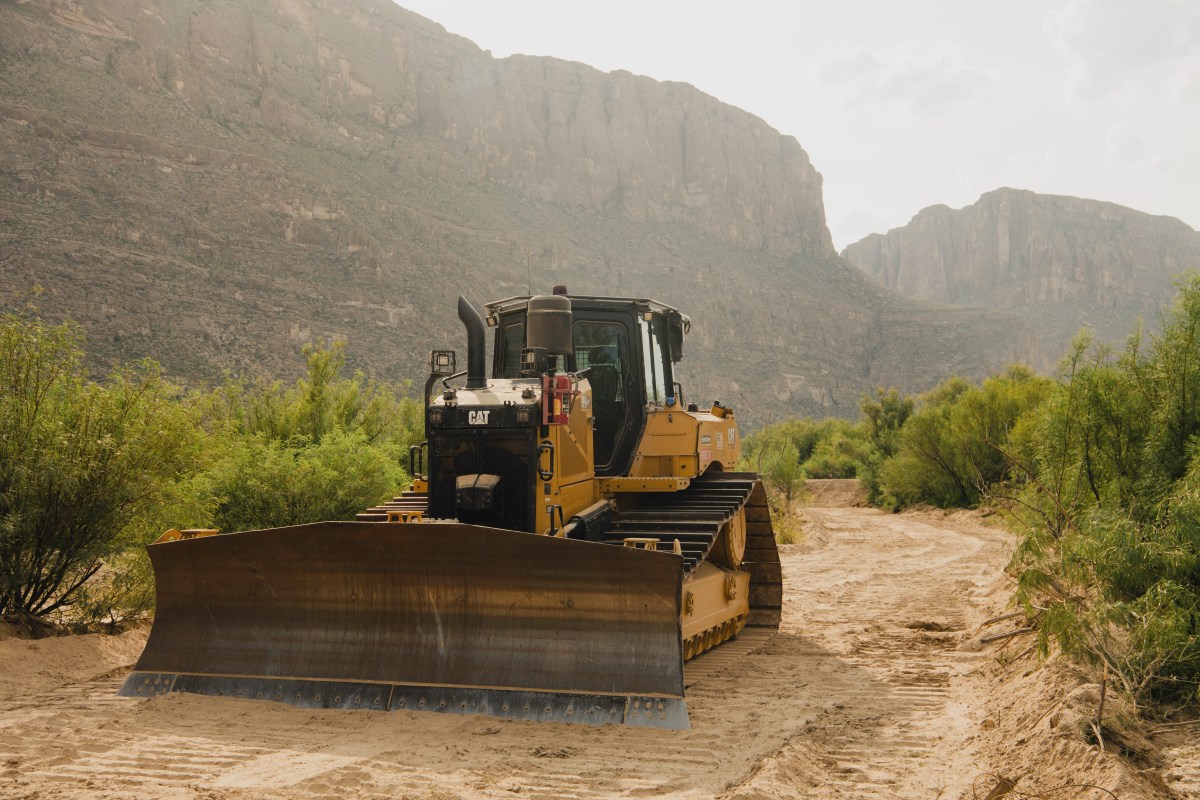
Bulldozers have started work around Big Bend National Park in Texas amid a battle over the Trump administration’s plans to expand the president’s border wall across one of the country’s most remote national parks.
Social media videos by conservation groups and local activists emerged on Thursday, showing vegetation being cleared near the Rio Grande amid federal plans for multibillion-dollar border security project that includes vehicle barriers, surveillance systems and extensive patrol-road construction across the Big Bend region.
Videos show a large bulldozer in operation while ground workers wearing high-visibility vests and hard hats look on.
“It’s mainly going to be confined to the river corridor, which, for me, is very, very important. I’m a river guy. The Rio Grande has always been the lifeblood, not only my livelihood, but just my kind of emotional well-being for all these years,” Mike Davidson, who works as a tour guide in Big Bend, told Newsweek on Friday. “[They] might as well send a bulldozer through the graveyard where my parents are buried or something like that. It hits me very strongly.”
Davidson, who has lived and worked in the region since the 1970s, is one of dozens of business owners who have voiced their concerns about the project. He told Newsweek that there had been little to no communication from the federal government with locals about the changes.
Why the Big Bend Project is Controversial
The plans have faced bipartisan political backlash, and opposition from environmental groups, former National Park Service leaders and local tourism businesses, who say the project could damage desert ecosystems and change the character of a park that attracts hundreds of thousands of visitors each year.
“This is the most heinous attack on an American national park in generations,” said Laiken Jordahl, national public lands advocate at environmental group Center for Biological Diversity. “The administration is preparing to blast hundreds of miles of destructive roads through the wildest place left in Texas and cut off public access to the Rio Grande, all to enrich private contractors.”
Republican Terrell County Sheriff Thaddeus Cleveland, who spent 26 years as a U.S. Border Patrol agent, nearly half that time in the Big Bend Sector, told Newsweek that construction was “both unfortunate and unnecessary.”
Cleveland said officials making the decisions “do not have the first-hand knowledge of Big Bend that the men and women who have actually patrolled this country possess,” arguing that the region could be secured through strategically placed technology, improvements to existing roads and the expertise of agents familiar with the terrain.
“We can secure this sector effectively without unnecessarily bulldozing one of the most rugged and treasured landscapes in America,” Cleveland said. “Border security is too important for one-size-fits-all solutions developed from behind a desk. Big Bend requires a plan built around the realities on the ground.”
Texas state Representative James Talarico, a Democratic candidate for the U.S. Senate, criticized the project after footage emerged, calling the project “a monument to corruption” and said local sheriffs, mayors and business owners had told him the project would not improve public safety.
“This week, over the objections of local leaders and communities, bulldozers showed up anyway, wrecking one of our nation’s greatest treasures to build an expensive wall on an already existing natural barrier. We need modernized surveillance technology and more Border Patrol agents, not sweetheart, no-bid contracts that waste billions,” Talarico said in a statement released Thursday.
More than 140 outfitters, recreation groups and local businesses recently urged Texas leaders to halt or modify the project, warning that barriers and roads could harm river access and threaten a tourism economy built around outdoor recreation in Big Bend.
Davidson is among them. He told Newsweek that he has seen thousands of people visit the state and national parks in the area and discover the joys of the nature on offer—something he believes is at risk if the work already underway is completed.
“I’ve chosen to live in very rural or remote areas for my adult life, but we get people that are in the city, they have stressful lives with real minimal vacation time, and we provide something that is really valuable, I would say [a] mental health outlet for people to get out and be in a natural setting with the river and the canyon walls,” he said. “I think that’s real important. That’s part of us having a civilized nation.”
Construction is Underway
Marfa Public Radio reported this week that contractor Southwest Valley Constructors had moved bulldozers and trucks into the park near Cottonwood Campground. The company holds a contract valued at approximately $1.7 billion to carry out border-security construction work in the region.
Newsweek contacted the company via its website on Friday.
The Department of Homeland Security (DHS) and U.S. Customs and Border Protection (CBP) say the infrastructure is necessary to strengthen security in a region spanning hundreds of miles along the souther border. DHS has cited more than 89,000 migrant encounters in the Big Bend Sector between fiscal years 2021 and 2025, as well as drug seizures, when justifying additional infrastructure.
Newsweek contacted CBP via email outside office hours on Friday. CBP told Newsweek on August 5 that early construction is underway in parts of the Big Bend region and that the agency was coordinating with park officials to minimize disruptions and use existing roads where possible.
CBP added that construction had not begun on the fourth segment of the project, including portions within Big Bend National Park, where plans call for roughly 200 miles of patrol roads and detection technology, and said it is “not planning to construct 30-foot-high barrier” within Big Bend National Park, Big Bend Ranch State Park or the Black Gap Wildlife Management Area.
Is There a Border Crossing Problem in Big Bend?
Recorded migrant encounter figures across the wider Big Bend Sector have fluctuated in recent years.
Latest CBP data show Border Patrol recorded 148 encounters in the sector in June 2026, down from 412 in June 2023, during the peak of the border crisis.
During the first nine months of fiscal 2026 (October through June), authorities recorded 1,509 encounters, down from 10,291 during the same period in fiscal 2023, a decline of about 85 percent.
The figures cover the entire Big Bend Sector, which is wider than the park itself and spans roughly 517 miles of the border.
“I assure you that there is no crisis in this area. Not remotely, certainly not in the national park,” Davidson said. “The concept that there is a crisis is absolutely false.”
Texas Governor Greg Abbott’s press secretary, Andrew Mahaleris, previously told Newsweek in a statement that the governor supported using “every necessary tool and strategy” to help the White House with its border security goals.
“Rugged, isolated areas like Big Bend are great opportunities to deploy technology to aid in securing the border,” Mahaleris said. “Texas is a law-and-order state, and it works hand in glove with the Trump Administration every single day to uphold the laws of this country.”
Contact Newsweek editors on this story: Matthew Cannon and Dave Siminoff.