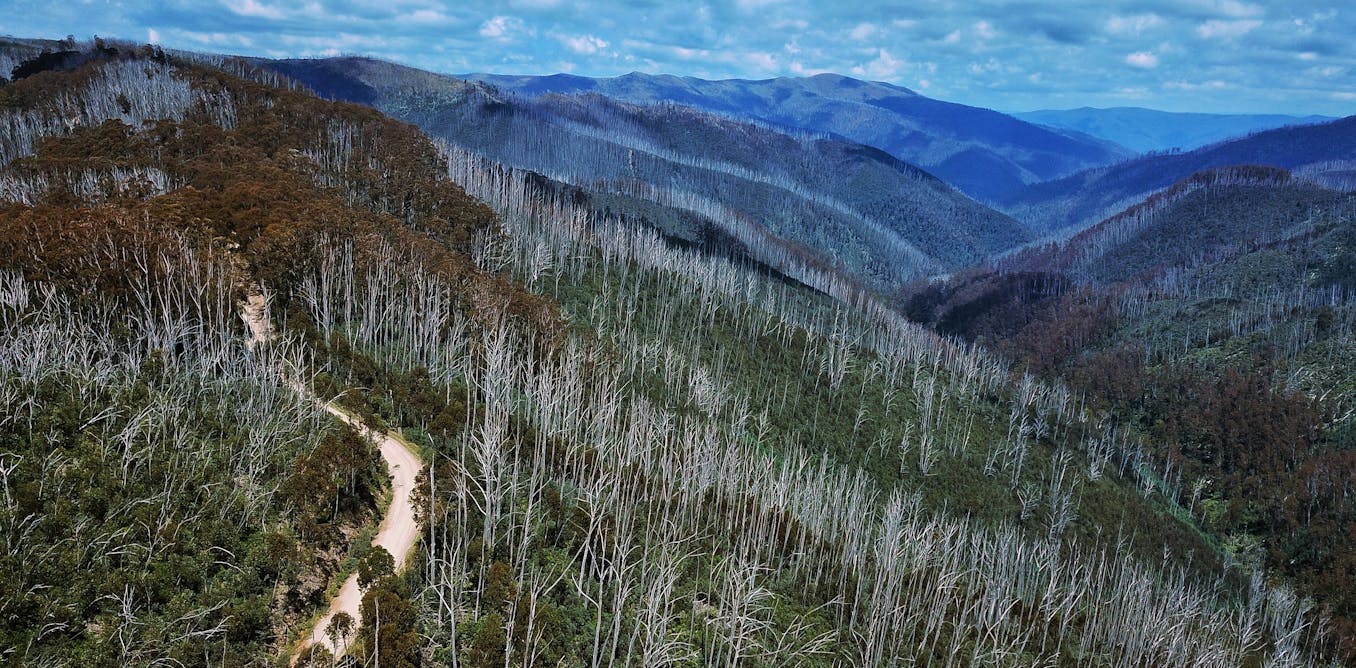
An alpine ash forest is a sight to behold.
Alpine ash (Eucalyptus delegatensis) is a tall eucalypt species that grows in the cool, wet mountains of south‑eastern Australia.
These forests store large amounts of carbon in their wood and soils. They help regulate water flows into major rivers and dams, and provide habitat for a wide range of birds, mammals and insects.
Mainland alpine ash forests are now formally listed as endangered. This is because bushfires are becoming more frequent and severe due to climate change, which threatens to wipe out some of these forests.
In our new study, we examined how alpine ash forests would change under different climate scenarios, and found that difficult choices likely lie ahead.
Is it still possible to protect this unique species? We think so.
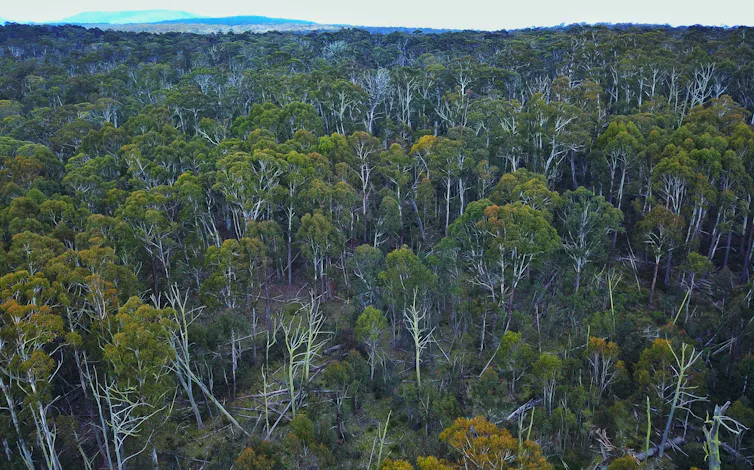

Author provided (no reuse)
From the ashes
Alpine ash is what ecologists call an “obligate seeder”. This refers to plants that, after a major disturbance such as a bushfire, can only regenerate from seed.
If a mature forest burns, many adult trees die. However, the heat from the flames opens their seed capsules high in the canopy, releasing a flush of seed that allows the forest to regenerate. But this strategy only works if there is enough time between fires for young trees to mature and start to reproduce.
In recent decades, increasingly hot and dry conditions have sparked larger fires, including the devastating “Black Summer” fires of 2019-20. As a result, some regions have been repeatedly burnt within a matter of years.
When fire returns before the new generation of trees can produce seed of their own, alpine ash forests can fail to regenerate and may be replaced by other vegetation. This process, known as “immaturity risk”, is a major reason why alpine ash is now considered an endangered species.
Read more:
Climate change is bringing a new world of bushfires
In response, forest managers are increasingly turning to aerial resowing. Helicopters or planes are used to drop seed over burnt areas where young trees were killed before they could produce seed. The goal is to protect patches of alpine ash forest which could otherwise be replaced by other species, and turn into shrublands or grasslands.
Research has shown this active management approach helps protect smaller pockets of alpine ash affected by repeated severe fires. But it’s still unclear how effective aerial sowing can be at a landscape scale.
What we did
In our study, we used a powerful computer model to simulate these ecosystems over the next century and examined the forest changes that happened along the way. We focused on the Australian Alps, the country’s highest mountain range which stretches across southeast Australia.
We then tested how alpine ash forests will fare under different climate scenarios. This allowed us to consider three main questions:
-
what drives alpine ash decline in mainland Australia and how much loss can we expect?
-
in a warmer climate, how important is the reproductive age, meaning when the trees first produce seed, to the species’ survival?
-
how effective is aerial resowing after fires for protecting alpine ash at a landscape scale?
Finally, we examined how these combined factors – climate, fire, tree maturity and resowing – together may reshape the size, location and spread of alpine ash forests over the next century.
Read more:
Australia’s alpine ash forests are now officially endangered. Can we save them?
What we found
The results were striking.
Across all scenarios, alpine ash forests shrank dramatically – by between 49% and 65% – over the next 100 years, even without taking extra warming from future climate change into account.
This means that even our current climate and fire patterns are enough to push alpine ash towards extinction. The main drivers of its decline were aridity (hot and dry conditions) and the frequency and severity of current bushfires. But what mattered in its survival?
The strongest factor was the age at which trees first produced seed. We examined trees at seven and 15 years of age. Scientists often treat 15 years as the “normal” age for this species to reach maturity. Work by colleagues and our own field observations, however, suggest that young alpine ash trees can start producing seed much earlier, at about seven years age.
When we assumed trees could produce seed earlier, our model predicted about 96,000 hectares more alpine ash forest would survive in a century’s time. compared to maturity at 15 years. That’s about 14% of existing alpine ash forests in mainland Australia.
Surprisingly, our study shows aerial resowing after fire would only boost alpine ash survival marginally, saving between 1% and 3% of alpine ash forest area over the next 100 years.
Hard decisions ahead
Our findings show even current climate and fire risk are enough to push Australia’s alpine ash forests towards long-term decline. Therefore, authorities have to make hard decisions about which areas can be saved – and which can’t.
It also means we can’t wait for the future to unfold. To protect this important species, we must make targeted decisions about which regions to prioritise now.
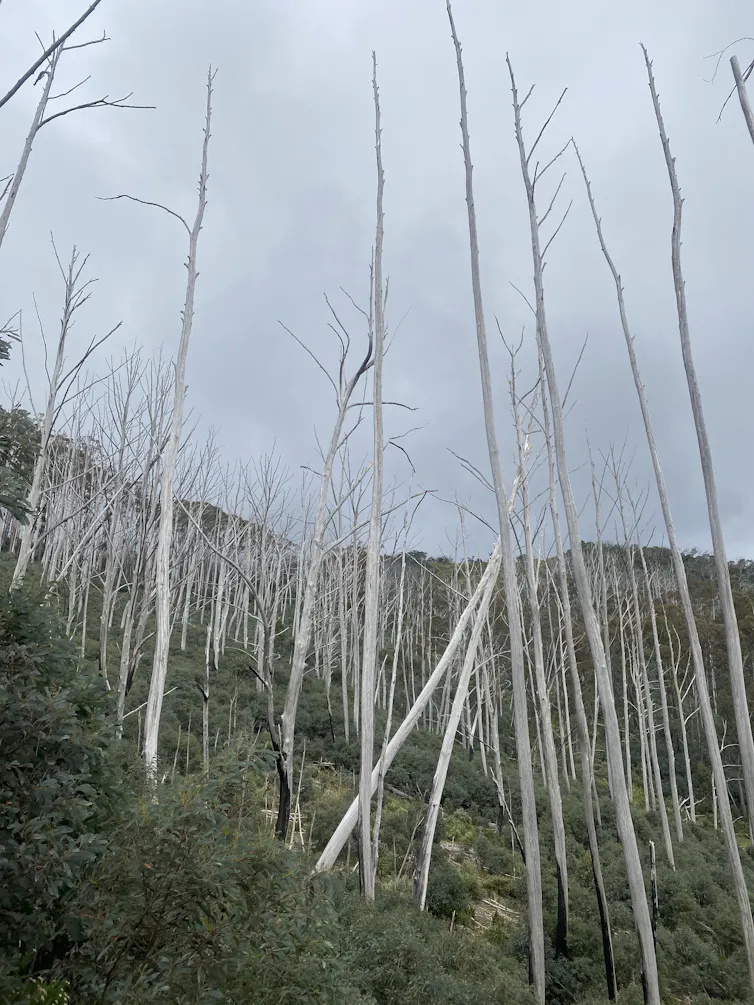

Author provided (no reuse)
To guide these difficult decisions, authorities can use the resist–accept–direct framework to target management and conservation activities at large scales, relevant to species conservation.
Resist
In some high value areas, forest managers can “resist” change by focusing on fuel management to reduce the intensity of future fires and limit how quickly they spread.
In areas where fuel management works, managers can also use targeted resowing. Given our research shows this approach isn’t as effective across large scales however, resowing should be used selectively to to keep patches of alpine ash connected and protect forest edges that will burn more frequently.
Accept
In high-risk areas, managers may need to “accept” that alpine ash will be taken over by more fire-tolerant vegetation, such as resprouting eucalypts. These trees can survive fires and regenerate their crowns by growing fresh shoots from their bark or roots. Such vegetation types may provide different ecosystem values, but are more resilient to future fire and climate.
Direct
In the remaining areas, managers can actively “direct” change. For example, they could introduce these fire-resilient “resprouter” tree species, such as mountain gums (Eucalyptus dalrympleana), or snow gums (E. pauciflora). They could also sow or plant alpine ash in areas previously occupied by other species or used by humans, or test climate-resilient seed sources for regeneration.
The future for alpine ash is likely going to be a mixed bag.
Landscape-scale models like ours can be used to map and better understand which areas can be protected, which can’t, and what else can be done to help forest managers take the best course of action.
That’s crucial to protect our unique alpine ash forests in a warmer, drier and more fire-prone world.