NASA has issued a formal request for ideas on how to extend the operational life of the Hubble Space Telescope by reboosting its orbit before it reenters Earth’s atmosphere in the early to mid-2030s. Source: arstechnica.com.
What Happened
NASA released a Request for Information (RFI) inviting commercial companies to submit proposals for reboosting, servicing, or managing the controlled reentry of the Hubble Space Telescope.
Responses are due by November 30. The agency is seeking technical and operational insights into missions that would raise Hubble’s orbit to at least 373 miles (600 km), with the goal of maintaining the telescope’s functionality until at least 2032.
NASA has not committed to funding or launching such a mission. The RFI is intended to identify potential contractors, assess cost estimates, and evaluate the feasibility of achieving a reboost within the required timeframe.
Background: Hubble’s Orbit and Decline
Since its launch, Hubble has operated in low Earth orbit, providing groundbreaking astronomical data across visible and ultraviolet wavelengths.
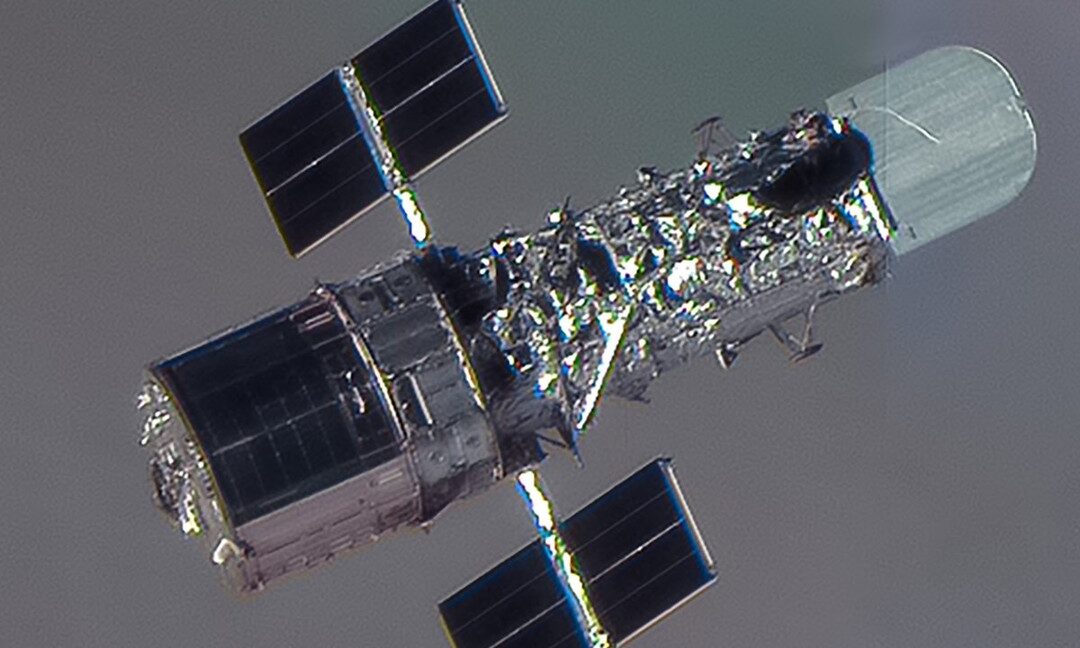
Its last orbit adjustment occurred in 2002 during a Space Shuttle mission flown by the Space Shuttle Columbia. That servicing mission was part of a series of five visits designed to maintain and upgrade the telescope’s instruments and systems.
Following the final shuttle servicing mission in 2009, no further reboosts were conducted. Since then, Hubble has gradually lost altitude due to atmospheric drag, with no onboard propulsion to counteract this natural decay.
Without intervention, orbital dynamicists predict that Hubble will reenter Earth’s atmosphere between 2033 and 2034. Solar activity can influence reentry timing, but current models remain stable within this range.
It took 24 years for Hubble to descend from its 2002 altitude of 362 miles (583 km) to its current orbit of about 292 miles (470 km). This slow descent results from the thin upper atmosphere, which exerts a persistent drag on objects in low Earth orbit.
A reboost to 373 miles (600 km) would extend Hubble’s operational life by at least 25 years, allowing it to continue delivering scientific data to researchers worldwide.
Technical Requirements and Constraints
- The mission must raise Hubble’s orbit to at least 373 miles (600 km).
- It must not damage the telescope’s instruments or structure.
- The mission must be completed by 2032.
- The contractor must provide the launch vehicle, a dedicated servicing spacecraft, and full mission operations.
- A crew is only required if human operations are part of the mission design.
Currently, Hubble orbits at about 292 miles (470 km), below the required altitude. Achieving a 373-mile orbit would require a precise and powerful reboost, likely using a rocket motor or a propulsion system on a dedicated spacecraft.
The mission must include safety and redundancy features. Any failure could damage the telescope or lose valuable data.
Previous Attempts and Lessons Learned
In 2022, billionaire Jared Isaacman proposed a crewed servicing mission using SpaceX’s Dragon spacecraft. The plan would have reboosted Hubble by at least 30 miles and attached a rescue pod with new gyroscopes to fix its pointing system.
At the time, NASA described the concept as ‘notional’ and not yet feasible. The mission would have required complex docking, in-orbit operations, and a crewed launch — all with significant technical and safety challenges.
That same year, NASA also issued a separate RFI for orbit-boosting solutions. Eight responses were received, including a joint robotic reboost proposal from Astroscale and Momentus, combining satellite servicing and in-space transport capabilities.
These early efforts showed that non-crewed solutions could offer viable paths to extend Hubble’s life, setting the stage for more mature approaches in the years that followed.
Recent Progress in Satellite Servicing
Over the past few years, the commercial satellite servicing industry has matured. Advances in robotics, autonomous navigation, and in-space propulsion have made such operations more realistic.
Northrop Grumman launched the world’s most advanced robotic servicing satellite in early 2026. This mission proved that robotic capture and reboost in low Earth orbit are technically possible.
Startups like Astroscale and Starfish Space have also secured contracts with the U.S. Space Force and NASA for servicing and refueling demonstrations. These partnerships have developed compact, agile spacecraft capable of operating in low Earth orbit.
Swift Rescue Mission: A Proven Prototype
NASA awarded a $30 million contract to Katalyst Space Technologies last year to develop a rescue mission for the Swift satellite — a smaller NASA observatory on the verge of reentry.
Katalyst had nine months to design, build, and launch a satellite capable of capturing Swift and boosting it to a higher orbit.
The mission successfully launched the rescue spacecraft and brought it within about 6 miles (10 km) of Swift. Ground teams stopped the approach due to issues with power and reaction control systems.
While no reboost occurred, the mission proved that a low-cost, rapid-response satellite servicing mission is technically feasible. It showed a private company can design and launch a spacecraft capable of approaching and interacting with a space-based asset.
Why This Matters
Hubble remains one of the most scientifically valuable instruments in space history. Its visible and ultraviolet observations have revolutionized astronomy, enabling breakthroughs in star formation, galaxy evolution, and exoplanet atmospheres.
Its successors — such as the James Webb and Nancy Grace Roman — focus on infrared wavelengths. They do not replicate Hubble’s visible-light capabilities. Hubble’s unique ability to observe in visible and ultraviolet light makes it irreplaceable for certain research areas.
Extending Hubble’s life would allow more discoveries in visible and ultraviolet astronomy — vital for understanding the universe’s structure and dynamics.
NASA Administrator Jared Isaacman stated: ‘Hubble still has important science ahead of it. We should be looking at every reasonable opportunity to keep it delivering for as long as possible. If there are innovative and cost-effective ways to extend the life of an asset already on orbit, we owe it to the American taxpayer and the scientific community to explore them. Extending Hubble’s life would mean more discoveries, more science, and more opportunities to expand our understanding of the Universe.’
Limitations and Open Questions
Hubble is significantly more complex and expensive than the Swift satellite. A rescue mission would likely require far greater funding than the $30 million used for Swift. Its large size and aging systems present greater technical challenges.
NASA currently has no budget for a Hubble reboost or servicing mission. Any such effort would need private investment or a public-private partnership.
While robotic solutions are now feasible, a crewed mission — like the one proposed in 2022 — is unlikely. SpaceX plans to retire its Crew Dragon fleet by 2030. Crewed operations near a fragile, aging instrument carry substantial risks.
Even with a successful reboost, Hubble will eventually need to be decommissioned. No current mission is designed to extend its life beyond the 2030s. The telescope lacks long-term in-orbit maintenance capabilities.
What to Watch Next
NASA will evaluate all responses to its RFI. The agency will assess which proposals are technically viable, cost-effective, and timely.
Any selected mission would likely be robotic, using existing satellite servicing technologies. Success could set a precedent for maintaining scientific assets in orbit.
While a rescue mission is not guaranteed, the RFI marks a key step in evaluating whether Hubble can be saved — not with a new telescope, but by reactivating one already in orbit.
For now, Hubble remains a symbol of scientific achievement. Its future depends on innovation, collaboration, and the commercial space industry’s readiness to act.
Sources & further reading
Featured image: original publisher image. Via original publisher. Image source