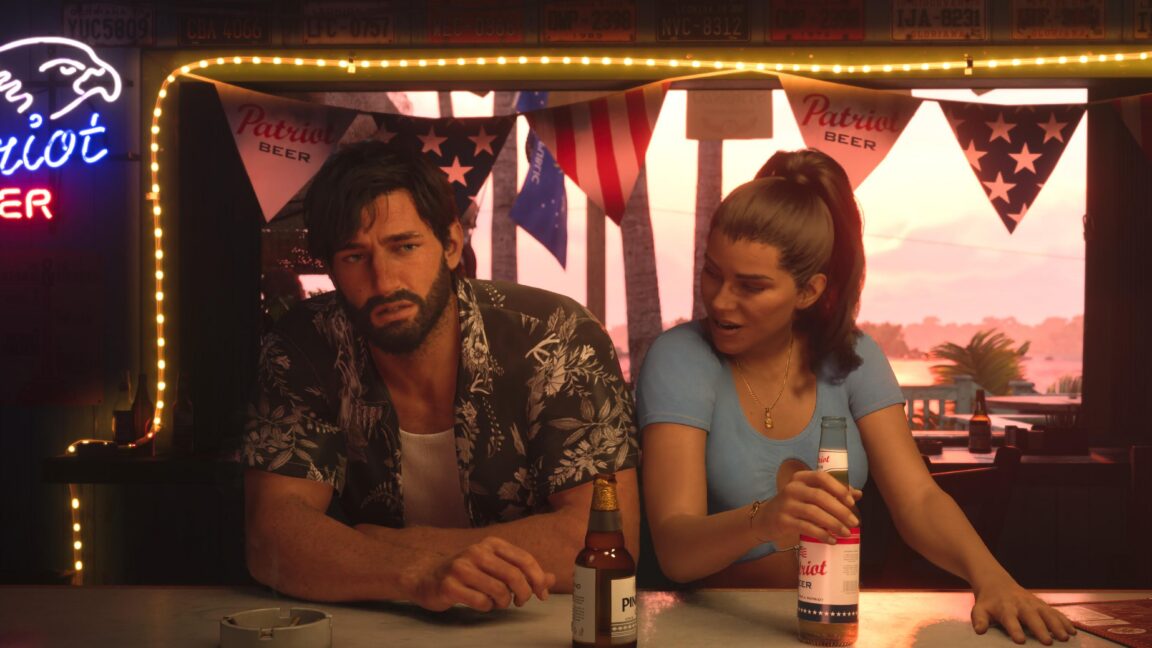
Grand Theft Auto VI blends intense crime action with intimate daily life. The game creates a world where violence and routine coexist in a believable, surreal balance. At its heart are Jason and Lucia, a couple navigating crime while building a real-life partnership.
The Dual Protagonists: Jason and Lucia
Jason and Lucia are the core of the story. Their relationship starts awkwardly—Lucia’s prison time leaves emotional scars. Jason, a former military man, speaks little and often says ‘Yeah, sure, that’s fine.’ But subtle moments show he’s not entirely emotionless.
Lucia is vibrant and energetic. Her background includes economic hardship and a strained relationship with her mother. These details shape her journey—she wants to escape poverty and build a future with Jason.
They bond through everyday moments: talking on the couch, sharing a laugh, or protecting each other in a firefight. These scenes feel real, not romanticized. The game avoids over-the-top emotion, making their connection feel earned.
While players can switch between them, it’s in their shared moments that the emotional depth shines. Simple acts—grilling burgers, playing fetch, helping a neighbor—show that crime isn’t the only form of connection.
Relationship Mechanics and Simulations
The game includes a basic relationship system with a ‘heart level’ that rises or falls based on simple choices. Choices are straightforward—like staying with Jason or going to work. There’s no drama or emotional conflict.
For example, if Lucia has a job that requires late hours, the game asks: ‘Do you want to stay with Jason or go to work?’ The answer is practical, not emotional. The game doesn’t explore consequences or fallout.
Still, this simplicity works. The relationship feels real because it’s built on consistent, believable interactions. When Lucia teases Jason or Jason helps fix a broken appliance, these moments feel genuine and add emotional continuity.
Story Progression and Criminal Escalation
The game begins slowly. Lucia gently pushes Jason into introducing her to minor crooks. These early missions are like errands: drive to a warehouse, avoid police, return. The stakes are low, and the tone is light.
Many side characters are one-note—defined by a single trait or behavior. One wears a hat, another speaks in riddles. Their interactions are transactional, not deep. This reflects a common pattern in action games: using archetypes for quick world-building.
By the second half, the story shifts. Jason and Lucia join a professional criminal network. Missions grow complex—undercover ops, intelligence gathering, heists. The game alternates between Jason and Lucia to show their different skills.
For example, Jason manages security during a heist, while Lucia uses her social skills to gain access. These moments show how their partnership evolves from casual to strategic. The missions aren’t just about completing tasks—they build trust and show decision-making under pressure.
Gameplay and Action Sequences
Combat is familiar to fans. Players hide behind cover and fire at enemies with many weapons. Enemies often have poor aim, even at close range. Both protagonists take heavy punishment, making combat feel more like a simulation than a fight.
Driving is a highlight. The game features realistic traffic and dynamic handling. Players can navigate urban areas, avoid police, or chase targets. The variety of vehicles—sports cars, trucks, motorbikes, off-road—adds immersion. Each has unique handling.
Driving also opens side activities—drone racing, rally events, meditation spots. These offer rewards and appeal to both casual and completionist players. Drone racing requires precision, rally events involve obstacle courses. These aren’t filler—they support progression and exploration.
World Design and Environmental Detail
Vice City spans a vast, real-world-scaled map. Traveling from northern wilderness to southern keys covers over six miles and takes ten minutes under ideal traffic. Distances and travel times reflect real-world conditions.
The city changes noticeably by region. From gated communities to downtown skyscrapers, to backwoods swamps and island towns, each area has a distinct tone and activity level. These shifts affect mood and gameplay.
Interior spaces are where the game truly shines. Each mission introduces a new, fully furnished space. These feel lived-in—kitchens have chipped mugs, bedrooms have half-finished books, living rooms are cluttered with personal items. These details show the spaces are homes, not just settings.
The crowd system is impressive. Over a hundred non-player characters appear in a single space, each with unique looks, clothes, and movements. Players can eavesdrop on conversations, overhear arguments, or observe daily routines. These interactions feel organic, not scripted.
Environmental details are carefully coded. Clothes show dust only where they touch the ground. Older characters have visible veins and wrinkles. Fabric and hair move naturally. During storms, rain beads and drips realistically. These small touches build immersion and realism.
Visual and Lighting Effects
The lighting system is one of the game’s strongest features. At night, headlights and police lights cast dramatic, otherworldly glows. A car driving through a dark alley creates long shadows and reflections on wet surfaces. These moments feel atmospheric and immersive.
Even in daylight, details stand out. A laptop screen reflects in a character’s glasses. Laser effects play across dancers in a club. Tree shadows shift with the sun. These moments form a consistent visual language that enhances realism.
One moment stands out: Lucia eats chips while preparing for a firefight. As she picks up a soda, she shakes the bag above her head to pour chips into her mouth. This specific, nuanced action—coded for a rare edge case—shows the game’s deep commitment to realism and immersion.
Development and Technical Scale
Grand Theft Auto VI took about a decade to develop with thousands of Rockstar staff. The reported budget reached one billion dollars. Development involved extensive world-building, scripting, and simulation design. The team focused on creating a persistent, evolving world where player actions matter.
The process wasn’t just about building a game—it was about building a world. Designers spent countless hours crafting environments, scripting dialogue, and refining mechanics. The world evolves based on player choices, and the narrative adapts in response.
While side missions offer new mechanics, some still feel like tutorials. They are designed to teach systems, not serve the story. These moments can interrupt pacing and feel out of place.


Humor and Satire
The humor has aged. Jokes about kinky sex or male anatomy feel dated compared to early 2000s Grand Theft Auto humor. These moments rely on crude stereotypes and are often over-the-top.
Some satire targets modern trends—like crypto bros and multi-level marketing. A character runs a scheme with a PowerPoint and fake success stories. The game mocks the absurdity with exaggerated dialogue and gags. This critique is sharp but lacks deeper societal insight.
Still, the game offers little social commentary. Jokes about ‘wokeness’ feel like outdated tropes. The humor is surface-level, relying on punchlines rather than nuanced exploration. This reflects a broader trend in gaming—using satire for entertainment, not critique.
Target Audience and Content Rating
The game is rated M for Mature. This reflects graphic violence, sexual themes, and mature humor. It marks a shift from earlier entries, which earned AO ratings for limited content. The current M rating shows broader acceptance of mature content in gaming.
Parents should know the game includes explicit content. It’s not suitable for children or young teens. It’s designed for mature players comfortable with explicit scenes and seeking a realistic, immersive experience.
Why This Matters
Grand Theft Auto VI represents a major evolution in game design. It balances action with emotional realism, showing how a game can simulate both crime and everyday life. It proves a world can feel expansive and intimate at the same time.
For players, it offers deep immersion. For developers, it sets a new benchmark in world-building and player engagement. Its success may influence future games to prioritize emotional authenticity over spectacle.
Despite strengths, the game has flaws. Many side missions feel repetitive or like tutorials. The criminal world lacks deeper moral or societal exploration. Some characters rely on clichés. The relationship simulation is underdeveloped. There’s no co-op mode, which limits shared experiences. This omission is notable given the game’s focus on partnership.
The narrative pacing is uneven. Early sections feel slow. Later heists are intense but lack cohesion. It’s unclear how the game will evolve beyond its current scope. Future updates may fix these issues, but no roadmap has been released.
For now, Grand Theft Auto VI stands as a technically impressive and emotionally grounded experience—though not without shortcomings.
Original source: Ars Technica
For more on the making of Grand Theft Auto VI, see Bloomberg’s feature on development.
Read the full review and community reactions at the review’s comments section.
Sources & further reading
Featured image: original publisher image. Via original publisher. Image source