Prime Minister Mark Carney has asked Canadian provinces to restore US alcohol to the shelves of supermarkets as a trade deal with the US edges closer.
Trade negotiators met on Wednesday for the third time in as many days after US President Donald Trump paused a new wave of tariffs he had threatened to impose overnight on a range of Canadian goods.
Details on what the agreement includes have not yet been announced, but the premier of Nova Scotia said Carney had asked for an end to the boycott of US whiskey and other drinks.
Reports suggest the deal may cover Canadian steel, aluminium and cars, in addition to US alcohol.
Trump said the proposed deal would be welcomed by US farmers and manufacturers, while Carney said it will secure “the best terms” for Canada’s strategic sectors and provide certainty on the future of US-Canada trade.
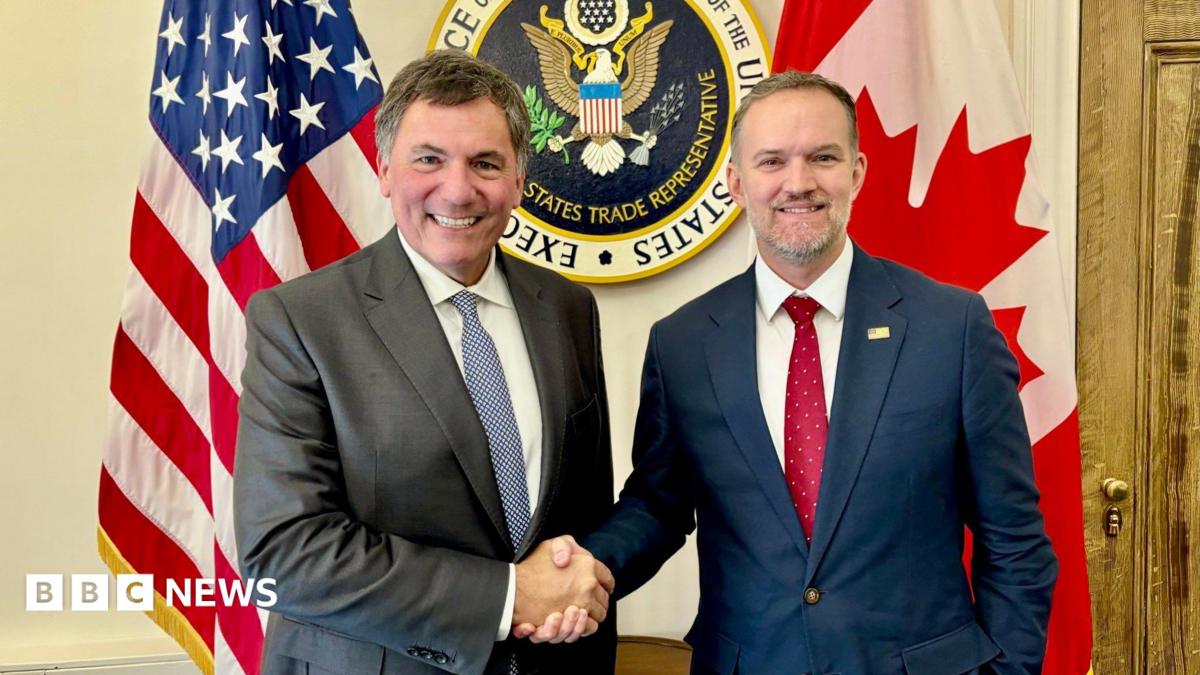
Speaking to reporters on Wednesday after a 45-minute meeting with his Canadian counterpart, US trade representative Jamieson Greer said the US was “very happy” and that the deal eliminated “some of the irritants” with Canada.
“We feel confident that we’ve reached an agreement that will not only continue to protect American workers, American jobs, American supply chains, but really strengthen the North American economy,” Greer said.
He said he will soon brief Congress and US stakeholders on the deal’s details.
Canada has been in pursuit of a deal that would have the US drop or reduce tariffs on its steel, aluminium, automobiles and lumber.
Under a deal that could be completed by Friday, US tariffs on Canadian steel and aluminum would reportedly be cut to 25% from 50%.
The US may also lower its headline tariff rate on Canadian-made vehicles from 25% to 15%, according to reports from US and Canadian media.
The prime minister met his cabinet and leaders of Canadian provinces on Wednesday afternoon to brief them.
Following Carney’s meeting, Nova Scotia Premier Tim Houston said the prime minister asked provinces to return US alcohol to Canadian markets.
“It’s been something that has kind of really bothered the United States for so many reasons,” Houston said. “Now, whether Canadians will really buy it when it’s back on the shelf, that’s a whole other discussion.”
Most Canadian provinces banned US alcohol sales last year in retaliation to Trump’s tariffs.
The US, meanwhile, has been asking for a number of concessions from Canada, including removing its remaining retaliatory tariffs on American vehicles and adjusting its dairy quotas to allow greater access for US cheese producers.
Asked on Wednesday if the latest deal will include significant concessions on dairy, trade minister Dominic LeBlanc said that Canada’s dairy supply management programme – which oversees production quotas and sets pricing and import quotas on dairy, eggs and poultry – will remain “entirely intact”.
Polls suggest that a majority of Canadians would be unhappy if the Carney government made significant concessions to the US, with 56% surveyed by polling firm Leger, external saying they wanted Canada to take a hardline approach.
But business organisations from both sides of the border have lobbied for a deal to be reached, cautioning that additional tariffs between the two trading partners would be harmful for both countries.
Dennis Darby, president of Canadian Manufacturers and Exporters and a member of Carney’s advisory committee on Canada-US trade, told the BBC he was optimistic a finalised deal was on the horizon.
“The committee was informed this morning that the negotiations continue and that we’re close, and that’s more positive than we’ve seen in some time,” Darby said.
He added that businesses hoped this would be the first step towards a return to the terms set under the North American free-trade agreement, known as USMCA, with most goods flowing tariff-free through Canada, the US and Mexico.
Additional reporting by Peter Hoskins