Asia-Pacific, Central Asia, Civil Society, Economy & Trade, Editors’ Choice, Education, Featured, Freedom of Expression, Headlines, Human Rights, Population, Press Freedom, Sustainable Development Goals, TerraViva United Nations, Youth, Youth Thought Leaders
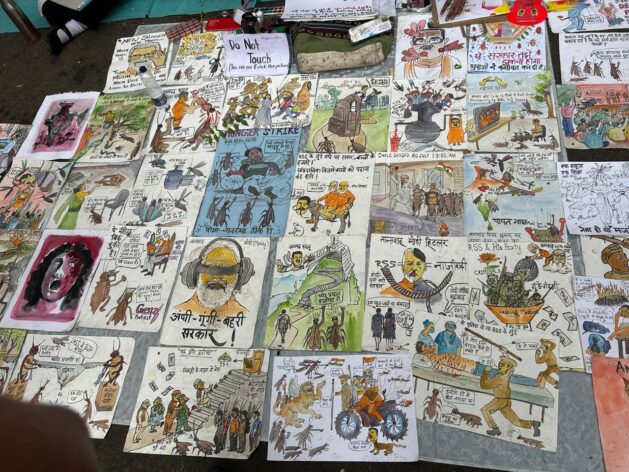

Student-made posters and artwork line the streets of Jantar Mantar, capturing messages of resistance and hope.
Aishwarya Bajpai/IPS
NEW DELHI, Jul 27 2026 (IPS) – On July 25, after 50 days of protest at Delhi’s Jantar Mantar, Union Education Minister Dharmendra Pradhan resigned.
The movement had begun in May as a satirical social media page called the Cockroach Janta Party, founded by Abhijeet Dipke after the Chief Justice of India, Surya Kant, used the term “cockroaches” during a Supreme Court hearing, apparently referring to young people with fake law degrees, but his remark sparked a massive public backlash.
Weeks later, the NEET-UG paper (for admission into medical colleges) leaked, and alleged irregularities in the Central Board of Secondary Education on-screen marking process transformed satire into a nationwide campaign.
On June 6, Dipke called for a sit-in protest at Jantar Mantar, demanding Pradhan’s resignation. But by the time the protest entered its seventh week, the movement had outgrown its original demand – and many argue that replacing one minister will not restore faith in an education system battered by paper leaks, administrative failures and growing privatisation.
The crowd reflected that evolution.
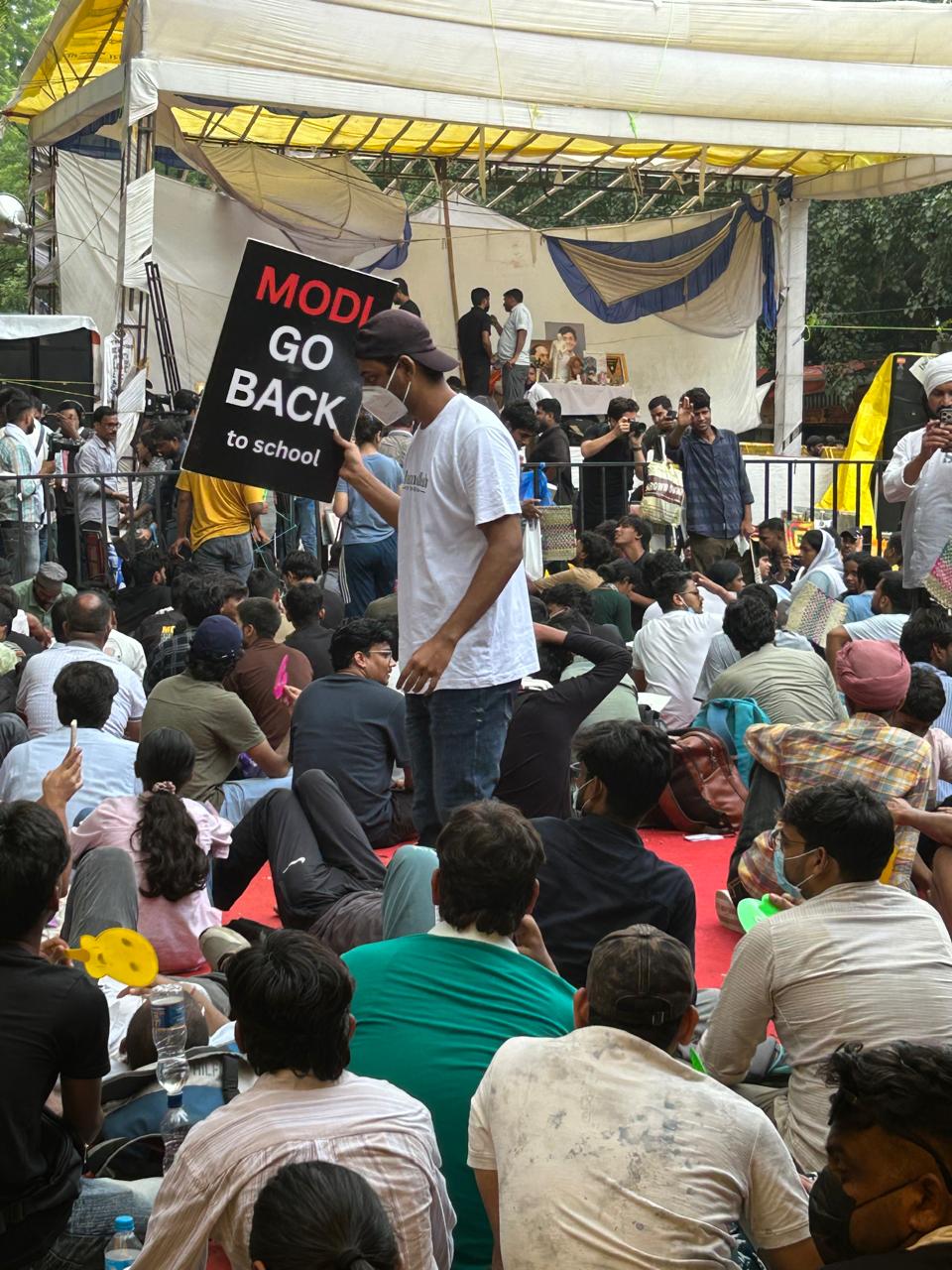

Protesters gather at the main stage at Jantar Mantar, where peaceful demonstrations and slogans continued throughout the sit-in. The stage later became the focal point of the movement as education reformer Sonam Wangchuk began his indefinite hunger strike. Credit: Aishwarya Bajpai/IPS
The seat of the protest, Jantar Mantar, had become far more than a student protest. Farmers stood beside parents, young professionals, senior citizens, queer activists and wage labourers. Volunteers distributed food, arranged train tickets for protesters travelling home and coordinated donations. People travelled from across India, while a handful of foreign nationals joined in solidarity. Despite their different backgrounds, they shared one belief — that the crisis threatened the future of public education itself.
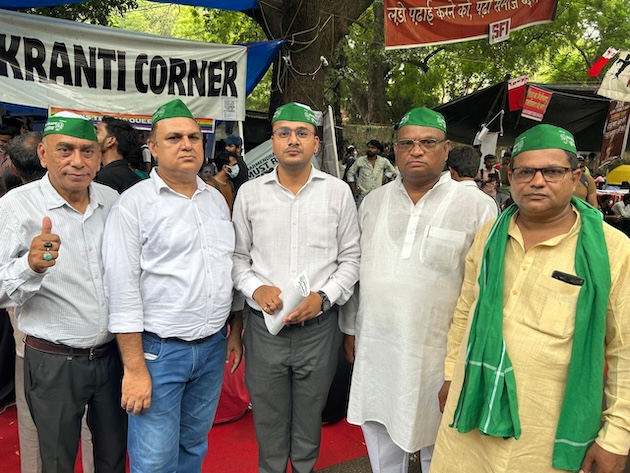

Ashutosh Agarwal (centre), national vice-president of the Bharatiya Kisan Union, India’s Youth Wing, stands with colleagues from Meerut in solidarity with the student-led movement. Credit: Aishwarya Bajpai/IPS
The seriousness and urgency are also reflected in the numbers. India has recorded 152 examination paper leaks in the past decade – roughly one every month. In 2026 alone, more than 20 million candidates appeared for NEET-UG, while reports of the leak were followed by the deaths of nearly 20 aspirants by suicide. Yet clearing these examinations offers no certainty. According to the State of Working India 2026 report by Azim Premji University, nearly 40% of graduates aged 15–25 remain unemployed, while unemployment among graduates aged 25–29 stands at 20%. Although the country produced 5 million graduates each year between 2004/05 and 2023, only 2.8 million found employment.
As the protests grew, they also drew support from opposition leaders, public figures and education reformers, expanding the movement beyond student circles.
The turning point came on June 28, when education reformer Sonam Wangchuk joined the sit-in with an indefinite hunger strike. CJP announced a march to Parliament on July 20, the opening day of the Monsoon Session. Later, on 18th July, Delhi Police removed Wangchuk from the protest site and admitted him to Safdarjung Hospital for medical observation, a move his family described as forced hospitalisation against his wishes.
What followed altered the course of the movement.
On July 20, police and the Rapid Action Force dispersed marchers using batons, tear gas, water cannons and pellet guns. Protesters alleged that some lathis were studded with nails, while the RAF’s own chief later admitted that “excessive force” had been used during the operation.
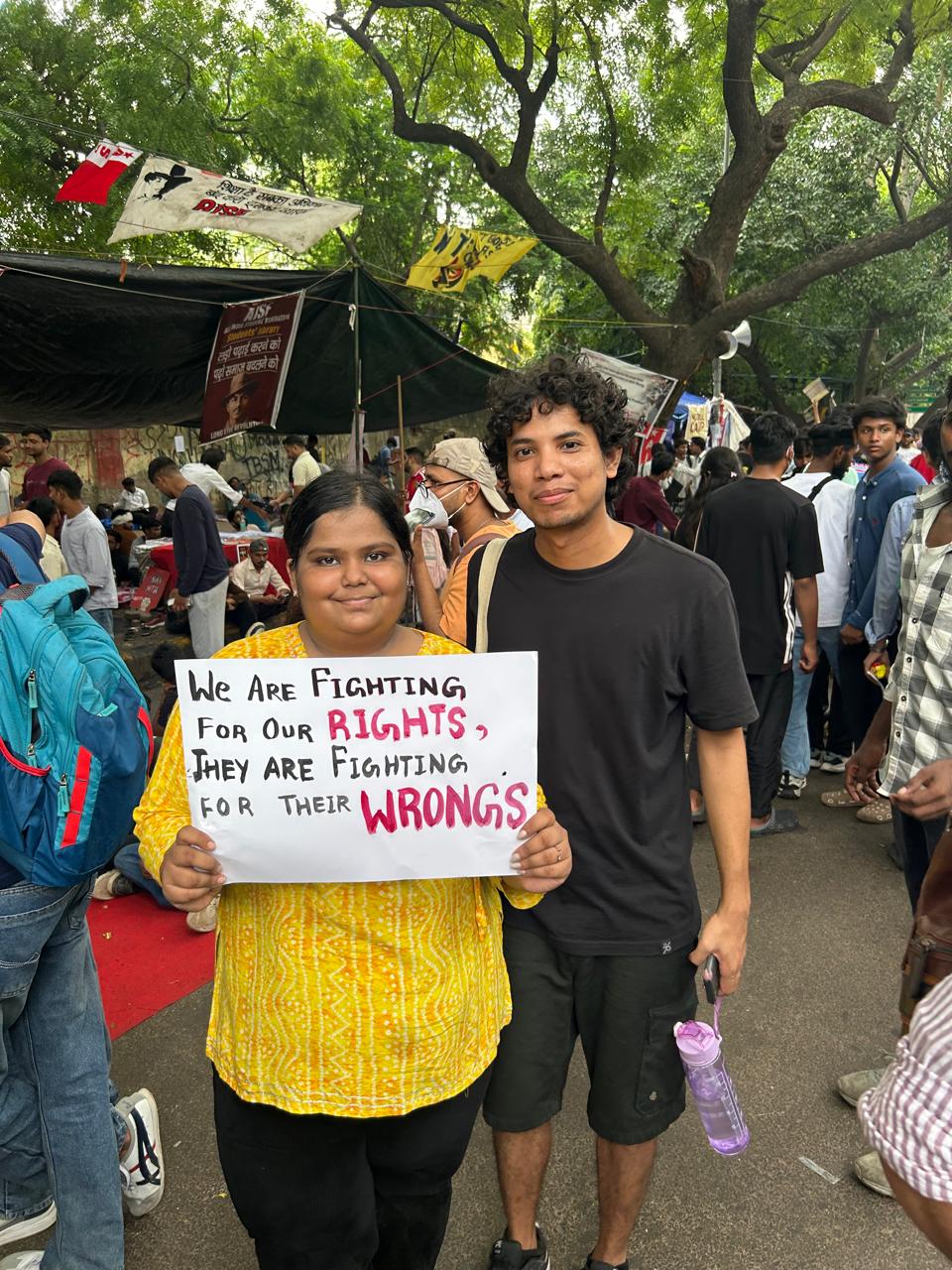
Nazia Khanam (left) and her friend travelled across Delhi to join the protest. Credit: Aishwarya Bajpai/IPS
Instead of dispersing the protesters, however, the crackdown brought more people to Jantar Mantar.
Nineteen-year-old Anshil Khan was among those who returned.
A first-year student at Delhi Skill and Entrepreneurship University, he had spent nearly three weeks at the protest. Four days earlier, he said, police had beaten him while demonstrators were trying to march towards Parliament Street. Even as he spoke, he carried hospital reports documenting his injuries.
“I got hit three times by the Delhi police,” he said. “I have been resting for four days, and today I have come back.”
He recalled crossing two barricades before police stopped the march at the third.
“We were peacefully protesting and only raising slogans of “Inquilab Zindabad” (Long Live Revolution). Nothing violent happened from our side.”
Delhi Police had issued a public advisory before the march stating that no permission had been granted for any procession beyond the designated protest site and later maintained that officers were enforcing prohibitory orders. Officials also said that both protesters and security personnel suffered injuries during the clashes.
For Anshil, however, the police action only strengthened public support.
“The students are coming along with their parents now,” he said, referring to the days following Wangchuk’s detention and the July 20 crackdown.
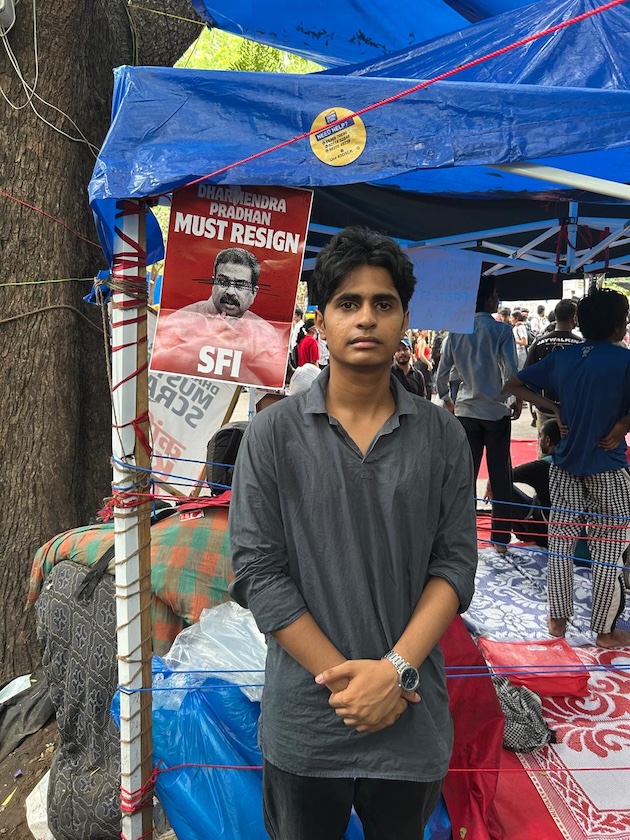
Anshil Khan, a member of the Students’ Federation of India (SFI), joins fellow protesters at Jantar Mantar. Credit: Aishwarya Bajpai/IPS
His demands had also evolved.
“Dharmendra Pradhan’s resignation is the first step,” he said. “Education is our first priority.”
That sentiment surfaced repeatedly across conversations at Jantar Mantar. Protesters were no longer speaking only about accountability for one minister; they were debating how India’s education system itself should function.
Standing nearby with a placard reading “We are fighting for our rights,” Nazia Khanam had travelled across Delhi to join the demonstration, despite never having been directly affected by an examination scandal.
A law student from Jodhpur interning in the capital, Khanam had successfully cleared the Common Law Admission Test (CLAT). But with her younger sister now preparing for the same examination, she felt she could not remain on the sidelines.
“Being an elder sister of a student who is going to give a competitive exam, it becomes my responsibility,” she said. “Even though I’m not personally affected, I should still come here and raise my voice.”
Unlike many demonstrations driven solely by outrage, Khanam arrived with ideas for reform.
“There should be stricter checks and balances at every bureaucratic level,” she said, referring to agencies such as the National Testing Agency, examination centres and other bodies involved in conducting competitive exams.
She also questioned how education policy is made.
“There should be other stakeholders involved,” she said. “Educators who have done actual groundwork, who know the ground reality, should be part of consultations before policies are formulated like Sonam Wangchuk.”
That conversation had drawn unexpected allies.
Among those standing with the students was Ashutosh Agarwal, National Vice-President of the Bharatiya Kisan Union, India’s youth wing. Before arriving in Delhi, he said, the union had organised meetings across Meerut, Muzaffarnagar and other parts of western Uttar Pradesh to mobilise support for the students.
“We demand one nation, one education,” he said.
For Agarwal, the increasing commercialisation of essential public services was inseparable from the examination crisis.
“We demand the end of privatisation of both education and health,” he said. “Otherwise paper leaks won’t stop.”
He argued that growing corporate influence over private schools, colleges and hospitals had weakened public institutions, making quality education increasingly inaccessible.
Parents had reached a similar conclusion.
Alisha Siddique came to Jantar Mantar thinking about her three children, particularly her daughter pursuing a Bachelor of Science degree. Unlike many protesters, she did not begin with paper leaks. Instead, she pointed to the everyday rules that, in her view, unfairly punish students.
“If students reach one or two minutes late because of an accident or emergency, they are not allowed to sit for the exam,” she said. “Their entire year’s hard work goes to waste.”
For Siddique, the issue was larger than examinations.
“We want our children to become good citizens,” she said. “That starts with good education.”
The examination crisis merely provided the spark for Avinash Kumar, a human rights practitioner and activist who is the former Executive Director of Amnesty International India and the Director of Policy, Research and Campaigns at Oxfam India.
“The constant leaking cauldron of competitive exams provided that cause,” he said. “Yet everyone knows it’s now not just about that.”
According to Kumar, the protests became an outlet for frustrations that had accumulated over years — declining public services, rising costs, increasing privatisation, shrinking civic freedoms and a growing sense that institutions no longer worked for ordinary citizens.
“You need a cause which cuts across classes and masses, age and gender and religion,” he said. “Competitive exams became that cause.”
What struck Kumar most was not just the scale of the demonstrations in Delhi but also the emergence of protests in places that rarely make national headlines.
“My attention was particularly drawn towards mass-scale showings in small unknown towns like Begusarai, Narnaul and Aurangabad,” he said. “All were speaking in one language of years of frustration.”
To him, that distinguished this movement from many previous protests.
Rather than revolving around one organisation or one political leader, it drew strength from multiple voices – student leaders, education reformers, farmers, parents, opposition politicians and ordinary citizens – each contributing from their own experience.
“It is a movement with very different leaders at different points of time,” Kumar said.
Two days after resignation, the protest site is almost empty.
The questions raised over 50 days of protest — about accountability, privatisation, public education and the future promised to India’s youth — remain standing.
IPS UN Bureau Report


-

-

-

-