Climate negotiations at the COP31 UN climate summit in Turkey have stalled. Countries failed to agree on a new global climate agreement after overnight talks. Source: bbc.co.uk.
Deadlock Over Fossil Fuel References
A draft agreement omitted any mention of reducing fossil fuel demand. This sparked strong opposition from several nations.
France and Panama led a coalition pushing back. They argue such a gap fails to address climate change’s root causes.
France’s Minister of Ecological Transition, Monique Barbut, said it’s unacceptable to pass a climate deal without fossil fuels. She warned carbon capture could be used as a loophole to keep burning oil and gas.
Barbut said: "We cannot announce 1.5°C warming and act as if nothing happened." Her comments highlight growing concern that current policies may allow high-emission practices to continue.
Island States and EU Nations Advocate for Change
Ministers from island nations, Panama, and EU countries like Spain, Belgium, Sweden, and Finland support a fossil fuel phase-out in the final agreement.
One EU negotiator said: "How can a climate deal ignore the source of emissions?" But not all EU nations joined. Some saw it as damaging to broader talks.
Developing Nations Demand Financial Commitments
They say climate impacts hit the Global South hardest. Infrastructure is weaker, and people face rising seas and extreme weather.
Zanetor Agyeman Rawlings, Ghana’s Environment Minister and African Group chair, said: "We did not come here to beg. We came here to claim what is rightfully ours for our people who are suffering from developed countries’ actions."
Her statement reflects a demand for fairness and shared responsibility in climate action.
Proposed Compromise: Fossil Fuel Exclusion in Exchange for Clean Energy Pledges
A proposal suggests removing fossil fuel references in exchange for oil-producing nations, including Saudi Arabia, committing to 35% clean electricity by 2035.
While this may ease some concerns, it does not fix the lack of funding for adaptation in vulnerable nations.
Key Facts and Timeline
- The COP31 summit took place in Turkey.
- Negotiations ran into the night. No agreement was reached by Friday evening.
- France and Panama led a group opposing the fossil fuel omission.
- France’s Minister Monique Barbut criticized carbon capture as a loophole for continued fossil fuel use.
- One proposal offers a 35% clean energy pledge from oil-producing nations in exchange for fossil fuel references being removed.
- A new final agreement is expected to be published on Saturday.
Why This Matters
For the first time at a COP, the Antalya Accords acknowledge the 1.5°C warming goal has been missed.
The world is now in a period called "overshoot"—when warming exceeds the Paris Agreement’s 1.5°C limit.
Scientists warn millions more people will face rising seas and extreme heat beyond this point. Coastal and low-lying areas are especially at risk.
Without clear fossil fuel reductions and financial support, climate impacts will grow stronger and faster.
What to Watch Next
Final negotiations will continue into Saturday.
Whether the agreement includes a fossil fuel phase-out remains uncertain.
Any final text must balance urgent climate action with the financial needs of developing nations.
The outcome could shape global energy policy for decades to come.
Source: BBC News
For more on how ocean currents influence global weather patterns, see El Niño’s Climate Power.
Sources & further reading
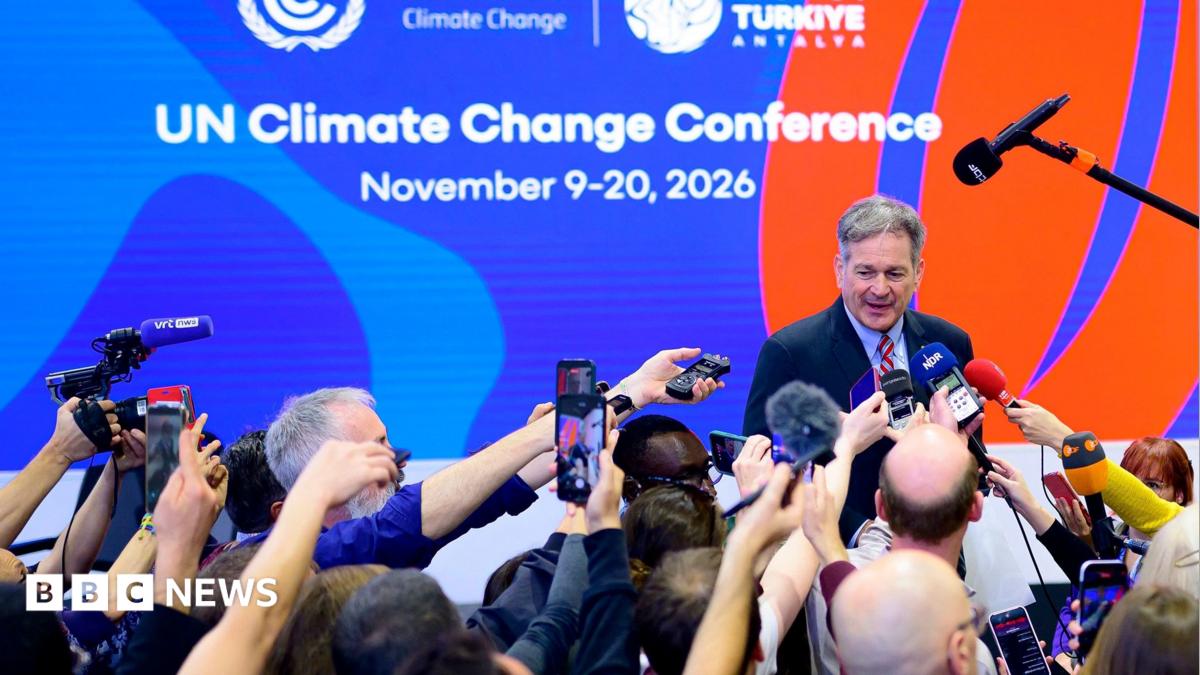
Featured image: A man in a blue suit and red tie is surrounded by the world's press. In the background is a screen that reads "UN Climate Change Conference, November 9-20 2026" and has the UN and Turkey Antalya logos. The screen has blue and red swirls on it.. Via original publisher. Image source