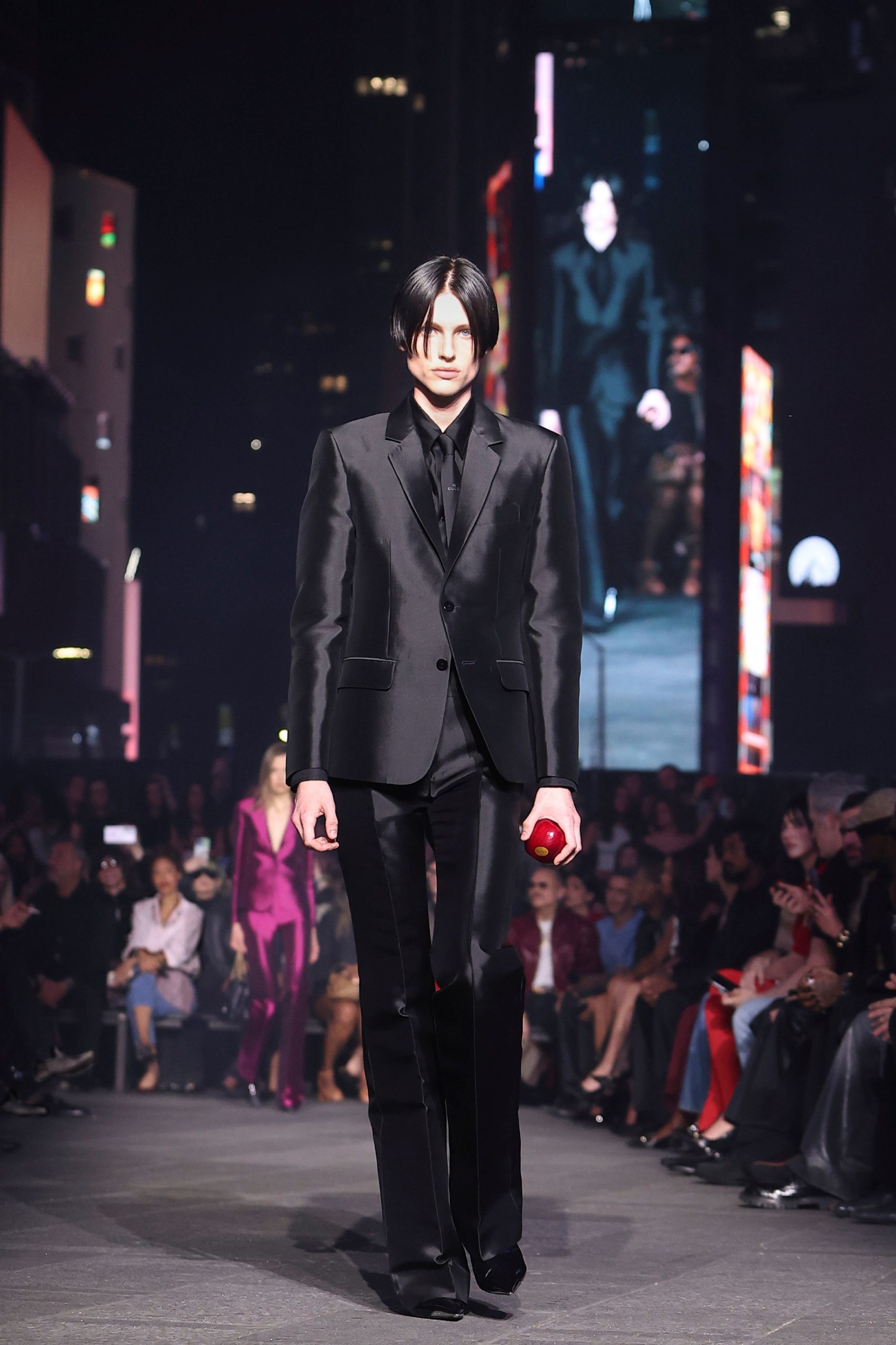
Since arriving at Gucci, Demna has adopted a “go big or go home” policy. The Spike Jonze and Halina Reijn-directed movie “The Tiger” that stood in for a show last September. The gargantuan February set flanked by an Uffizi’s worth of 3D-scanned statues. And now, his first cruise show staged smack dab in the middle of the City that Never Sleeps in the crucible of American consumerism that is Times Square. Digital invites landed in inboxes only this afternoon with the show’s address. Just think of the security permits, the negotiations with all the different parties—no brand has ever dared something so audacious.
At 8:30 pm, a half-hour before showtime, some 50 of the multi-story screens towering above the Square began playing found video footage. On cue, hundreds of phone screens lit up, recording the scenes of sunsets, snow-capped peaks, galloping horses, and what looked like AI generated garden scenes, and spliced in between them commercials for Gucci products both real and imaginary: Gucci Acqua (water, obviously), Gucci Viaggio (airplanes, “because the sky is not the limit”), even Gucci Life. “I like the kind of absurdity, the annoying interruption of the beautiful vision of the world by advertising something that you don’t have to sell,” Demna said. “That part was interesting for me.”
Selling, however, is very much the objective of the collection he presented. GucciCore, as he calls it, is a wardrobe of the kind of everyday fundamentals that he noticed have gone strangely missing at Gucci with the designer turnover that preceded him at the brand. But can a guy for whom irony and knowingness and irreverence are second nature (see: the above-mentioned ads which, fake or not, are proliferating exponentially on social media) actually make classic clothes?
At a preview, all of it was arranged on racks like it might be in a Gucci store in order to prove, it seemed, that, yes, he most certainly can. Jackets went from fitted to just this size of oversize, and included an excellent red peacoat in the heavy wool used for Buckingham Palace’s King’s Guard. Skirts ranged from short and trapeze-shaped to Carine Roitfeld-coded and pencil slim to mid-calf length in scarf printed pleats. And a fitted suit with exactingly tailored flared trousers had what Demna described as “the ultimate Gucci fit.”
It felt like a more complete vision than the one he put forth at his big show in February, with its insistence on slick, shrink-wrapped silhouettes. He called it “probably the most commercial collection I’ve ever done.” Here and there, it was laid on a little thick, like with the printed shirt dress and extroverted double-G belt modeled by a brunette Paris Hilton. But shown as it was with a fitted leather jacket and slouchy paisley print button-down, the pencil skirt hasn’t looked this relevant since Tom Ford was at Gucci.
A lot of its appeal came down to the styling and cast. To do something that felt of the city, Demna said, “I wanted to show the collection on the kind of people you might pass on the street, individuals with their own way of wearing clothes.” That’s an idea he’s riffed on since his Balenciaga days; back in 2022, he was at the Stock Exchange with that brand exploring New York characters, too. But what a cast this one had: the gallerist Jeanne Greenberg in a leather coat hand-painted in the Flora print; Rory Gevis, a painter of a certain age, in a chevron shearling and a panettone bag; Cindy Crawford in a feather sprigged gown; and, yes, Tom Brady doing his best Terminator in head-to-toe black leather. Uptown, downtown, outer borough, the whole lot, reproduced ad infinitum on the screens that surrounded them in a Gotham-sized hall of mirrors. Only in New York, kids!