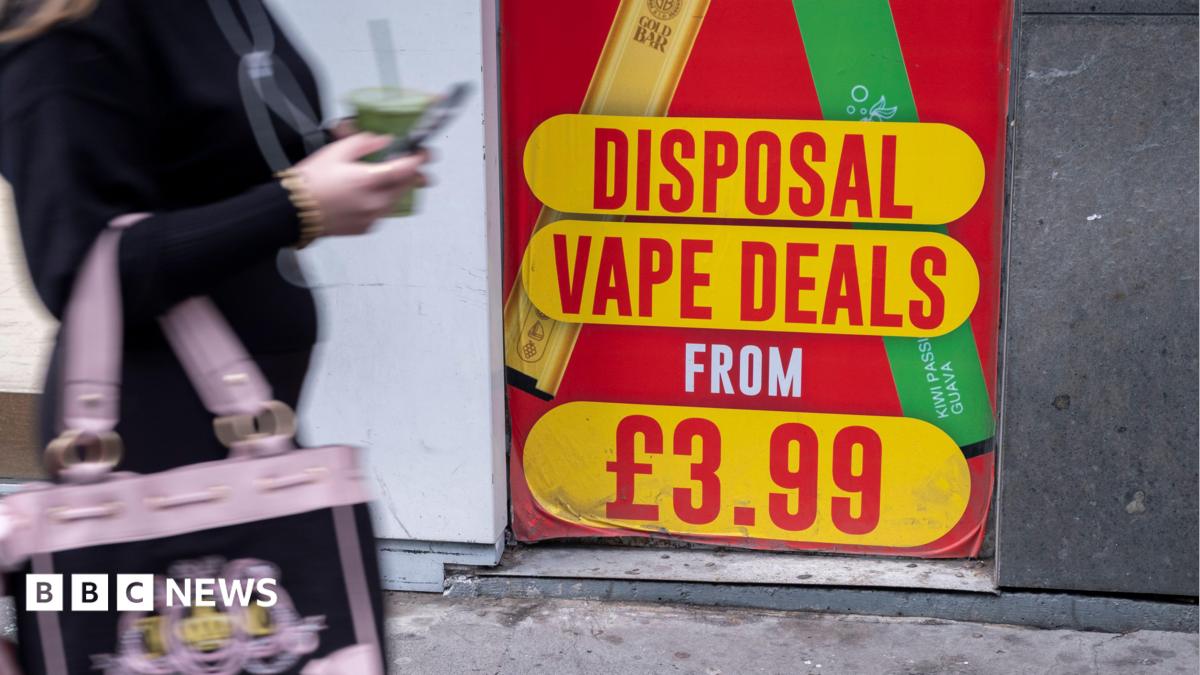
New vape shops will require planning permission and councils will get more powers to block new betting shops, under government plans aimed at improving high streets.
Prime Minister Andy Burnham said town centres had been “hollowed out” by decades of decline and for many people, the high streets they grew up with are “unrecognisable”.
He said the plans were “shaped” by a series of BBC News investigations which exposed organised crime on high streets, revealing shops selling illegal cigarettes, vapes, cannabis and cocaine, enabling illegal working and suspected money-laundering.
The Conservatives and Reform said the proposals would lead to “more empty” shops, without tax relief for other small businesses.
Burnham said the measures will give councils more power to control what businesses open in town centres.
The proposals come as the prime minister embarks on a tour of the UK, with Downing Street saying he will be in “listening mode” during his visits as he works on a “10-year plan to bring back hope”.
The plans announced by the government include:
-
Changes to planning law which would mean every new shop selling e-cigarettes, or vapes, would need to apply to their local council for permission to open (England only)
-
Tightening the definition of a vape shop to prevent businesses avoiding the rules by describing themselves as a general convenience store or retailer (England only)
-
Scrapping a rule known as “aim to permit”, which currently restricts councils’ ability to refuse new betting shops and 24-hour slot machine shops (Great Britain-wide)
-
Requiring planning permission for new adult gaming centres, which offer 24-hour access to gambling machines (England only)
-
New powers to extend closure orders for mini-marts and vape shops found to be selling illegal tobacco for up to twelve months, something previously proposed by former Prime Minister Sir Keir Starmer (England and Wales)
The National Crime Agency (NCA) estimates that at least £1bn of criminal cash is laundered through high street stores in the UK each year through businesses connected to the sale of fake goods, tax evasion, illegal working and illegal drug supply.
Burnham told the BBC that the changes would make it “easier for police to close a vape shop and have it closed for longer”.
He said: “At the same time we’re changing the planning regime… which should stop the proliferation of vape shops on our high streets.”
The prime minister added that Operation Vulcan in Cheetham Hill, Greater Manchester, cleared the area of counterfeits and crime and “proved” what could be achieved.
“When I look at police reform across England, I will be asking for a similar approach to be taken,” he said. “I want the strongest possible neighbourhood policing, with all agencies involved, to rip out criminal behaviour that is pulling places down.”
Burnham said he did not accept the decline of the high street as “inevitable”.
“I don’t see why anywhere should have to accept they have empty shops, vape shops and the challenges that come with that.”
Housing Secretary Angela Rayner told BBC Breakfast on Tuesday that many people were frustrated at vape and gambling outlets “popping up even near schools and some of them are linked to illegal activity and crime”.
In response to the government announcement, Conservative shadow communities secretary Sir James Cleverly said “once-treasured shops” have been replaced by a “smattering of rogue operators”.
But Sir James said increases to business rates by Labour had left “empty units for whoever is left standing to fill”.
He said: “Unless the government takes steps to support the high streets and hard-working businesses, Labour’s increases in planning regulation will just mean more empty and boarded up shops.”
For the Liberal Democrats, home affairs spokesman Max Wilkinson said Burnham’s plan “could go up in a puff of smoke” unless he toughens up powers to “properly crack down on cowboy vape shops and dodgy operators”.
His calls included asking the prime minister to scrap the business rates system.
Reform UK economy spokesman Robert Jenrick said: “Until this government scraps the jobs tax, addresses sky-high business rates and provides real, fundamental support for high street businesses, this policy will only create even more empty shops on our high streets.”
A Green Party spokesperson said the government’s proposals “look like more inadequate tinkering and reannouncements”.
They called on the prime minister to “go further and allow councils to introduce rent controls for small businesses”.
The Betting and Gaming Council said it supports “tough action against criminal operator” and agrees “local people should have a proper say over their high streets”.
A spokesperson for the industry body added it was “simply wrong” to suggest that betting shops are spreading “unchecked”, adding around 3,000 shops have closed since 2019.
Councillor Eamonn O’Brien, who chairs the Local Government Association, said it was “positive” that councils and communities “will get a greater say on what shops and services are found on their high streets”.
Responding to Burnham’s announcement, Scotland’s First Minister John Swinney said his government would “explore further steps” around the prominence of vape shops.
In Scotland, any retailer can sell vaping products provided they register on a Scottish government portal. Planning permission is not required and there is no licensing scheme.
Swinney told BBC Scotland News that not all current high street outlets were “businesses that we’d all choose to be there, particularly vape shops and betting shops”.
For 18 months, BBC News has reported on high street organised crime, including drug gangs, money laundering, child sexual exploitation reports, immigration crime and ghost directors linked to shop fronts selling illegal cigarettes and illegal vapes.
In April 2025, the BBC joined the NCA as it raided barbers, mini-marts and vape shops in response to growing intelligence reports that some of these shops were being used for money laundering and illegal working.
In May and June of last year, the team found secret underground tunnels supplying sacks of illegal cigarettes to high street mini-marts in Hull.
In July last year, mass Freedom of Information requests revealed for the first time that 3,700 illegal shops had operated across the UK.
In November, the BBC exposed asylum seekers buying and selling high street mini-marts for cash and criminal kingpins erasing £60,000 illegal working fines, and revealed a Kurdish organised crime gang operating on high streets the length of Britain.
In response, Home Secretary Shabana Mahmood launched an “urgent” investigation led by the NCA, Immigration Enforcement, HMRC and police forces from across the country.
She said the BBC’s evidence proved that “the system was broken” and demonstrated a pull factor in the small boat crisis.
In March the BBC revealed a senior council worker had repeatedly shared with West Midlands authorities reports of children as young as 11 being sexually abused in high street mini-marts, and last month undercover reports exposed how cocaine, cannabis, laughing gas and prescription pills were being offered for sale.
One street visited in the West Midlands was described as “lawless” by an anonymous law enforcement source.
After the report, six mini-marts and vape shops on one high street in Cradley Heath were forced to close following an investigation by police and Trading Standards.
Earlier this year, ministers announced a £30m enforcement operation targeting high street businesses suspected of money laundering, tax evasion and illegal working.
Raids involving police, HMRC, Trading Standards and Immigration Enforcement have since taken place across the country.
Additional reporting by Phill Edwards and Richard Wheeler