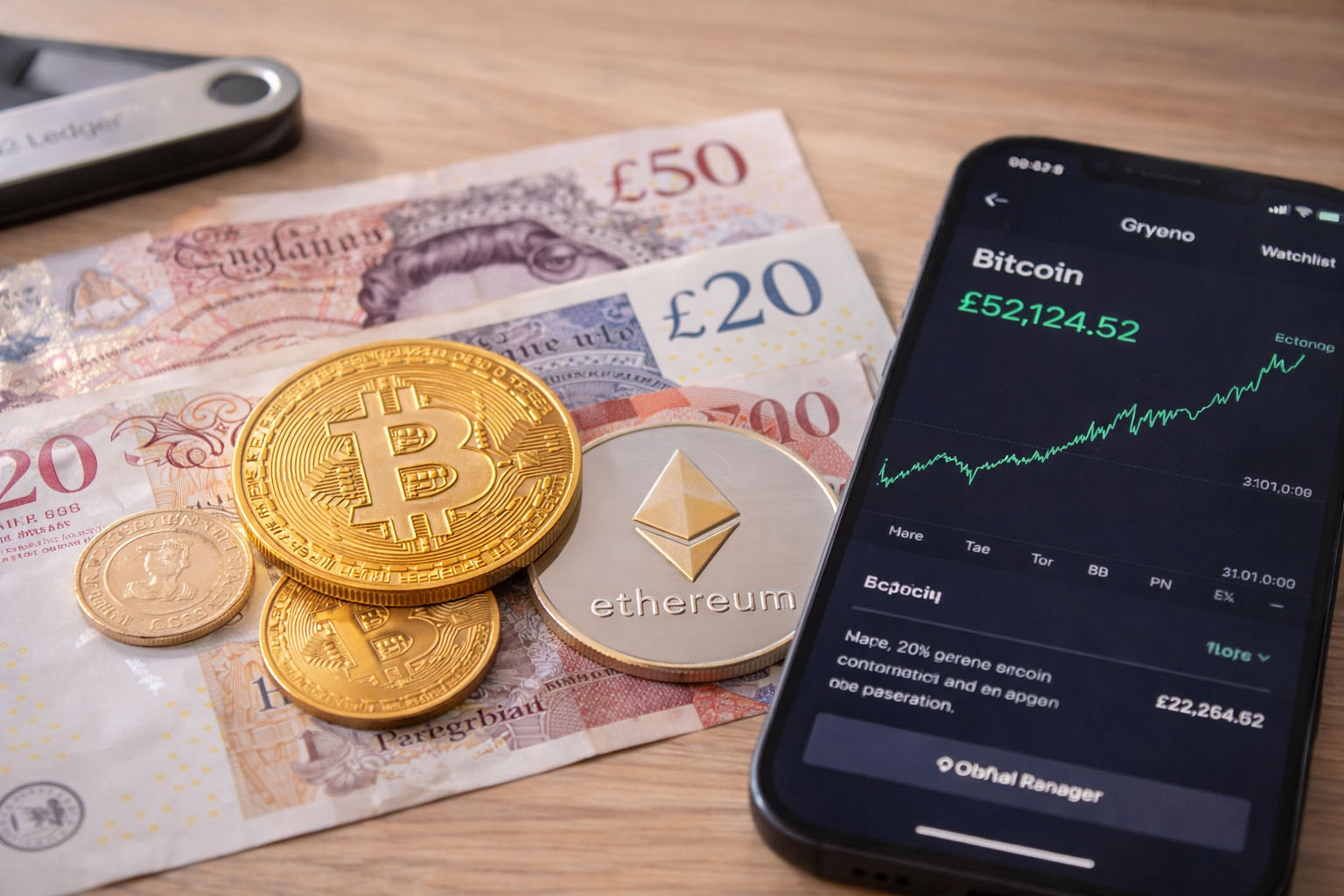
Crypto can be exciting—but it’s also high risk, full of confusing jargon, and heavily targeted by scammers. If you’re in the UK and you’re starting from zero, this guide will help you understand where to buy, how wallets work, how to stay safe, and how to spot the most common scams.
Important: This is educational information, not financial advice. Crypto is high risk and you should be prepared to lose the money you invest.
Crypto in one minute: what you’re actually buying
A cryptocurrency (like Bitcoin) is a digital asset recorded on a blockchain (a shared database). When you “buy crypto,” you’re usually buying:
- the asset itself (e.g., BTC, ETH), held in a wallet, or
- exposure through a product (which can carry different risks and rules)
The #1 beginner mistake
Thinking crypto works like a bank account. It doesn’t.
- In crypto, you can be your own bank (self-custody)—but that means you’re responsible for security.
- If you use an exchange, they can hold the crypto for you (custody)—but you take counterparty risk if the platform fails.
UK basics: what regulation does (and doesn’t) protect you from
In the UK, crypto rules are evolving, but key consumer warnings have stayed consistent:
- The FCA is the AML/CTF supervisor for UK cryptoasset businesses under the Money Laundering Regulations.
- The UK introduced a cryptoasset financial promotions regime (rules about how crypto is marketed to UK consumers).
- Most cryptoassets aren’t covered by the Financial Services Compensation Scheme (FSCS) if a platform fails.
The takeaway: regulation can improve standards, but it does not guarantee your money is safe.
Exchanges vs wallets: what’s the difference?
Exchange (where you buy/sell)
An exchange is like a marketplace/app where you can:
- deposit GBP
- buy crypto
- trade or convert coins
- withdraw crypto to a wallet
Beginner-friendly: easier UI, fewer steps
Risk: if the exchange is hacked, collapses, freezes withdrawals, or you lose account access, you may lose funds.
Wallet (where you store/hold)
A wallet is how you control your crypto.
There are two main types:
1) Custodial wallet (exchange wallet)
- The exchange holds the private keys
- You log in with email/password/2FA
Pros: easy recovery, simple
Cons: “Not your keys, not your coins” risk
2) Non-custodial wallet (self-custody)
- You control the private keys via a seed phrase
- No one can reset it for you
Pros: maximum control
Cons: if you lose your seed phrase, funds may be unrecoverable
Wallet types explained: hot vs cold storage
Hot wallet (connected to the internet)
Examples: mobile wallets, browser extension wallets
Best for: small amounts, learning, regular use
Risk: phishing and malware attacks are more common
Cold wallet (offline, hardware wallet)
Examples: dedicated hardware devices
Best for: larger holdings, long-term storage
Trade-off: extra cost and extra setup steps
Rule of thumb:
- learning / spending money → hot wallet
- savings you’d be upset to lose → cold wallet
How to choose a crypto exchange in the UK (safely)
Use a safety-first checklist:
1) Check FCA status (don’t skip this)
Look for whether the firm is on the FCA Cryptoasset Register or has FCA warnings against it. (The register relates to AML registration and is not the same as full FCA authorisation for all activities.)
2) Understand marketing rules
Crypto promotions to UK consumers fall under the financial promotions regime—this affects what firms can advertise and how.
3) Security features you want
- Strong 2FA options (prefer authenticator app)
- Withdrawal address allowlist (whitelisting)
- Anti-phishing code (email verification phrase)
- Proof-of-reserves (helpful, not perfect)
- Clear incident history and transparency
4) Fees and spreads
- Trading fee (maker/taker)
- Deposit/withdrawal fees
- Spread (difference between buy/sell price)
Beginner setup: the safest first purchase flow
Here’s a cautious path many beginners use:
- Choose an exchange (do the FCA + security checks above)
- Turn on 2FA immediately (authenticator app, not SMS if you can avoid it)
- Start with a small test amount you can afford to lose
- Buy a major asset (beginners often start with BTC/ETH rather than unknown tokens)
- If you plan to self-custody, withdraw a tiny test transaction to your wallet first
- Only then withdraw the larger amount
Why the test withdrawal matters: crypto transfers are not like bank transfers—mistakes can be permanent.
The safety checklist that prevents 90% of beginner losses
Do these once, then keep them forever:
Account security
- Use a unique password (password manager helps)
- Turn on 2FA
- Use an email address with strong security + 2FA
- Beware SIM-swap risk (SMS codes can be intercepted)
Wallet security
- Never store your seed phrase in screenshots, email, or cloud notes
- Write it down and store it securely (some use two secure locations)
- Never type seed phrases into random websites (that’s usually a scam)
Transaction safety
- Copy/paste addresses carefully
- Verify the first/last characters match
- Do small test transfers for new addresses
- Watch out for fake “address poisoning” transactions
Common crypto scams in the UK (and how to spot them)
Scammers don’t need to “hack crypto.” They hack people.
1) Fake support / impersonation scams
You get a message: “Support team here—your account is locked.”
They ask for:
- seed phrase
- 2FA code
- remote access to your PC/phone
Reality: real support will never ask for your seed phrase.
2) Phishing links and fake apps
Looks like a real exchange site—slightly different URL.
Fix: bookmark the official site and use the app store carefully.
3) “Guaranteed returns” and high-yield traps
Anything promising fixed high returns, “risk-free,” or “secret strategy” is a red flag.
4) Romance / “pig butchering” scams
A friendly person slowly introduces “a crypto investment opportunity.”
They show fake profits, then pressure bigger deposits.
5) Giveaway scams
“Send 0.1 BTC and we’ll send back 0.2 BTC.”
This is nearly always fraud.
6) Rug pulls and fake new coins
A new token is hyped, price spikes, then insiders sell and liquidity disappears.
Simple rule: if you can’t clearly explain what the project does and who runs it, don’t buy it.
If you think you’ve been scammed: what to do immediately (UK)
- Stop sending money (even if they promise recovery)
- Contact your bank/card provider if you transferred GBP (ask about recall/chargeback options)
- Contact the exchange immediately if your account is involved
- Report:
- Action Fraud (UK reporting centre)
- FCA (if the firm is on the warning list / misleading promotions)
Also change passwords and secure your email + phone number.
FAQ: quick beginner answers
Is crypto safe?
The technology can be robust, but users are frequently targeted by scams and phishing. Your safety depends heavily on your security habits.
Do I need a hardware wallet?
Not on day one. But for larger amounts you want to hold long term, a hardware wallet is often used to reduce online attack risk.
Is my crypto protected by FSCS?
Generally, cryptoassets are not FSCS-protected if a crypto platform fails.
Why do UK crypto adverts look different now?
Because of the UK cryptoasset financial promotions regime and related FCA rules.
Simple glossary (so you can read crypto pages without stress)
- Blockchain: shared ledger/database
- Private key: secret that controls funds
- Seed phrase: backup words that restore a wallet
- 2FA: two-factor authentication
- Custody: who controls the private keys
- Stablecoin: token designed to track a currency (e.g., USD)
- Gas fee: network fee (often on Ethereum-like networks)
Final checklist: your “safe beginner” plan
- ✅ Use FCA checks + basic due diligence before choosing platforms
- ✅ Turn on 2FA and lock down email
- ✅ Start with a small test amount
- ✅ Learn wallets and seed phrase security
- ✅ Treat DMs, “support,” and “guaranteed returns” as red flags