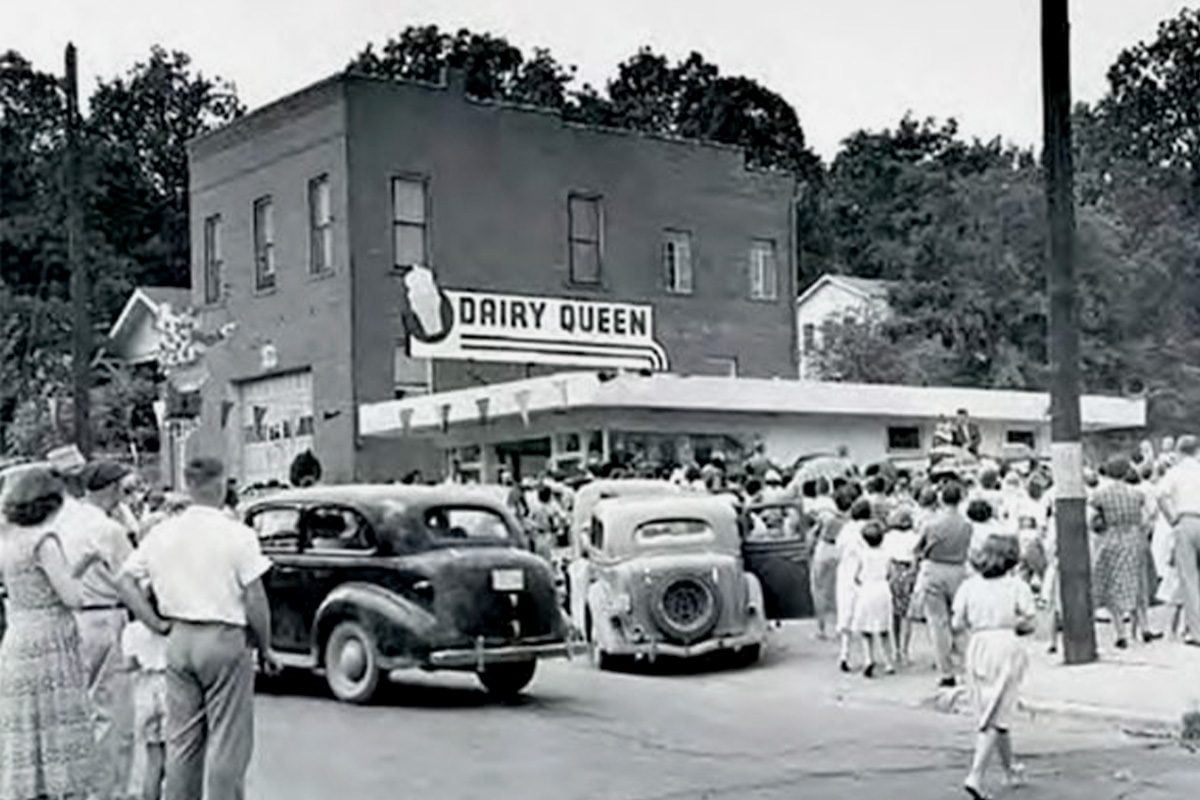


Long before Blizzards and burgers, Dairy Queen had one bold idea.
The original Dairy Queen menu feels almost impossible to believe. Not because of what was on it, but because of what wasn’t.
When the first Dairy Queen opened in Joliet, Illinois in 1940, there were no burgers, no Blizzards, no Dilly Bars, no magic shells—not even a milkshake. The entire menu fit on a single board. That’s because the original Dairy Queen wasn’t trying to offer customers more choices. It was asking them to try something they hadn’t experienced before: soft serve.
At the time, most Americans knew ice cream as something that was hard-packed and scooped by hand. Dairy Queen was betting a smoother, creamier version was exciting enough to make people forget everything they thought ice cream was supposed to be. Every item on that first menu—cones, sundaes, pints and quarts—was simply another way to order the same new idea.
Vanilla Soft Serve

Imagine opening an ice cream shop today with exactly one flavor and expecting that alone to draw a crowd. That’s essentially what Dairy Queen did.
Today, ice cream shops compete by promising more. More flavors. More toppings. More mix-ins. More choices than the place across the street. But the first Dairy Queen was all about simplicity. Soft serve itself was the attraction.
Americans were used to firmer, hand-scooped ice cream, so a creamy swirl served fresh from a machine felt like something entirely different. The menu didn’t ask customers to choose among dozens of desserts. It asked whether they wanted a 5-cent cone or an 8-cent sundae. Looking back now, it’s remarkable that one new texture was enough to launch one of America’s biggest restaurant chains.
Cones
The ice cream cone may be the most successful piece of food packaging ever invented. It works so well we barely notice it anymore. You don’t need dishes or silverware or even a table to place it on. But you’d better eat it fast if you order on a hot day!
That simplicity mattered. Dairy Queen didn’t invent the cone, but it embraced what the cone made possible: dessert on-the-go. Instead of elegant ice cream parlors where families settled in over dessert and coffee, Dairy Queen opened roadside stands for people who were already on their way somewhere else.
Long before fast food became synonymous with convenience, Dairy Queen had already built its business around food people could carry away in one hand.
Sundaes

Ordering a sundae in 1940 involved considerably less soul-searching than it does now. Back then, you got to choose chocolate, strawberry or pineapple. That was the entire decision. Nowadays, it feels like you have to study the menu before you even get to Dairy Queen. After all, it’s not just chocolate anymore. It’s chocolate sauce or hot fudge or Oreo crumbles or Heath crumbles or brownie bits.
One scoop of topping transformed simple soft serve into a different dessert—or at least made it feel like one. Restaurants have been happily borrowing that trick ever since.
Pints and Quarts

Why buy soft serve by the cone when you can order a whole quart?!
Customers could take home vanilla soft serve by the pint or quart, turning what most people probably thought of as a roadside treat into dessert for the whole family. It was a practical idea for a business built around one product. If someone loved your soft serve enough to take home a quart, you didn’t need to invent another dessert—you just needed a bigger container.
The Dairy Queen We Know Now Took Decades

Looking at the first Dairy Queen menu, you realize just how much of Dairy Queen hadn’t been invented yet. There were no malts or shakes—that wouldn’t happen until 1949. Banana splits followed in 1951 and Dairy Queen didn’t start serving burgers until it expanded into hot food in 1957. The Buster Bar arrived in 1968, the Peanut Buster Parfait in 1971 and the Blizzard—the upside-down icon that’s become almost synonymous with the brand—didn’t make its debut until 1985. Even the Chicken Strip Basket, which probably accounts for at least one person in every family order, wouldn’t show up until 1995.
It’s tempting to look at that first menu and see everything it was missing. I keep coming back to the opposite conclusion. Dairy Queen didn’t start small because it hadn’t figured itself out. It started small because one really good idea was enough.
Related:
- This is What a Menu from 1776 Would Look Like
- Dairy Queen Just Launched a Brand-New Blizzard with Its Summer Menu
- Dairy Queen Copycat Recipes