
James Talarico’s victory on Tuesday did more than settle a primary. It confirmed what many Democrats had been whispering for months — that the party may have found its next national star in a place it has not won statewide in more than three decades.
For years, “turning Texas blue” has been more fever dream than strategy. Democrats have pointed to demographic shifts, narrowing presidential margins and booming suburbs as their ticket out of the wilderness in the Lone Star State. Yet no Democrat has won statewide office since the first Clinton administration.
State Representative Talarico won 52.4 percent of the vote, compared to Congresswoman Jasmine Crockett’s 46.2 percent, after 91 percent of the vote was counted, according to the Associated Press, which called the race at 2:37 a.m. ET (1:37 a.m. CT) Wednesday.
The 36-year-old’s win over Crockett in the Democratic senate primary does not change that history. Not yet, at least. But it does alter the conversation.
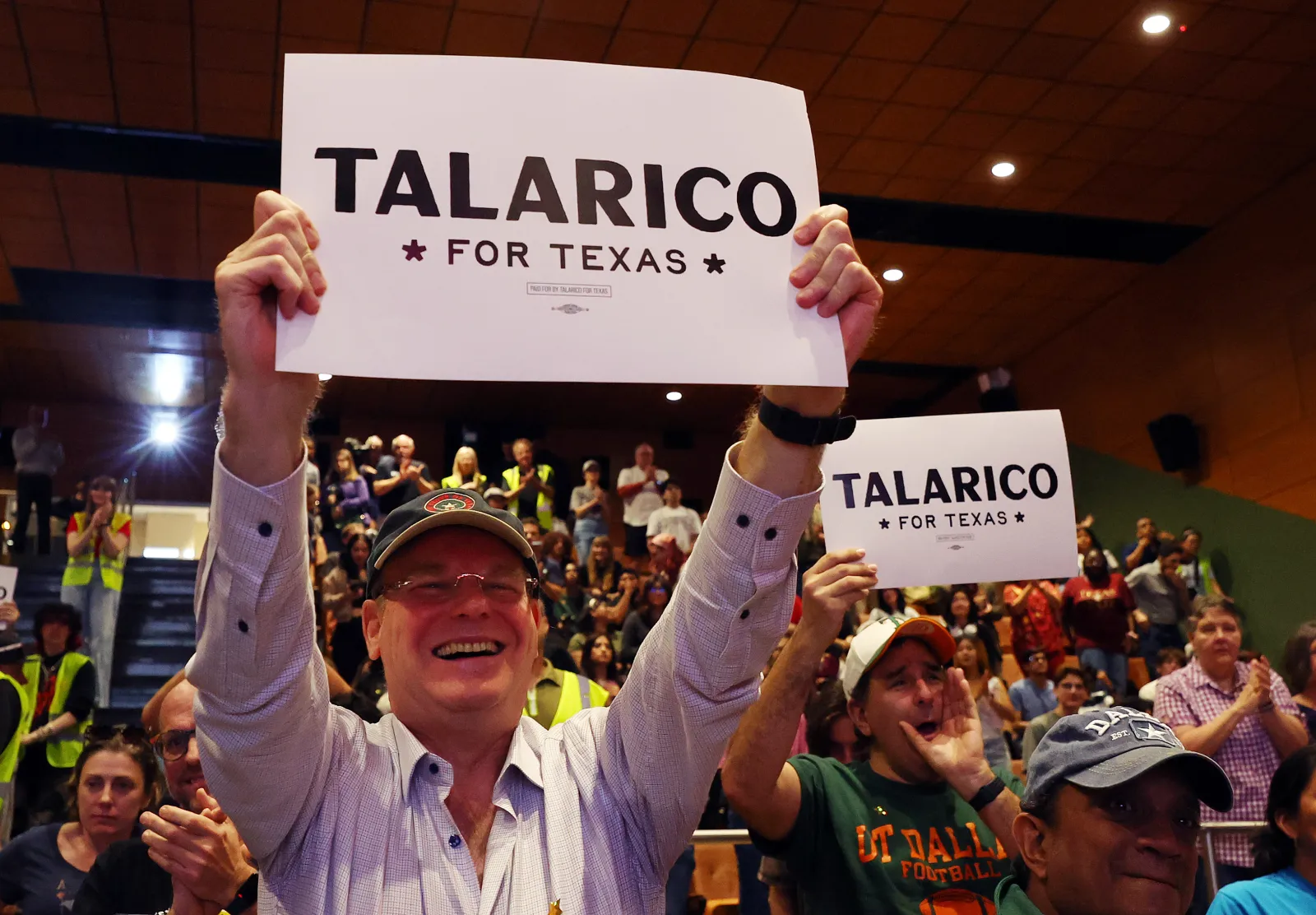
Talarico did not run as a culture-war progressive. He ran as a coalition builder. A former public school teacher and current seminarian, he campaigned in heavily Republican counties, spoke frequently about his Christian faith and centered his message on economic affordability — housing, energy costs and health care.
His argument was direct: Texas cannot be won by energizing Democrats alone. It requires persuading Republicans and independents.
“I’m extending an open hand, rather than a closed fist, to folks who haven’t voted for the Democratic Party in the past,” Talarico said — a calculus that strategists consulted by Newsweek described as essential in a state like Texas.
“In Texas, you cannot do this with just Democrats,” political strategist Mike Madrid, co-founder of the Lincoln Project, told Newsweek. “You have to win Republicans. His whole approach has been about building a bigger coalition.”
A Narrow but Real Opening
Texas remains difficult terrain for Democrats. In the last three presidential elections, Republicans averaged just under 54 percent of the statewide vote. Democrats averaged roughly 44 percent. The margin has narrowed over the past decade, but it has not disappeared.
The central question now turns to whether Talarico can change that math in November — or if he becomes the latest in a long line of Texas liberals who couldn’t get over the finish line in the end.
Matt Bennett, Democratic consultant and co-founder of Third Way, said the climb remains steep. “Texas is brutally tough for Democrats,” he said. “It will be this year, too.”
Still, Bennett argues Talarico may be better positioned than recent nominees to compete for voters beyond the Democratic base.
“He talks openly and authentically about his faith,” Bennett said. “That makes him different from recent Democratic candidates and potentially more competitive with voters in the middle.”


Over the course of the campaign, Talarico made deliberate efforts to engage audiences Democrats have struggled to reach in recent years. He appeared in media spaces outside the traditional party ecosystem, including as a guest on The Joe Rogan Experience, and emphasized persuasion over confrontation. He has also acknowledged that the party’s national brand can be a liability in red states.
“Our national party is pretty condescending to people, and culturally, in many ways, hostile toward faith in red states,” Talarico said in one interview, arguing that Democrats need to build relationships with people “who aren’t with us yet.”
He also benefited from a high-profile controversy in February, when late-night host Stephen Colbert said CBS declined to air a segment featuring him. In the aftermath, Talarico raised more than $2 million, bolstering an already expensive primary campaign.
Keith Edwards, a political influencer and digital strategist who oversaw social media for Senator Jon Ossoff’s 2020 campaign — himself widely seen as a rising star within the Democratic Party — said Talarico’s approach reflects lessons Democrats learned in Georgia.
“James Talarico represents a couple of things,” Edwards told Newsweek. “He’s a post-Trump politician who wants to bring voters together rather than pinning them against each other.”
Edwards added that Talarico’s openness about his own faith changes the dynamic in a state where religion remains politically influential.
“He represents the true values and teachings of Christianity,” Edwards said. “That forces Republicans to not only run on their record, but to defend how they’ve used faith in politics.”
That appeal has not gone unnoticed by Republicans.
A Reality Check
In the days leading up to the primary, GOP operatives privately warned that their “worst possible scenario” was unfolding. As first reported by Axios, Republican strategists widely believed Talarico — with his “progressive Christian” pitch and centrist tone — would be a tougher general election opponent than the firebrand Crockett, who ran an unconventional campaign forced largely on voting rights, criminal justice reform — and herself.
Madrid pointed to Talarico’s strategy of positioning himself as an outsider within his own party, while also staying on message on kitchen-table issues.
“The main thing he’s doing is challenging some of the basic assumptions of the Democratic Party,” Madrid said, pointing to Talarico’s focus on housing costs, energy prices and health care — issues that consistently rank among the top voter concerns in Texas. “Those are determinative issues in a race like this.”

Part of that concern also stems from the Republican field itself. Attorney General Ken Paxton has faced years of legal controversy, impeachment proceedings and ethical scrutiny. The Trump-alligned MAGA favorite survived an impeachment vote, centered on accusations he abused his office to help a real estate investor and allegations of an extramarital affair, in 2023.
His wife, Angela Paxton, filed for divorce on “biblical grounds” in July 2025, a break-up seized on by a recent attack ad from the campaign of the man he is tryng to unseat, Senator John Cornyn.
Cornyn, who represents a receeding traditional wing of the Republican Party, has come under fire in recent years himself. He was booed onstage at the Texas GOP convention in 2022 and still faces heat from many Texans for voting in favor of a bipartisan gun control package after the Uvalde school shooting that left 19 children and two teachers dead.
How Talarico Polls vs. Paxton or Cornyn
Now headed for a May 26 runoff, both Republicans enter the general election cycle with underwater favorability ratings, creating conditions in which a disciplined Democratic nominee could deliver an upset.
Paxton and Talarico were tied in a hypothetical race, Emerson polling conducted January 10 – 12 suggested. Cornyn held a 3-point lead. A similar University of Houston poll conducted January 20 – 31 had Paxton ahead by 2 points and Cornyn by 1.
The polls reported a margin of error of +/- 2.8 and +/- 2.53 percentage points respectively.
“When you combine a Republican nominee carrying baggage with voters who are frustrated about affordability, that creates movement,” Madrid said. “It doesn’t flip the state automatically, but it makes it competitive.”
The longtime Latino strategist said Talarico has a rare opportunity to strengthen Democratic support among Hispanic voters, a key and increasingly competitive bloc in Texas elections. He performed particularly well in several counties near the border — areas where the GOP made significant gains in recent cycles.
However, some strategists cautioned that while Republican weaknesses may narrow the margin, they do not erase Texas’ structural realities. In 2024, Republicans carried the state by roughly 14 percentage points, a sharp expansion from the 6-point margin seen in 2020.
Even in a year when the GOP ticket carries vulnerabilities, Bennett argued, the underlying math still favors Republicans. Rural margins remain large. Party identification statewide continues to tilt red. And Democrats have seen narrowing gaps before without breaking through.


“He’ll also need to persuade more than 60 percent of self-identified moderates to vote for him given that there are so many fewer liberals than conservatives in red states.”
Carter Wrenn, a veteran Republican strategist, echoed that assessment.
“We’re in an off-year election that may favor Democrats,” Wrenn told Newsweek. “But at the end of the day, whether he wins depends on how much the off-year election tilts to Democrats – not on him.”