
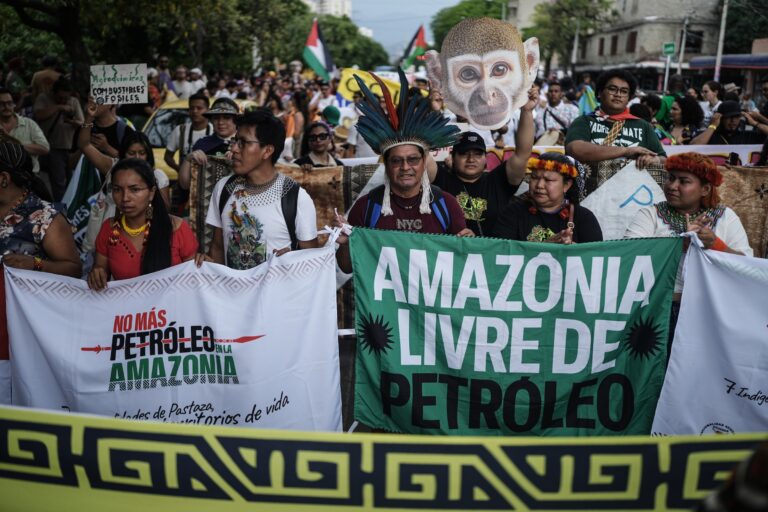
- A recent climate conference in Colombia that was the first to focus on transitioning away from fossil fuels has been hailed as a historic achievement and a momentous step toward a phaseout.
- One of the most significant outcomes was the plan to develop national road maps to end fossil fuel dependency, as well as the launch of a new science panel to provide phaseout support to nations.
- While finance was discussed at the conference, such as alternative financing mechanisms and the impact of investor-state dispute settlements (ISDS), no commitments, figures or deadlines were made.
- Funding remains a major barrier for some countries to achieve the transition, with fossil fuel subsidies currently vastly higher than support for clean energy.
The First Conference on Transitioning Away from Fossil Fuels in Santa Marta, Colombia, was viewed by many as a historic achievement and a momentous step toward ending fossil fuel dependency. After more than 30 years of U.N. Climate Change Conferences, or COPs, where the topic has been repeatedly blocked by states and lobbyists resistant to any kind of phaseout, and many have struggled to get a seat on the table, such as Indigenous and Afro-descendent peoples, the Santa Marta conference has been hailed a success.
“The conference was 100% positive,” Juan Carlos Jintiach, executive secretary of the Global Alliance of Territorial Communities (GATC), a coalition of Indigenous advocacy groups, told Mongabay over WhatsApp voice message. “These new proposals coming from the territories are being heard. It’s a responsible agenda regarding the paradigm shift of the transition, and it’s an opportunity.”
During the first days of the conference, which ran from April 24-29, the International Institute for Sustainable Development (IISD) released a new report that revealed the vast financial support fossil fuels continue to receive. According to its analysis, in 2024, fossil fuels globally received $1.2 trillion in subsidies and other forms of support, compared with $254 billion for clean energy.
Florencia Ortúzar Greene, director of the climate program at the Inter-American Association for Environmental Defense (AIDA), told Mongabay over WhatsApp voice message that the conference’s free-flowing format, with ministers and stakeholders given equal opportunities to contribute, was a great relief.
Attendees were unable to open their computers, meaning they could only say “what they knew and felt at that moment,” Greene said. This format was different from the typical COP negotiations, “which are extremely worn out after so many years of the same thing without getting anywhere.”
There were 57 countries represented in Santa Marta, including Australia, Brazil, Canada, Chile, Kenya, Norway, New Zealand and the U.K., as well as the European Union. China, Russia and the U.S. were not invited. Together, those three countries accounted for 45.15% of global greenhouse gas emissions in 2024.

Ahead of the second summit, which will take place in the Pacific island nation of Tuvalu in 2027, co-host nations Colombia and the Netherlands presented several key outcomes and three dedicated areas of focus to move ideas into implementation. The aim was not to develop new targets, but to discuss how to advance and accelerate progress on existing agreed goals.
Outcomes
One of the most significant outcomes was the plan to develop national road maps to end fossil fuel dependency, as well as the launch of a new science panel to provide phaseout support to nations. Another outcome focused on necessary reforms to the financial system to better facilitate fossil fuel phaseout.
Claudio Angelo, senior international policy adviser at Brazil-based think tank the Climate Observatory, told Mongabay over WhatsApp voice message that the road maps are “the most revolutionary thing about these talks at Santa Marta,” as they must include details about each country’s fossil fuel production. “Until now, countries like Brazil and Norway have hidden behind the fact that their energy system is already clean enough to completely ignore the oil that they extract and export.”
The road maps will identify legal, financial and political barriers to end fossil fuel dependency, complementing each country’s emissions reduction commitments (known as their Nationally Determined Contributions, or NDCs) under the Paris Agreement.
The new science panel, involving 50-100 scientists from around the world, will support the development of these road maps.
Greene said the panel is similar to the Intergovernmental Panel on Climate Change (IPCC), the U.N. body for assessing the science related to climate change, but involves a few key differences that make it better suited to support countries’ transition.
“One difference is that this panel will produce annual reports, while the IPCC does so every seven years, which is far too infrequent and slow for a crisis that is so rapid, fast and progressive,” she said. “Another difference is that this panel is completely independent; there will be no discussion with countries about what it can and cannot say. The IPCC, on the other hand, publishes summaries, which are what countries and decision-makers read, but these summaries have to be agreed upon with the parties.”

The contentious mechanism of investor–state dispute settlements (ISDS) was one legal obstacle discussed by participants at the conference. Under the ISDS system, fossil fuel companies and investors can threaten legal action against governments over climate or energy policies that they claim harm their businesses. According to a report published on April 22 by PowerShift, a Germany-based civil society organization that focuses on trade, raw materials and energy policy, and six other NGOs, the U.K. scored the worst overall in perpetuating the harm of ISDS, with many lawsuits coming from the mining and fossil fuel sectors. It was followed by the Netherlands, the co-host of the conference in Santa Marta.
“This creates a fundamental barrier to a just transition, by creating a prohibitive increase in the cost of payouts to foreign corporations when states attempt to enact phaseout policies — effectively turning the polluter pays principle on its head,” Cleodie Rickard, policy and campaigns manager at Global Justice Now and co-author of the ISDS report, told Mongabay over WhatsApp messages. “What’s more, the mere threat of being sued creates a chilling effect, where states are deterred from or delay their climate action for fear of claims.”
Participants highlighted the urgent need to address the issue, such as by pulling out from existing treaties and implementing safeguards to prevent negative impacts on Indigenous peoples. Bolivia was the first country to withdraw from the ISDS system in 2007. Colombia announced on March 25 that it has followed suit.
Despite widespread acknowledgement of the legal barriers of ISDS, Rickard said vested interests seem to have stalled the adoption of the recommendations raised at Santa Marta. In the co-hosts’ final takeaways document, ISDS was mentioned as a “perceived” and not actual barrier to the transition, which Rickard said doesn’t reflect the general sentiment at the conference. “With the Colombian government just off the back of announcing its withdrawal from the ISDS system, one can assume the Dutch government is playing a diluting role,” she said.
Next steps
Julia Peña Niño, Colombia country manager at the Natural Resource Governance Institute, told Mongabay that there was one crucial omission: the lack of involvement of national oil companies in the discussion.
Fossil fuels are still the world’s leading energy source, accounting for 87% of total energy supply. Oil is the most dominant, meeting 34% of total energy demand.
“Without their active participation in these discussions, it is difficult to develop practical road maps for a phased exit from fossil fuels,” she said. “Incorporating their perspectives is key to identifying barriers and alternatives to their transformation, allowing us to envision future scenarios for these companies in which oil and gas cease to play a predominant role.”
Niño also explained the absence of some of the world’s top carbon-emitting countries. “There was a deliberate intention not to invite the major powers that have typically hindered the progress of these talks (i.e., the United Arab Emirates, the United States, China, and Russia), and priority was given to inviting countries already aligned with the goal of moving away from fossil fuels. This resulted in a more productive discussion focused on the bottlenecks that countries, particularly those in the Global South, face in advancing their road maps.”

Niño also made a connection between the Santa Marta conference and the current political context in Colombia, with presidential elections scheduled for May 31.
“The country is on the cusp of a new government cycle, in which key priorities will be defined through the National Development Plan,” she said. “The conference comes at a time when these discussions can directly influence decision-making. Beyond the global consensus, what is at stake in Colombia is how these ideas are translated into concrete decisions about the country’s energy and economic future and how they can be maintained as a guiding light for long-term transformation.”
For Ignacio Arróniz, a senior associate for the NGO Earth Insight, the conference marked a genuine turning point, but the next step is to expand the process to include more actors, such as national security advisers, central bankers, and the frontrunners of the energy transition, like China.
“As mining operations inevitably expand to meet the demand for transition minerals, we urgently need guardrails to protect people and nature from unnecessary harm,” he added. “Santa Marta was a strong beginning. But the architecture of cooperation needs to grow considerably from here.”
Banner image: Activists participate in a demonstration during a conference aimed at transitioning away from fossil fuels, Monday, April 27, 2026, in Santa Marta, Colombia. (AP Photo/Ivan Valencia)
FEEDBACK: Use this form to send a message to the author of this post. If you want to post a public comment, you can do that at the bottom of the page.
Credits

