Gregor Fisher, best known for his role as the drunken everyman Rab C Nesbitt, has found a new audience through cooking videos. After decades of television fame, he now draws millions of viewers through simple, unpolished kitchen tutorials.
From Rab C Nesbitt to the Kitchen
Fisher played Rab C Nesbitt for nearly 30 years, a character defined by his drunken rants and string vest. The role made him a household name across the UK. The character originated as a monologue for a 1986 episode of the sketch show Naked Video, written by Ian Pattison. Fisher was selected to perform it by chance — a random casting decision that would later define his career.
At first, he wasn’t enthusiastic. He recalls thinking, ‘I wasn’t madly keen on it.’ He didn’t believe the character would gain traction or endure beyond a single episode. When the pilot was completed, he thought, ‘This will never fly.’ But Rab C Nesbitt went on to run for ten series, becoming a cultural touchstone. The character resonated with audiences for its authenticity and raw humor, capturing the frustrations and absurdities of everyday life in a way that felt deeply relatable.
The show’s success led to a live tour that sold out venues across the UK, cementing Fisher’s status as a national figure. However, the fame came with complications. He remembers being asked to shoulder a coffin during one of the tours. A staff member tapped him on the elbow and said, ‘Didn’t expect to see Rab here.’ The moment illustrates how celebrity can create unexpected social friction — a simple act of carrying a coffin becomes a surreal encounter because of the character’s public identity.
After the success of Rab C Nesbitt, Fisher’s public persona became inseparable from the character. He often found himself in situations where people recognized him not by his name, but by the role he played. This led to a sense of disconnection from his personal life. He once said, ‘It’s part of the game, but sometimes it can be a tricky part of the game, and sometimes a bit of the game that I really didn’t enjoy.’
Why Cooking Became His Voice
Fisher’s journey into cooking began not as a career move, but as a personal necessity. In his early 20s, he was diagnosed with a gastric ulcer. His doctor, after a brief conversation, told him, ‘I want you to buy yourself a cookery book. Don’t buy a fancy one. Just get a basic one and start making yourself some proper meals.’ This advice marked the beginning of his real engagement with food.
At the time, he had little exposure to cooking. As a child growing up in Neilston, he didn’t know what pasta was — he only learned about it during drama school. His diet in Dundee, where he met his wife Victoria, was limited to pies, chips, and pints. The doctor’s words were not just about health — they were a call to reclaim agency over his own body and lifestyle.
He began cooking as a way to heal himself, not to perform. He didn’t want to be seen as a celebrity chef or a performer. He wanted to simply cook — for himself, for his family, and for the people who might one day watch him. His early attempts were unpolished. He didn’t have a camera setup, no editing skills, and no interest in producing content for a mass audience.
It was his daughter Cissie who suggested he try cooking videos when he was attempting to promote a stage show. She said, ‘Why don’t you just make potato scones?’ He responded with a joke: ‘Who the hell is going to tune in to see me make potato scones?’
Instead, 2.5 million people tuned in to see him mash potatoes and flip scones. The videos were raw and unscripted — filmed by Cissie and posted on Instagram. They captured a genuine, unfiltered moment of a man who had spent decades performing for others, now finally cooking for himself. The audience responded not because of the content, but because of the authenticity. There was no pretense, no performance — just a man doing something simple, with a quiet confidence.
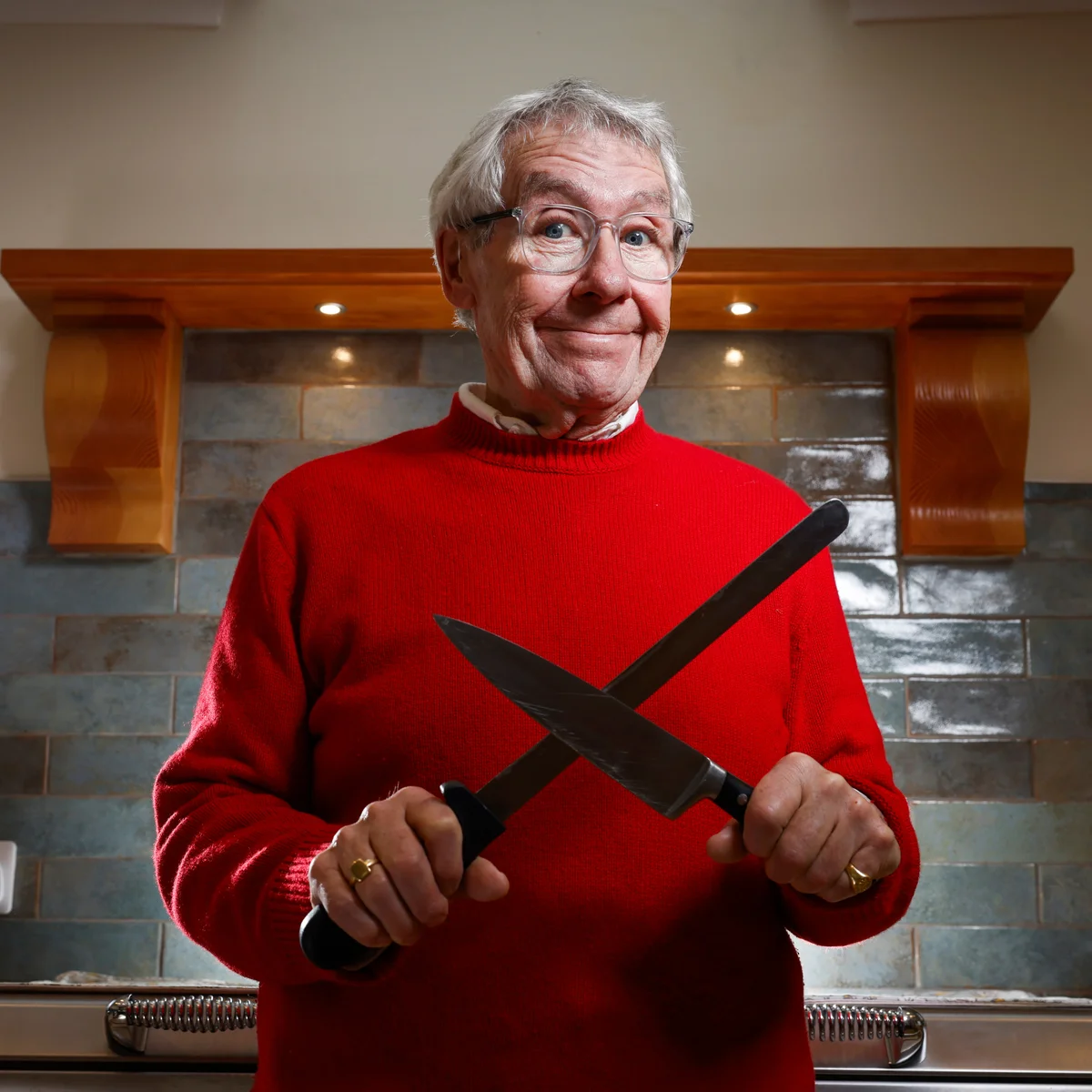
These early videos were short, often lasting only a few minutes, and were not designed to be polished or shareable in the traditional sense. They were, as Fisher puts it, ‘the three minutes you get on Instagram, where you’ve got to be runnin’ about like a blue-arsed fly.’ He later realized that the real value was not in the length or the format, but in the presence — the feeling of someone being real, unfiltered, and grounded.
He shifted the focus of his content to YouTube, where the videos could be more meditative. There, he could take his time, let the ingredients interact, and let the audience experience the process. He says, ‘We could actually put a lid on it, couldn’t we? I’ll get a lid.’ This small gesture — the act of covering a pan — becomes symbolic of the shift from performance to presence. It reflects a deeper philosophy: cooking is not about showing off, but about patience, attention, and care.
Simple Recipes, Real Roots
Fisher now favours hearty Scottish dishes — beef olives with cabbage, fish pie — recipes passed down from his mother. These are not elaborate creations, but dishes rooted in tradition and family. His mother, Cis, raised him in a house with an outside toilet and a coal fire for heating. The environment was modest, but it instilled in him a deep appreciation for simplicity and practicality.
He also has a small French influence. Fisher and Victoria lived in Cognac in southwestern France for 12 years. They bought an old farmhouse that needed significant renovation. The experience was transformative — not just in terms of property, but in how he viewed living. He says, ‘I like doing that. Shall we get a little spoon and just taste this?’ The act of renovating a house, of working with hands and materials, became a metaphor for his personal growth — a return to the physical, the tangible, and the real.
They returned to Scotland a few years ago, now living near Neilston — the town where he grew up. He now passes by places he once knew and thinks, ‘God that’s such and such. Too weird for words.’ The return to his roots was not planned. It was prompted by a conversation with an old friend, Johnny. They had known each other since childhood, and Johnny had a website that calculated how long someone had left to live.
Johnny asked Fisher to enter his information. Johnny was upset because he had a more privileged upbringing — he had ‘quite a few silver spoons.’
Johnny then asked how many times Fisher’s children visited him in France. He estimated twice a year on average — sometimes only once. He said, ‘Well, do the math. That’s how many times you’re going to see them.’ Fisher found this idea troubling. It made him reflect on the distance between his life and his family. He realized that the time he spent in France had been a form of emotional escape — a place where he wasn’t recognized, where he wasn’t a celebrity, but just a man with a story.

So, he and Victoria put the French house on the market and returned to Scotland. The decision wasn’t about nostalgia — it was about reconnection. He wanted to be closer to his children, to live in a place where he could see them regularly, where the rhythms of daily life could be shared without the distance of a foreign country.
Family Secrets and Adoption
As a child, Fisher noticed his parents were older than most families. His mother, Cis, doted on him, but his father, John Leckie, seemed to avoid him. They mostly kept out of each other’s way. This early dynamic left a lasting impression on him — he felt like an outsider in his own family.

At 14, he discovered he was adopted. He later learned he had been adopted twice — first by Jim, Cis’s brother, from a children’s home, and later by Cis after Jim’s wife died. There was no official paperwork. The siblings were scattered across the wider family. Cis took in three-year-old Gregor.
He wrote about this in his 2015 book, The Boy From Nowhere, co-written with Melanie Reid. He never wanted to dig into his origins while his mother was still alive. He believed that knowing too much could disrupt the present — the bond with Cis, the comfort of her presence.
Only after Cis died did he learn he was the product of an affair between a 38-year-old woman and a man in his late 50s. His biological mother, Kit, died of a heart condition when he was just three. The nature of the relationship between the two adults is essentially unknowable. He says, ‘It says on that record that happened, and it says on that record that they died — that’s the cause of their death. What does it tell you? Nothing.’
He acknowledges that this lack of information is not a failure — it is simply the nature of the record. There is no narrative, no story, only facts. And in that absence, he finds peace. He doesn’t need to know every detail of his origins to feel whole.
He regrets his relationship with John Leckie, his second adoptive father. If he could start over, he says, ‘I think I would have made a better fist of it with Leckie.’ He believes that his late arrival in the household made it difficult for the Victorian-era Leckie. He thinks he was more difficult than he realized as a child. The emotional distance between them, he now sees, was not due to malice, but to a mismatch in values and expectations.
Living with the Past
His time in France helped him escape the celebrity spotlight. In France, people didn’t know him — they only knew the person, not the fame. This allowed him to live without performance, without the need to explain himself. He could simply be present — in a kitchen, in a garden, in a conversation with a friend.
He recalls one moment: being asked to shoulder a coffin. A staff member tapped him on the elbow and said, ‘Didn’t expect to see Rab here.’ That moment highlighted how fame can create unexpected social friction — a simple act of carrying a coffin becomes a surreal encounter because of the character’s public identity.
Television, Cancellation, and Career Uncertainty
Fisher’s career in television has been marked by both success and instability. Rab C Nesbitt ran for ten series and sparked a live tour that sold out across the UK. He didn’t initially believe the character would take off. He thought it would never fly.
He later appeared in Only Child, a series about a father who moves back home to care for his grown son. The show was cancelled after two series. Fisher says he understands the nature of TV commissions. He notes that the head of comedy who commissioned Only Child has moved to Sky, and there have been internal reshuffles.
Despite being an older figure in the industry, Fisher remains active. He appears in the current series of Shetland as an oddball hoarder. He is also taking his stage show, An Evening With Gregor Fisher, back on tour. He and Cissie post a new YouTube video nearly every week, and a cookery book is in development.
He says his profession in comedy is inherently unstable. He reflects: ‘All this uncertainty, it doesn’t suit me as a human being.’ He believes he would have made a good architect — not a Frank Lloyd Wright, but someone with a solid career and a pension. He says, ‘I really think I would have made not a bad architect.’
His cooking videos offer a different kind of authenticity. They are unpolished, personal, and grounded in real life. He doesn’t need to perform. He doesn’t need to be on camera. He just needs to cook — and the audience responds.
What to Watch Next
Gregor Fisher’s stage show An Evening With Gregor Fisher begins at the Gaiety Theatre in Ayr on 4 February and tours the UK and Ireland until the end of March.
His YouTube channel continues to grow, with new videos posted weekly. The channel offers a more meditative pace than Instagram’s fast, reactive format.
His cookery book is expected soon, offering recipes rooted in Scottish traditions and family history.
For those interested in how public figures adapt to new forms of visibility, Fisher’s journey from television fame to cooking videos is a clear case of reinvention through authenticity.
His story shows how personal habits — like cooking — can become a form of public expression, free from the pressures of celebrity.
- Gregor Fisher began cooking as a personal project with no audience in mind.
- His daughter Cissie helped launch the cooking videos after a failed stage show promotion.
- 2.5 million people watched him make potato scones and mash potatoes.
- He learned to cook after being diagnosed with an ulcer in his 20s.
- He was adopted twice — first by Cis’s brother, then by Cis.
- He regrets his relationship with his second adoptive father, John Leckie.
- His time in France helped him escape fame and reconnect with himself.
- His show Only Child was cancelled after two series.
- He believes he would have been a better architect than a comedian.
- He is currently touring with An Evening With Gregor Fisher.
For more on how public figures use social media to rebuild identity, see the Guardian’s coverage of Gregor Fisher’s journey: Two million people tuned in to see me mash potatoes!
Fisher’s story reflects a broader trend: people turning to personal skills and routines as a form of self-expression in a digital age.
Sources & further reading
Featured image: original publisher image. Via original publisher. Image source