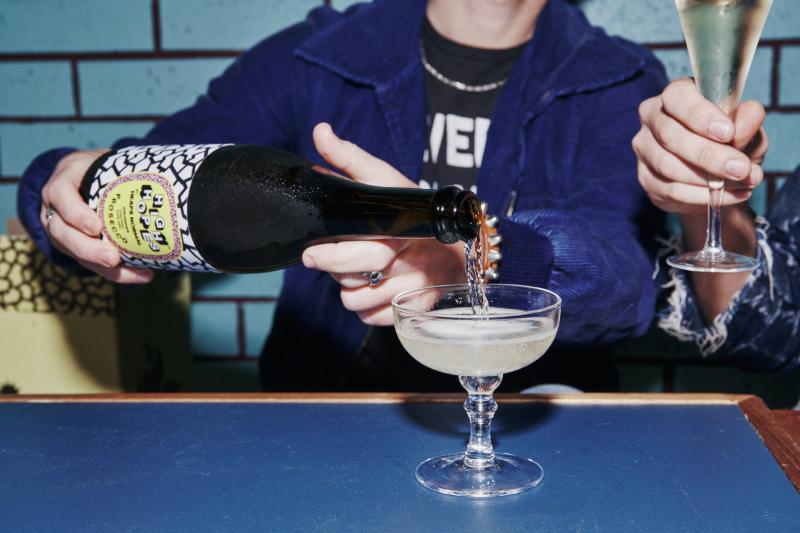
Making a non-alcoholic wine good enough to sit on a proper wine list is one of those challenges most of the drinks industry has pretty much given up on. I should know. I’ve tried a lot of them. And I can confirm, it’s not an easy thing to get right. Yet Heaps Normal decided to have a go anyway.
Five years after setting out to change the way Australians socialise, the Sydney company has launched High Hopes, its first-ever wine and, by its own reckoning, its biggest release since day one. The three reference points are a quirky, funny mix: the Memphis Design Movement, American new wave band Devo, and Barbara Kruger’s bold, bossy ad typography. But there’s a clever logic holding them together. All three, the brand argues, do “defiance through joy rather than aggression”. Or, as it puts it, “defiant optimism”.
First, though, someone had to make the wine. Not an easy challenge for a beer company wading into unfamiliar territory. In fact, it took 18 months, two tonnes of prosecco grapes, a “3am drive through a heatwave to Adelaide”, and a research partnership with the Australian Wine Research Institute, one of the leading centres for wine science anywhere. The prosecco is fermented with rare yeast varieties that naturally die off in a low-ABV solution, a method that builds character without the booze, resulting in a finished bottle at less than 0.5% ABV. Winemakers, bartenders and organic chemists were all consulted along the way. The outcome, the brand says, surprised even the experts, which, given how many non-alc wines don’t, feels like a mighty fine achievement.


The look is where it gets bold. “To be optimistic today often feels like a radical, quietly defiant choice,” says Heaps Normal’s chief brand officer Tim Snape. “There’s a rebelliousness to optimism now that we wanted to explore. We landed on a kind of DIY, punk pastiche that we feel encapsulates the idea that a really good non-alc wine could – and should – have a right to be seen in the same way as its boozier counterparts.”
Lead designer Paul Tooth took Memphis (the Italian collective that debuted at Milan Design Week in the early 1980s and cheerfully split the design world in two) as the visual foundation, though not the version you’re picturing in your head. “We weren’t interested in Memphis’s 1980s kitsch connotations, but looked more at its use of colour as disruption and shape as statement,” he explains.
“You can see that in how the label literally uses this shattered, chaotic and disrupted graphic element.” It all plays out in acid yellow, sky blue, and bubblegum pink, with an up-pointing arrow logo and a squiggle print that looks like it’s been photocopied one too many times. Kruger, meanwhile, shaped how the brand talks. “High Hopes is inherently optimistic, and we lean into this with our tagline ‘Aim Higher’, but we never want the brand to feel trite,” says Tooth. “Kruger was able to take these sincere, weighty notions and, through colour, typography and contrast, charge them with a new and subverted energy.”

It doesn’t stop there. To introduce High Hopes to the world, Heaps Normal commissioned Sydney film director Madeleine Purdy (Radio Free Alice, Gordi, Body Type) to make a music video for the debut single, ‘Kicks’, by Sydney punk band Meow Meow & the Smackouts. Shot in a warehouse among the pallets, all forklift solos and blackletter lyric cards, it’s exactly as scrappy and joyful as the brief demands. It was recorded entirely with independent partners: Marrickville’s Golden Retriever Studio, audio engineer Antonia Gauci (Kesha, Troye Sivan, DMAs) and producer Mikey Young.
There’s a printed zine to go with it, plus a run of limited-edition merch, including a clock, an incense holder, and a set of baseball caps. Case in point on the whole ethos: asked in the zine what the most punk thing a person could do in 2026 is, the band answer, “Eat your fruit and veggies”.
High Hopes is out now as a non-alcoholic prosecco, priced at $23 (around £12), and available from Heaps Normal’s Marrickville venue, the Heaps Normal Health Club, along with selected independent retailers and restaurants across Australia.
Whether it earns a spot on the country’s best wine lists is the real test at this point. But as a piece of brand-building, equal parts wine science and punk zine, it’s hard not to admire the effort involved.