Jesse Walker left a tech career to become a full-time Brazilian jiu-jitsu coach at Rough Hands BJJ in Louisville, Kentucky. His journey from product management to coaching is not just a personal transition—it reflects a broader shift in how small businesses operate today, especially when time and resources are limited.
From Product Manager to BJJ Coach
For years, Walker worked in tech as a product manager, where he was responsible for designing and launching digital products. His experience in product development gave him a strong foundation in user experience, workflow design, and process optimization—skills that have directly translated into how he runs his jiu-jitsu school.
He left the tech industry about a decade ago to focus on coaching jiu-jitsu in his evenings. What he brought with him was not just a passion for martial arts, but a mindset shaped by product thinking. “I have lots of techie stuff kind of infused in my business,” he says. This includes everything from managing member data to automating communication flows.
One of his early innovations was collaborating with Claude, an AI tool, to build an Apple TV app that runs a round timer and a clock on the gym floor. This app was designed to help students and instructors track time during training sessions, ensuring consistency and improving the flow of classes. The project demonstrated how even non-technical users can leverage AI to create practical, real-world tools.
Managing Leads Without Desk Time
Walker doesn’t have traditional office hours. Much of his time is spent teaching, answering emails, or cleaning gym facilities. This lack of desk time makes it difficult to develop and test business processes in a structured way.
He often has ideas for process improvements during “shower thoughts”—brief, spontaneous insights that come without dedicated time at a desk. These ideas, though fleeting, are valuable because they come from direct experience with daily operations. The challenge has always been turning these thoughts into actionable workflows.
Before using Zapier, he managed leads through two separate systems. One handled new student waivers via a Google Form and a Google Sheet. The other, from a marketing agency called Martial Consulting, collected leads from ads and bookings in a separate sheet. This dual system created inefficiencies and increased the risk of data silos.
Walker didn’t want to manage two systems. He wanted all new leads to flow into GymDesk, his existing CRM for members and leads. This would allow him to track student progress, manage communications, and maintain a unified view of all incoming leads.

Connecting Claude to Zapier
Walker discovered Zapier’s ability to connect with Claude, an AI tool, about seven years ago. At that time, he had used Claude only as a writing partner and occasional coding assistant. It never interacted with his other tools or systems.
He described the task in plain language: “Hey, here’s what I’m trying to do. Is this a thing? Can we do this?” This simple prompt triggered a chain of actions. With minimal effort, Claude built a Zap that watches a new Google Sheet and adds each lead to GymDesk.
The first version took under 10 minutes—mostly to grant permissions. The actual work of building the automation was minimal because Claude could interpret the task and translate it into a functional workflow without requiring step-by-step instructions.
Walker didn’t inspect the Zap manually. Once Claude was connected, he let it run. The system began sending sample outputs or alerts, reducing his need to intervene. This hands-off approach allowed him to maintain momentum without needing to spend time debugging or testing each component.
Fixing a Problem Without Intervention
The initial Zap had a flaw. New rows didn’t always appear at the bottom of the sheet. The system kept picking up the last row, leading to duplicate entries. This meant that the same lead would be added multiple times, creating inaccuracies in lead tracking.
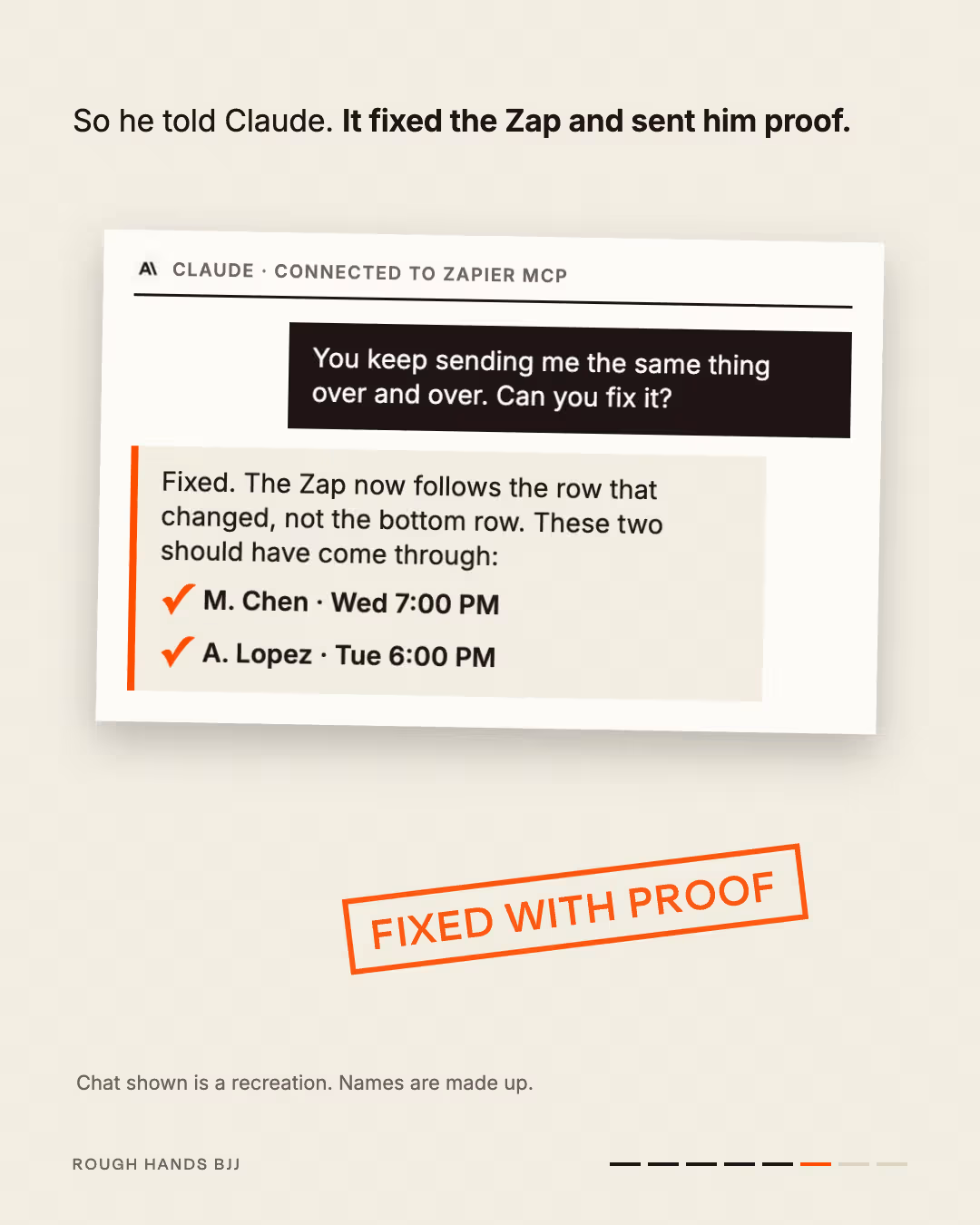
Walker told Claude: “I was like, hey, you keep sending me the same thing over and over again. Can you actually fix it?”
Claude identified the issue, named the two leads that should have been included, and updated the Zap. The fix took about five more minutes. “And it did it and it sent me the proof that it did it,” Walker says. This demonstration earned his trust. Claude didn’t just say the fix was possible—it showed it worked by executing the correction and sending a confirmation.
Next-Gen Zaps: A Different Approach
Walker assumed Claude would use the same Zap editor he was familiar with. Instead, it built a Next-Gen Zap. Next-Gen Zaps are written in TypeScript and use AI tools to build and edit them faster. They include agentic management, which monitors for errors and can draft or publish fixes. This feature is on by default and has not yet needed correction.
For Walker, the difference is speed. “It’s so much easier to quickly ask if a thing were possible rather than me having to map through all the little fields and this and that and try to figure it out myself,” he says. This shift allows him to move from a slow, manual process to one that is adaptive, responsive, and built with AI assistance.
Where Ideas Now Begin
Now, any process that crosses between apps goes through Zapier. Walker uses it as his go-to tool for app integration. The lead management Zap was the first built this way. He already has plans for others.
Every spring, Rough Hands BJJ hosts the BJJ Mental Models Spring Camp, tied to the podcast of the same name. He wants a Zap that compares camper emails in GymDesk to a waiver sheet and sends the form to those who haven’t signed it. This would ensure compliance and reduce follow-up work.
He also wants to pull the camp roster from GymDesk to analyze demographics—how many black belts, average age. This data could help him plan future programming and tailor content to different skill levels. If any of his older Zaps need structural changes, he plans to hand those tasks to Claude.
When a new idea hits, he knows where to start. “I would certainly try it first and see how far I could get with it,” he says. This mindset reflects a growing trend in small businesses: using AI not as a replacement for human judgment, but as a co-pilot that accelerates decision-making and execution.
Walker still checks in regularly. The small volume of leads makes issues easy to spot. He keeps an eye on the system to ensure no details have been missed. His experience shows how AI tools can support real-world operations—especially in small businesses with limited time and resources.
For more on how Next-Gen Zaps work, see the original article at Zapier’s blog.
Sources & further reading
Featured image: original publisher image. Via original publisher. Image source