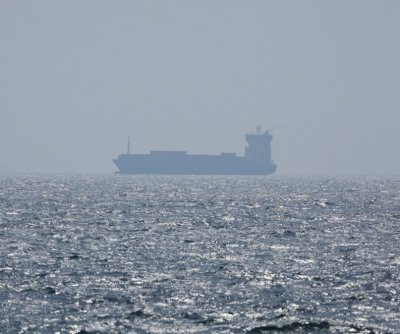
1 of 2 | A container ship sails on the Strait of Hormuz, as seen in June 2025 from Ras Al Khaimah, United Arab Emirates. The strait lies between Oman and Iran and links the gulf to the Arabian Sea. On Wednesday, Iran threatened shipping in the Red Sea, the Gulf of Oman and the Persian Gulf if a U.S. blockade continues. File photo by EPA-EFE/Ali Haider
April 15 (UPI) — As a U.S. blockade of Iranian ports continues, Iran threatened Wednesday to halt shipping in the Red Sea, the Persian Gulf and the Gulf of Oman, calling the blockade illegal.
The blockade went fully into effect over the past several days, with U.S. Central Command saying Wednesday that it has “completely halted” sea trade in Tehran, CNN and NBC News reported.
Maj. Gen. Ali Abdollahi of Iran’s armed forces said continuing this blockade would be a violation of the cease-fire and that Iran, through its influence in the area, “would not allow any exports or imports to continue in the Persian Gulf, the Sea of Oman and the Red Sea under such conditions,” CNN reported.
Also Wednesday, the White House said that the Trump administration “feels good about prospects of a deal.” NBC News reported that two people close to the negotiations said talks could resume this week
This comes a day after U.S. President Donald Trump said peace talks with Iran “could be happening in the next two days,” with American negotiators most likely to return to Islamabad where the first round of talks at the weekend ended without a breakthrough.
In an interview with the New York Post on Tuesday, Trump said talks between the sides were “happening, but, you know, a little bit slow,” saying a new round of direct negotiations would probably be hosted by a country in Europe.
However, around 30 minutes after the interview had concluded, Trump called back to tell the Post that it should keep its reporter covering the talks in Islamabad in place and not bring them home.
“You should stay there, really, because something could be happening over the next two days, and we’re more inclined to go there [Islamabad]. It’s more likely, you know why? Because the field marshal is doing a great job,” Trump said, referencing Pakistan’s Field Marshal Gen. Asim Munir who has a direct line of communication with the regime in Tehran and a strong relationship with Trump.
“He’s fantastic, and therefore it’s more likely that we go back there. Why should we go to some country that has nothing to do with it?” added Trump.
The Washington D.C.,-headquartered Institute for the Study of War also said a fresh round of negotiations was likely this week but said it believed Iran’s approach would be to try to buy time by spinning out the talks
“Iran likely aims to protract negotiations as long as possible in order to prepare for a potential resumption of conflict,” ISW said in a post on X.
The developments, which came as a fragile cease-fire that took effect April 7 entered its second week, followed earlier reports in which unnamed White House officials told CNBC, CNN and NBC News that in-person negotiations could restart before the truce expires on Tuesday.
Vice President JD Vance said round one of the talks in Islamabad, which ran for more than 20 hours, foundered on differences over Iran’s nuclear program — which the United States wants it to give up completely to ensure it can never develop a nuclear weapon — and control of the Strait of Hormuz.
Reports later emerged that more progress had been made than initially suggested, with the sides getting close to agreement on nuclear enrichment after Iran countered U.S. demands for a 20-year suspension with an offer to halt all enrichment for 5 years.
Trump told the Post he was unhappy with the thinking that a moratorium on enrichment, instead of terminating the program, would make the regime in Tehran more amenable to a lasting peace agreement by providing them a face-saving “success” to sell to the Iranian people.
“I’ve been saying they can’t have nuclear weapons. So I don’t like the 20 years. I don’t want them [Iran] to feel like they have a win.”
Experts concurred with Trump’s analysis, saying the only way to guarantee Iran would not be able to pursue a nuclear weapon in the future was to make sure the entire program was put beyond use, in a verifiable way, and that it needed to happen while Trump was still in office.
Under the Joint Comprehensive Plan of Action, a 2015 deal between Iran and the United States, Britain, France, Germany, Russia and China, enrichment by Tehran of its 300 Kg stockpile of uranium was capped at 3.67%, in exchange for sanctions relief.
However, that deal lapsed in October, although in practice it was long dead after Trump pulled the United States out of the agreement in May 2018, during his first term, with Iran subsequently proceeding to enrich an expanded 441 kg uranium stockpile to around 60%, not far short of weapons grade.

Speaker of the House Mike Johnson, R-La., speaks during a press conference on Tax Day and the Working Families Tax Cut outside the U.S. Capitol on Wednesday. Photo by Bonnie Cash/UPI | License Photo