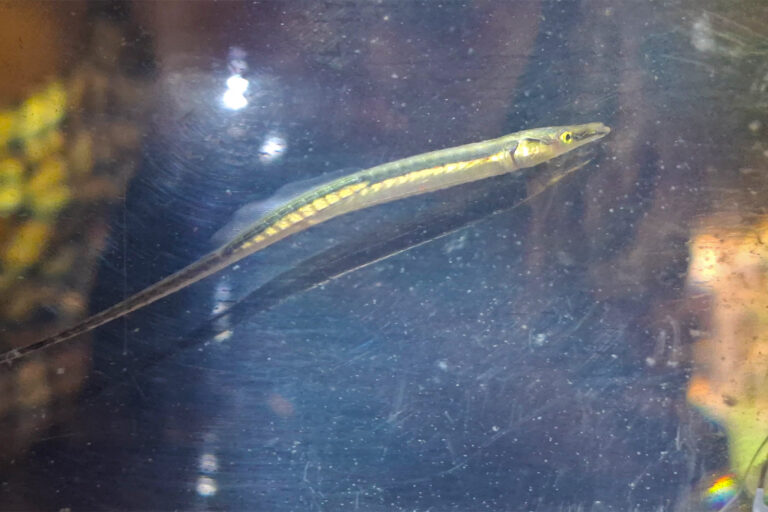
- Scientists have rediscovered spinach pipefish, a freshwater species endemic to Papua New Guinea’s Sepik River, not seen in nearly 40 years.
- The discovery came during a two-week survey led by local scientists and community members. Local fisherwoman Helen Asu netted two spinach pipefish, which scientists sent to experts for confirmation of the taxonomy.
- Scientists say the rediscovery offers hope that populations of the little-known, elusive fish still survive and provides an opportunity to understand more about its life cycle, habitat and ecology.
- The discovery highlights the importance of combining local knowledge with scientific research.
By mid-June, Jerrica Agebido was staring at disappointment. His nearly two-week-long, exhausting search for a mysterious fish that hasn’t been seen by scientists for nearly four decades was drawing to a close. His team of researchers had braved Papua New Guinea’s hot, humid summer days, meandering along the Sepik River’s course by boat and canoe — but the spinach pipefish still eluded them.
“We had spent days travelling through the Lower Sepik, talking with communities and looking for information about the pipefish,” Agebido, a researcher at the Papua New Guinea University of Technology and the New Guinea Binatang Research Centre, wrote in an email. “We had almost given up hope.”
The spinach pipefish (Microphis spinachioides) is a small, slender pipefish with an elongated snout it uses to capture small prey, reaching maybe 15 centimeters (6 inches) in length. This greenish-brown freshwater creature, a close relative of seahorses and seadragons, is well camouflaged in its only known home here in the Sepik River — the country’s longest waterway — hiding among water lilies and other plants near riverbanks.
Just like seahorses, pipefish males carry their embryos in a brood pouch for weeks until the young are born.
Much about the spinach pipefish has remained an enigma, because scientists haven’t seen it since 1985. It was last assessed for the IUCN Red List in 2016, and at the time, was classified as data deficient by IUCN, the global conservation authority. The only known museum specimen, on which the taxonomy of the species was based, was kept in the Hamburg Museum in Germany, and was destroyed during World War II.
The species ranked among the top-10 most wanted on the “Lost Fishes” list — a master list of more than 300 freshwater fish species currently missing to science, compiled by conservation organizations SHOAL, Re:wild and the IUCN Freshwater Fish Specialist Group.
During their June expedition, Agebido’s team went looking for this enigmatic fish, hoping that it’s still around so they could learn more about its ecology and the threats it faces. Along their journey, they spoke to local communities and fisherfolk, showing them pictures of the fish, and sought their help with the search.

Those efforts paid off on June 18, 2026, when local fisherwoman Helen Asu showed up with two spinach pipefish she caught with her umben, a traditional hand net. She’d been out fishing for prawns on the Sepik River in Imbando, a village in East Sepik province.
It was the very last day of Agebido’s expedition.
“It was honestly an incredible moment,” Agebido said. “When Helen showed the fish to us, I immediately realized that we had found something very special.”
Agebido photographed the nearly 10-cm- (4-in-) long fish and sent it to Gerald Allen, an Australian ichthyologist who is well-versed in the region’s fish. He confirmed it was indeed the spinach pipefish, ending the four-decade-long search for one of the planet’s most-wanted “lost” freshwater fish.
“It makes my heart sing to hear that the spinach pipefish has been recorded anew,” Amanda Vincent, who chairs the IUCN’s Seahorse, Pipefish and Seadragon Specialist Group and directs Project Seahorse, said in a press release. “Freshwater pipefishes are particularly threatened species, largely from habitat degradation. To learn that the spinach pipefish still exists gives us hope that other ‘lost’ species are out there, too.”


Rediscovery braids science with community’s ecological knowledge
To the untrained eye, it’s easy to miss this small, well-camouflaged fish among thick grasses along the river’s margins. Scientists don’t know much about its habitat, ecology, or even where to look for it. The only people who possibly knew something about the spinach pipefish were local communities.
It’s that ecological knowledge that Agebido’s team tapped into — which made the rediscovery possible. When the researchers asked Asu if she had seen the pipefish, she told them she’d caught something similar before, offered to help and — caught them the next day.
“The fact that a species could go without a confirmed record for around four decades — and then be found through the daily activities of a local fisher — is a powerful reminder of the importance of local ecological knowledge,” Agebido said. “Without Helen’s knowledge, experience and willingness to help us, we may not have found the species.”
The researchers learned a bit about the spinach pipefish’s ecology. Those living along the Sepik River said they sometimes catch one or two, while fishing for prawns and other small aquatic critters. This suggests they all share similar habitats. But local people don’t eat this fish.
Women seemed to know a lot more about them than men, according to Roger Maikei, a member of the search team and a researcher at the New Guinea Binatang Research Centre, because “they regularly catch freshwater prawns and small fishes along vegetated riverbanks where pipefish occur.”
People along the river had different names for this fish: In Imbando, it’s called karuweng; upstream communities at Kanduwanum call it inap or karuwenai. In PNG’s official language, Tok Pisin, it’s known as lon nus.
Communities shared key information on the pipefish’s ecology. The fish are found along the Sepik River’s vegetated margins and around tributary confluences. People rarely reported seeing them in floodplain lakes or swamplands.

“We can design the most sophisticated scientific surveys in the world, bringing in the latest technologies to search for lost species, but nothing can replace the traditional ecological knowledge of the people who live alongside these species and ecosystems,” Benjamin Barca, exploration program manager at Re:wild said in a press release.
They also shared some threats the fish face.
“During our survey, communities repeatedly described changes in native fish populations, as well as increasing sedimentation and the growing abundance of introduced fish species,” Agebido said. “While it is incredibly exciting to know that the spinach pipefish is still surviving in the Sepik, we also need to understand and address the environmental changes affecting its habitat.”
That’s where the next steps lie, Agebido said.
“For me, this rediscovery has strengthened my commitment to studying the species. I hope that by combining field surveys, local ecological knowledge, taxonomy and eDNA technology, we can better understand where the spinach pipefish occurs, what it needs to survive and how we can help ensure that it remains part of the Sepik River ecosystem.”
Banner image: Spinach pipefish is an endemic species found in Papua New Guinea’s Sepik River. It was not seen by scientists for more than four decades. Image Courtesy of New Guinea Binatang Research Centre.
Spoorthy Raman is a staff writer at Mongabay, covering all things wild with a special focus on lesser-known wildlife, the wildlife trade, and environmental crime.
New species of ghost pipefish named after Sesame Street character found in Australia
A fish a day: More than 300 freshwater species described in 2025
PNG’s Torricelli Mountains teem with life — and the risk of extinction
Cite this article
Spoorthy Raman (2026). Local knowledge guides rediscovery of spinach pipefish, not seen in four decades. Mongabay Conservation news. DOI: https://doi.org/10.66709/news-327148