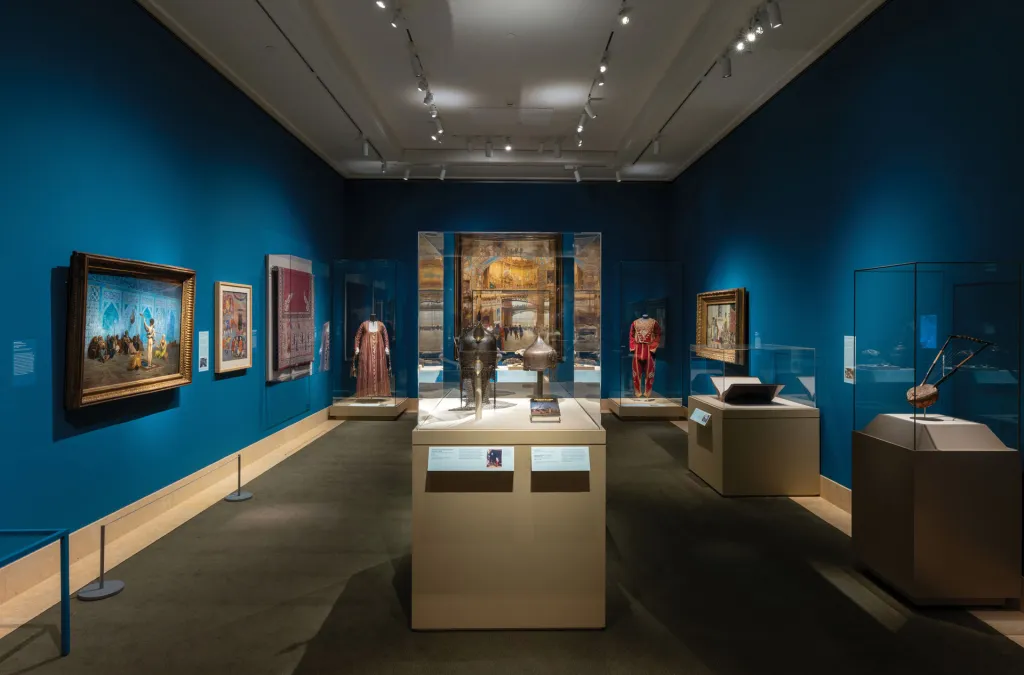
The Metropolitan Museum of Art’s new exhibition on Orientalism has sparked debate. Source: artnews.com.
What Happened
The exhibition features works by artists like Jean-Léon Gerome and Osman Hamdi Bey—key figures in 19th-century European depictions of the Middle East and North Africa.
It centers on the concept of ‘Orientalism,’ popularized by Edward Said in his 1978 book Orientalism.
Said argued that Western portrayals of the East were often reductive, exoticized, and rooted in colonial power dynamics.
Yet the exhibition does not engage with Said’s critique. It presents the artworks as historical artifacts, without explaining their ideological roots.
Key Facts
- The exhibition includes paintings by Jean-Léon Gerome, known for idealized, romanticized depictions of Arab and Islamic life.
- Osman Hamdi Bey, a Turkish artist, is featured for his detailed, ethnographic-style works. But the presentation downplays his role as a cultural observer.
- Many works are framed as neutral historical records, not as expressions of colonial bias or power imbalance.
- There is no dedicated section addressing Edward Said’s critique or the legacy of Orientalist thought.
A professor at MIT, who has taught a graduate seminar on Orientalism for 34 years, notes the absence of critical engagement with Said’s work.
He says, ‘Every two years, I wonder if the subject has become too mainstream. But something always happens—on the world stage—that reminds me it’s still vital.’
He adds that the exhibition’s approach risks normalizing outdated views of the ‘Orient’ as static, exotic, and separate from modern realities.
Background: How Orientalism Works
Orientalism, as Edward Said defined it, refers to the Western construction of the East as mysterious, primitive, and in need of Western guidance.
19th-century art often depicted the Middle East through a lens of romanticism and exoticism.
These images were used to justify colonialism and imperial expansion.
Artists like Gerome created idealized scenes of Arab life, often with minimal cultural accuracy. These depictions were widely reproduced, shaping public perception.
Hamdi Bey, though Turkish, produced works that combined realism with cultural observation. His art is now seen as a counterpoint to Western Orientalism.
Why It Matters
The Met exhibition’s failure to engage with Said’s critique raises concerns about how institutions present art with historical and political weight.
By treating Orientalist artworks as neutral or celebratory, the exhibition may reinforce the very biases it claims to explore.
Art institutions have a responsibility to provide context for works that reflect power imbalances.
This includes acknowledging how art has been used to justify domination.
Without such context, viewers may see the works as objective or timeless—when they are actually products of specific historical and political agendas.
Limitations and Open Questions
The exhibition does not include any section on Edward Said’s work or the broader academic discourse on Orientalism.
There is no discussion of how these depictions contributed to colonialism or the marginalization of Muslim and Arab societies.
Some critics argue the show presents a sanitized version of history, omitting the harm caused by such representations.
One scholar said, ‘The exhibition makes the past look neutral, when in fact, it was deeply ideological and often violent.’
Another noted that the Met’s choice to highlight these works without critique may reflect a broader trend in museums: prioritizing aesthetic value over historical and ethical responsibility.
What to Watch Next
Future exhibitions at the Met or other institutions may include more critical framing of colonial-era art.
Public reactions and academic responses to this exhibition will likely shape how museums approach representation in the years ahead.
Art institutions must balance accessibility with accountability. If they present art without context, they risk repeating the very systems they claim to critique.
Sources & further reading
Featured image: Installation view of a blue gallery with Edward Said's book orientalism placed near the painting that appears on its cover.. Via original publisher. Image source