This means that for thousands of households, their annual Council Tax bills could have been reduced — and in some cases, they may even be entitled to a refund for overpaid amounts. Source: skintdad.co.uk.
What Happened in the 2025–2026 Financial Year
Government figures released on 29 October 2026 show that 71,320 Council Tax challenges were resolved across England and Wales between April 2025 and March 2026.
Of these, 10,510 resulted in a lower band. About 65% of cases ended with no change to the existing band.
Some challenges involved properties being removed from the Council Tax list or split into separate homes — often after redevelopment or property division.
One key figure comes from informal band reviews in England: of 13,080 such reviews, 4,420 resulted in a reduction. That’s about one in three cases.
Success is not guaranteed. It depends on strong, relevant evidence. These figures reflect outcomes, not individual households.
Regional Breakdown: Council Tax Band Changes in Yorkshire
Across Yorkshire and the Humber, 900 Council Tax challenges resulted in a lower band.
These figures are rounded to the nearest ten. The actual number may vary slightly but remains close.
Areas like Hull, Leeds, and Wakefield have seen notable challenges. In Hull, a home in band C has an annual Council Tax bill of £2,040.04 for 2026/27.
If moved to band B, the bill drops to £1,785.04 — a saving of £255 per year.
A move from band E to band D in Hull saves £510 annually. These figures are based on current rates and do not include local discounts or exemptions.
How Council Tax Bands Are Determined
Band assignments are based on property values from fixed historical dates.
- England: values from 1 April 1991.
- Wales: values from 1 April 2003.
These values are used to assign bands — from A (lowest) to G (highest).
Band assignments do not update annually. Changes only happen through formal challenges or informal reviews.
Because the valuation dates are fixed, a property’s band may seem outdated — especially in areas with rising property values.
How to Challenge Your Council Tax Band
Challenging your band is free and requires no third-party involvement.
- Check your current band: Visit the GOV.UK Council Tax band checker and enter your postcode or full address.
- Compare with similar homes: Look at nearby properties that match your home in size, age, type, and design.
- Gather evidence: Record addresses and bands of at least three to five comparable properties.
- Submit a review: If you’re a new owner, you may have a legal right to make a formal challenge within six months. Otherwise, request an informal review.
The Valuation Office warns that online property price data is not reliable evidence. It reflects current market values, not the historical values used for banding.
Outcomes of an Informal Review
- 34% resulted in a lower band.
- 64% ended with no change.
- 2% resulted in a higher band.
While a reduction is possible, it is not common. In 2% of cases, the Valuation Office found the property should be in a higher band — which could increase your Council Tax bill.
Informal reviews take up to 12 months. You must continue paying your current bill during this time.
You cannot appeal the outcome. A formal challenge allows appeals and follows different rules.
What to Watch For
Even if your current band is correct, you may qualify for Council Tax Reduction if your income is low.
If your band was wrong in past years, your council may owe you a refund. The amount depends on when the correction took effect, the rates at the time, and any discounts you received.
Refunds are not automatic and are calculated on a case-by-case basis.
For those struggling to pay, support services like Council Tax Reduction or local financial advice are available.
Skint Dad says: It’s worth taking a few minutes to check whether your Council Tax band is right. After all, nobody wants to pay more than they should. But finding a neighbour in a lower band doesn’t automatically mean you’re being overcharged. Compare similar homes properly and gather some evidence before making a challenge. It’s free to check, and there’s no need to pay a company to do it for you.
Challenging your Council Tax band is free. No third-party companies are needed. Check your band today — it only takes minutes. And it could save you hundreds of pounds a year.
For more on saving on household bills, see our guide on saving money on energy bills.
Sources & further reading
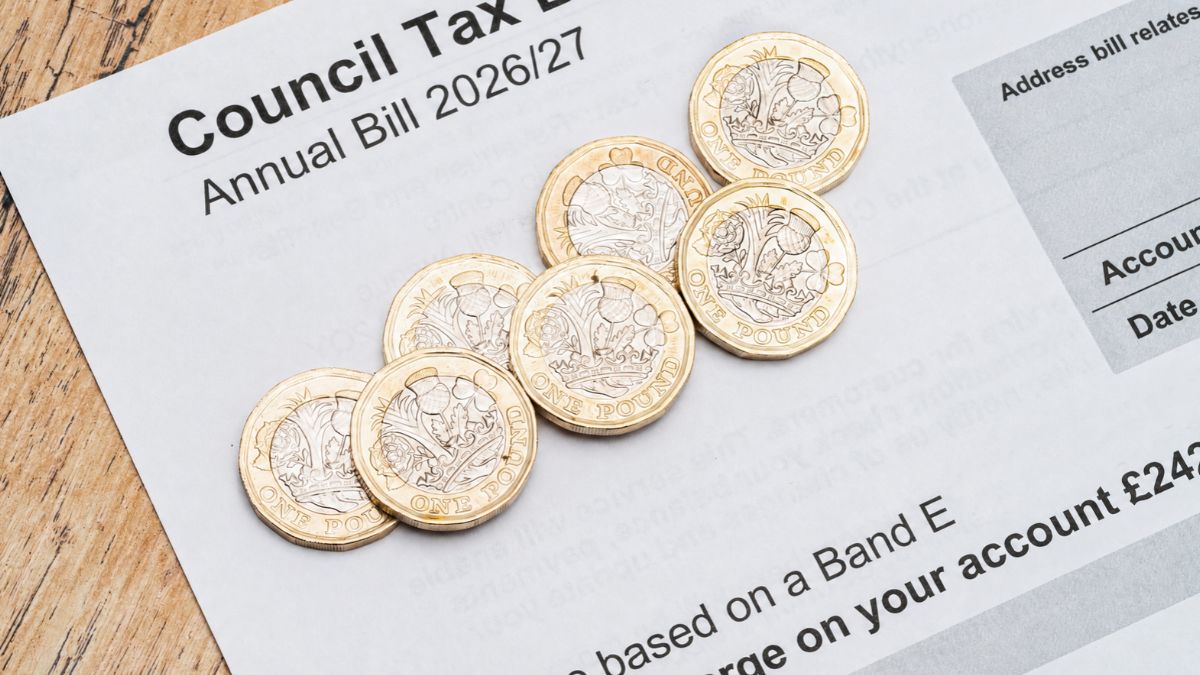
Featured image: Close-up of a Council Tax bill with British pound coins. Via original publisher. Image source